
No products in the cart.

Vial products: price per kit of 10 vials. Quantity 1 = 10 vials. Capsule products are priced per capsule pack as listed. Dismiss
By Pepkitshop | Peptide Research Education
Updated July 2026 | Educational Content, Not Medical Advice
What is the difference between acetate and TFA salt forms in peptides and why does this distinction appear on Certificate of Analysis documents and product specifications more often than most researchers expect?
If you have spent time evaluating research peptide documentation, you have almost certainly encountered references to salt form. A supplier specifies that a compound is delivered as a trifluoroacetate salt. Another offers an acetate salt version at a higher price. A COA lists the counterion alongside the purity percentage. And most researchers pass over this information without understanding what it means or whether it affects their research.
What is the difference between acetate and TFA salt forms in peptides is not a minor technical footnote. It affects the actual amount of peptide present in a given weight of compound, it affects compatibility with certain research applications, and it reflects a specific step in the manufacturing process that has direct implications for compound quality.
This guide explains what is the difference between acetate and TFA salt forms in peptides completely, from the chemistry of counterions through the practical implications for research use, which applications require acetate over TFA, and what the most current 2026 peer reviewed literature shows about salt form effects on peptide properties.
If you are not yet familiar with how research peptides are synthesized, read our guide on [peptide synthesis] first. The salt form question arises directly from the synthesis process and is much easier to understand with that context.
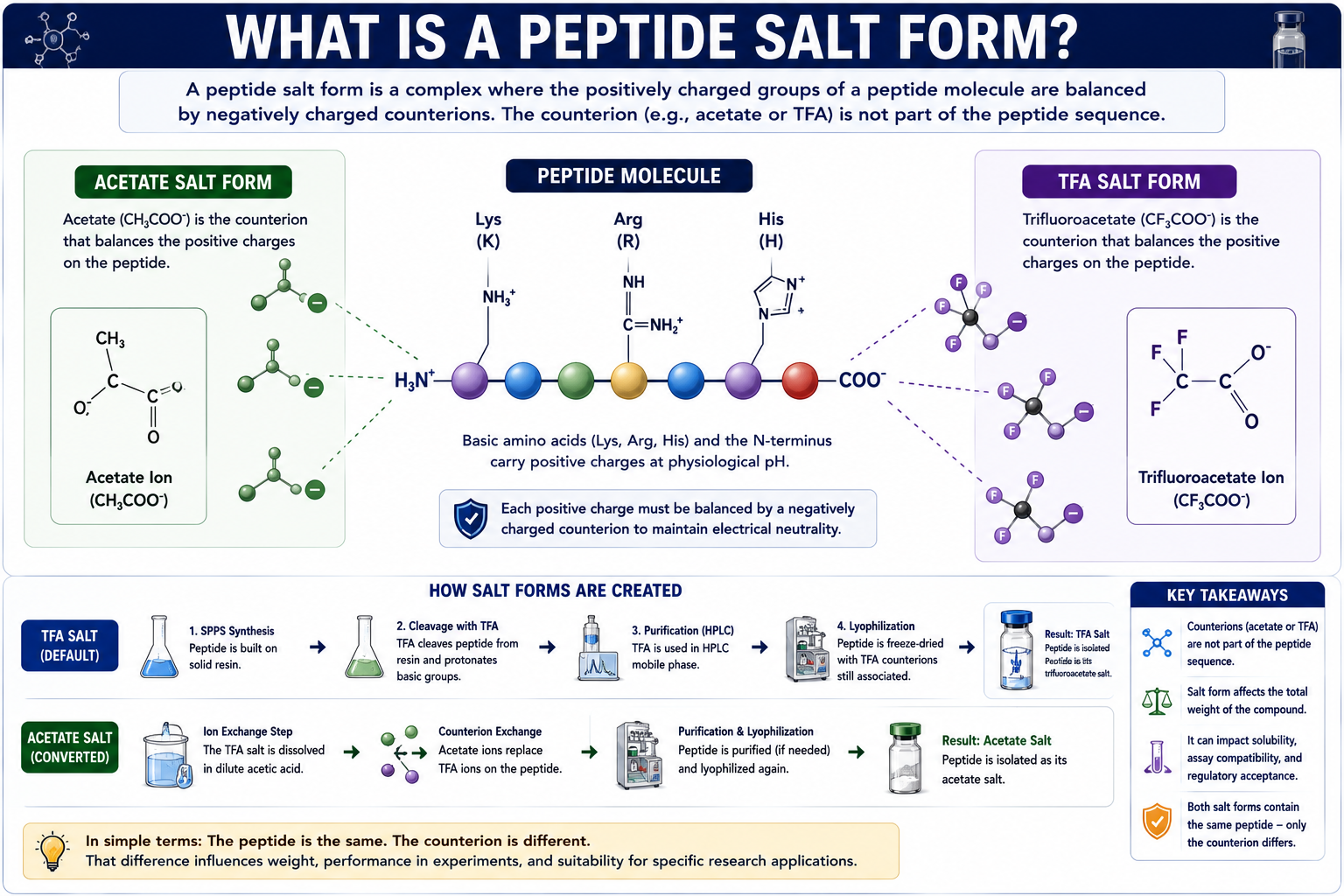
What is the difference between acetate and TFA salt forms in peptides starts with understanding what a salt form actually is.
Every synthetic peptide exists as a salt a complex of the peptide molecule with a counterion. The two most common salt forms are acetate and trifluoroacetate. Understanding the difference matters because the salt form affects the actual peptide content by weight, and some research applications are sensitive to TFA contamination.
In chemistry, a salt is formed when a positively charged component and a negatively charged component associate together through ionic interactions. For synthetic peptides, the positive charges come from the basic amino acid residues in the peptide chain, specifically lysine, arginine, histidine residues, and the N-terminal amino group. These groups carry positive charges at physiological pH.
Every positively charged group requires a negatively charged counterion to maintain electrical neutrality. The counterion associates with the peptide but is not covalently bonded to it. It is part of the lyophilized powder you receive but is not part of the peptide sequence itself.
In solid phase peptide synthesis, the peptide may be exposed to trifluoroacetic acid during the cleavage of the peptide from the resin support. The TFA salt can be converted to another salt form such as acetate or HCl through ion exchange in a subsequent step. Acetate salts are usually the most common counterion choice and preferred in later development over HCl and TFA salts.
Understanding what is the difference between acetate and TFA salt forms in peptides therefore requires understanding that these are two different counterions that can be associated with the same peptide molecule, producing different versions of the same compound with different properties.
What is the difference between acetate and TFA salt forms in peptides rooted in?
Salts and counterions are especially relevant to peptide therapies, given that the majority of low molecular weight peptides synthesised by solid phase protocols form a trifluoroacetate salt due to the use of trifluoroacetic acid in resin cleaving and follow-on purification methods.
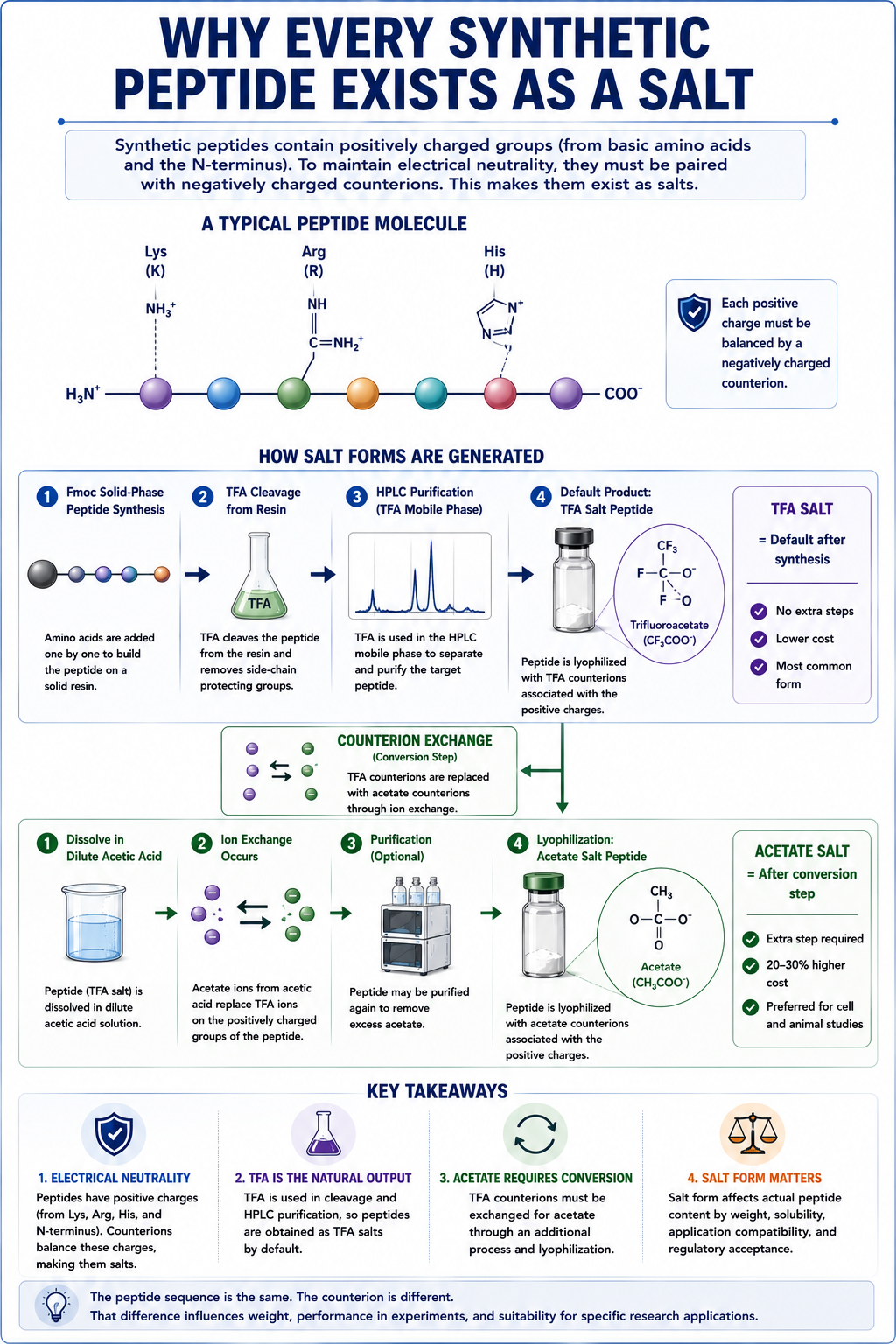
The reason every synthetic peptide exists as a salt goes back to the [peptide synthesis] process itself. As covered in our guide on peptide synthesis, the Fmoc solid phase synthesis method is the dominant approach for producing research peptides. In this method, trifluoroacetic acid plays two important roles.
First, TFA is used in the final cleavage step to release the completed peptide chain from the solid resin support. Second, TFA is typically used in the HPLC purification mobile phase that separates the target peptide from synthesis byproducts and impurities.
Both of these steps leave TFA molecules associated with the positively charged groups on the peptide as counterions. When the compound is subsequently lyophilized into the white powder that researchers receive, the TFA counterions are incorporated into that powder. The result is a trifluoroacetate salt of the peptide by default.
Trifluoroacetic acid is commonly used to release synthesized peptides from solid phase resins. TFA is also used during the reversed phase HPLC purification of peptides. The acids at low concentrations are helpful for peptide solubility and HPLC separation. However, the residual TFA or fluoride is undesirable in peptides intended for preclinical and clinical studies. Peptides are usually delivered as TFA salts by default.
This is why what is the difference between acetate and TFA salt forms in peptides begins with recognizing that TFA salt is the natural output of standard Fmoc synthesis, while acetate salt requires an additional conversion step.
What is the difference between acetate and TFA salt forms in peptides at the level of the TFA form specifically?
TFA stands for trifluoroacetate, the anionic form of trifluoroacetic acid (CF3COOH). It is a strong acid that completely ionizes in solution, producing a trifluoroacetate anion that associates with the basic residues of the peptide.
Key properties of TFA salt form:
TFA salt is the default output of Fmoc SPPS, meaning it requires no additional conversion step and is therefore less expensive to produce. It has a higher molecular weight counterion, meaning a given weight of TFA salt peptide contains proportionally less actual peptide by weight than the same compound in acetate form.
TFA counterions are heavier than acetate, meaning a 5 mg vial of TFA salt peptide contains slightly less actual peptide by weight, with the rest being TFA counterions. For a typical peptide with 3 basic residues, TFA content can be 15 to 25 percent of total weight.
TFA is generally considered non-toxic at the trace levels found in research peptides for most laboratory applications. However, specific research contexts exist where TFA interference becomes significant.
Trifluoroacetate is a salt commonly used in peptide products but it needs to be avoided in some experiments due to the biotoxicity of trifluoroacetate. For example, cell experiments where TFA concentrations above certain thresholds can produce cytotoxic effects that confound results.
For mass spectrometry applications, TFA can suppress ionization of the peptide, reducing signal quality and potentially affecting the accuracy of mass measurements. When evaluating [peptide purity] documentation that uses mass spectrometry, TFA presence in the sample is a relevant consideration.
What is the difference between acetate and TFA salt forms in peptides at the level of the acetate form?
Acetate salt form is produced by replacing the TFA counterions with acetate counterions through an additional manufacturing step called counterion exchange or salt conversion.
Acetate salt is produced by exchanging TFA counterions for acetate counterions, typically through multiple rounds of dissolution in dilute acetic acid followed by lyophilization. Acetate is lighter than TFA, so acetate salt peptide contains more actual peptide per milligram of powder.
The counterion exchange process works as follows. After standard Fmoc synthesis and HPLC purification yield a TFA salt peptide, the compound is dissolved in dilute acetic acid solution. Acetate ions from the acetic acid replace the TFA ions associated with the peptide’s basic residues. The solution is then lyophilized again, producing a powder where acetate is now the counterion rather than TFA.
If residual TFA would be problematic for your experiment, other salt forms such as acetate, lactate, or hydrochloride are recommended. However, these salt forms are usually 20 to 30 percent more expensive than regular TFA salt forms because of the peptide loss during the salt conversion and the increased amount of raw materials required.
The additional cost of acetate form reflects both the extra manufacturing step and the inevitable loss of some compound during the conversion process. This cost difference is one reason TFA salt remains the default for many research applications where TFA interference is not a concern.
The biotoxicity of acetic acid is much less than trifluoroacetic acid, so most pharmaceutical and cosmetic peptides use acetate. Acetate was chosen for most cell experiments.
What is the difference between acetate and TFA salt forms in peptides side by side?
Acetate vs TFA Salt Form Comparison Table
| Property | TFA Salt Form | Acetate Salt Form |
|---|---|---|
| Counterion | Trifluoroacetate (CF3COO-) | Acetate (CH3COO-) |
| Default from synthesis? | ✅ Yes, default Fmoc SPPS output | ❌ Requires additional conversion step |
| Counterion molecular weight | 113 daltons | 59 daltons |
| Peptide content per mg | Lower, TFA adds more non-peptide mass | Higher, lighter counterion |
| Cost relative to each other | Lower, no conversion required | 20 to 30 percent higher |
| Cell based assay compatibility | ⚠️ TFA can cause cytotoxic effects at higher concentrations | ✅ Preferred for cell assays |
| Animal study compatibility | ⚠️ TFA contamination concerns for in vivo use | ✅ Preferred for in vivo research |
| Mass spectrometry compatibility | ⚠️ TFA can suppress ionization | ✅ Better MS signal quality |
| General laboratory research | ✅ Acceptable for most non-cell, non-animal applications | ✅ Suitable for all applications |
| Pharmaceutical development | ⚠️ Regulators prefer other salt forms | ✅ Preferred for pharmaceutical development |
Different salts of the same peptide or drug can be defined as new chemical entities entirely due to the impact of salt form on a peptide and drug biological and physicochemical properties, for example aqueous solubility. For such reasons the majority of peptide medicines are marketed as hydrochloride or acetate salts.
The regulatory preference for acetate over TFA is one of the clearest signals of where the two forms differ in terms of broader application suitability. Regulatory bodies view TFA less favorably not because it is acutely toxic at research peptide concentrations, but because its biological and physicochemical effects at various concentrations are less well characterized than acetate, which is a naturally occurring biological molecule already present in human metabolism.
What is the difference between acetate and TFA salt forms in peptides in terms of what you actually receive?
This is one of the most practical aspects of what is the difference between acetate and TFA salt forms in peptides and one that is rarely explained clearly.
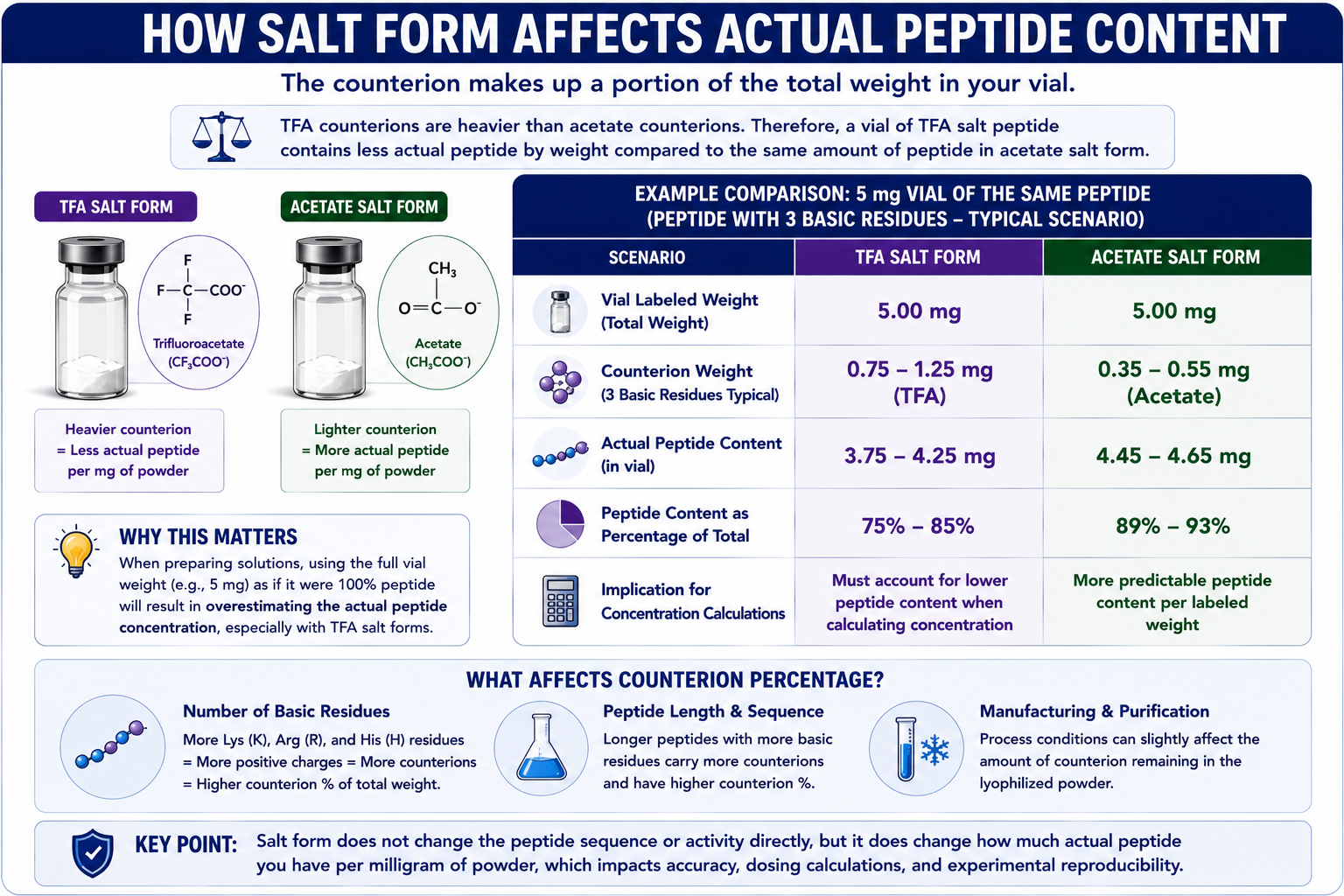
TFA counterions are heavier than acetate, meaning a 5 mg vial of TFA salt peptide contains slightly less actual peptide by weight, with the rest being TFA counterions. For a typical peptide with 3 basic residues, TFA content can be 15 to 25 percent of total weight.
Salt Form Effect on Actual Peptide Content
| Scenario | TFA Salt Form | Acetate Salt Form |
|---|---|---|
| Vial labeled weight | 5 mg total | 5 mg total |
| Counterion weight (3 basic residues typical) | 0.75 to 1.25 mg TFA | 0.35 to 0.55 mg acetate |
| Actual peptide content | 3.75 to 4.25 mg | 4.45 to 4.65 mg |
| Peptide content as percentage | 75 to 85 percent | 89 to 93 percent |
| Implication for concentration calculations | Must account for lower peptide content when calculating working concentration | More predictable peptide content per labeled weight |
This weight difference has direct implications for concentration calculations when preparing research solutions. A 5 mg vial of TFA salt peptide does not contain 5 mg of pure peptide. It contains 5 mg of the salt complex, of which 15 to 25 percent by weight may be TFA counterions. Researchers who calculate concentrations based on labeled vial weight without accounting for this will systematically overestimate the actual peptide concentration in their working solutions.
The extent of this effect depends on how many basic residues the peptide contains. A peptide with many lysine, arginine, or histidine residues carries more positive charges, requires more counterions, and therefore has a higher counterion contribution to total weight. A peptide with few basic residues has a smaller counterion burden.
Acetate salt reduces this uncertainty. Because acetate counterions are lighter than TFA counterions, the actual peptide content as a percentage of labeled weight is higher and more predictable. This is one of the practical advantages of acetate form beyond simply eliminating TFA interference in specific assays.
What is the difference between acetate and TFA salt forms in peptides in terms of application selection?
Form Selection Guide by Research Application
| Research Application | Recommended Salt Form | Reason |
|---|---|---|
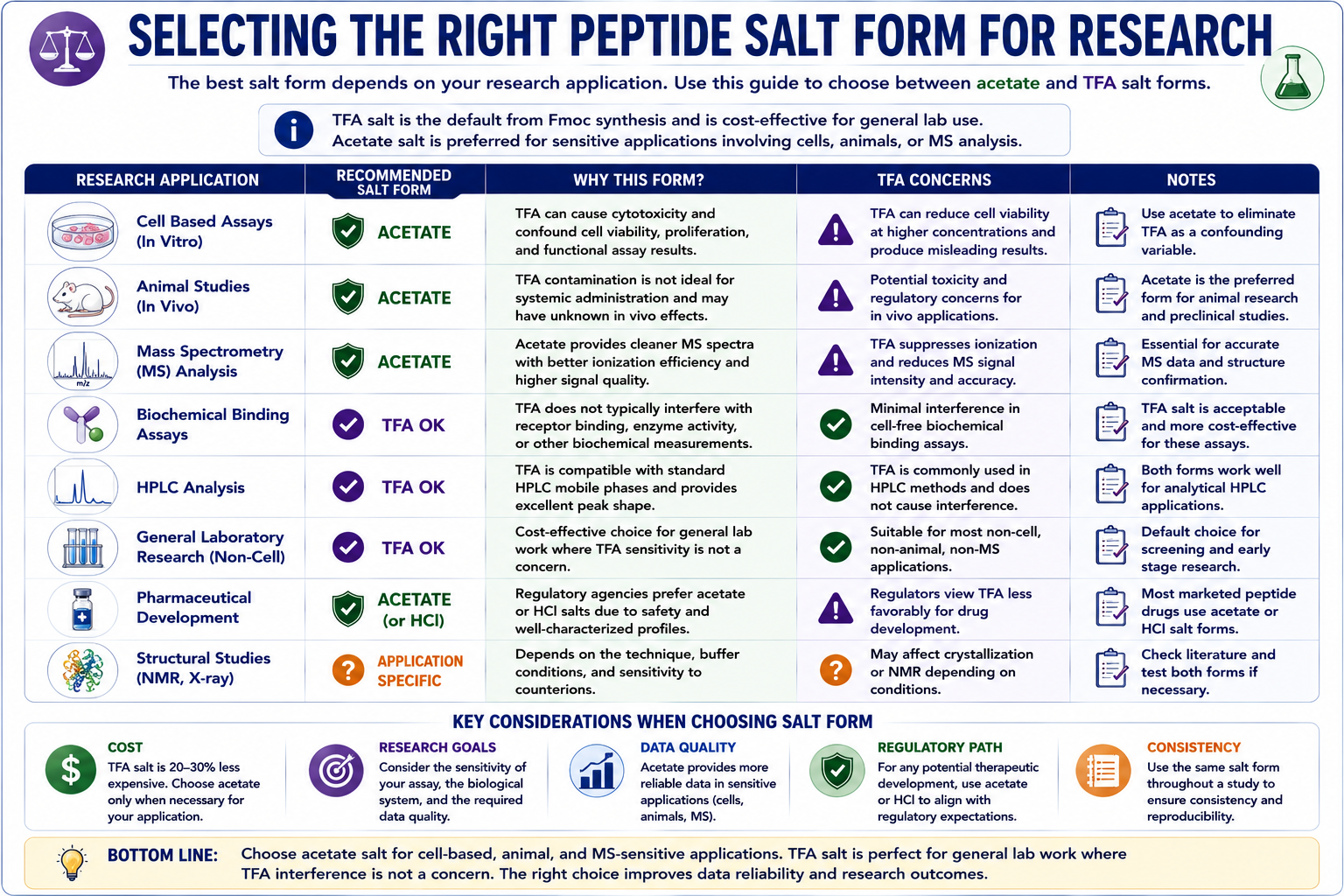
| Cell based assays (in vitro) | ✅ Acetate | TFA can cause cytotoxic effects that confound cell viability and proliferation results |
| Animal studies (in vivo) | ✅ Acetate | TFA contamination concerns for systemic administration |
| Mass spectrometry analysis | ✅ Acetate | TFA suppresses ionization and reduces signal quality |
| Biochemical binding assays | TFA acceptable | TFA does not typically interfere with receptor binding measurements |
| HPLC analysis | TFA acceptable | TFA is compatible with standard HPLC conditions |
| General laboratory research | TFA acceptable | Cost effective for applications without TFA sensitivity |
| Pharmaceutical development | ✅ Acetate or HCl | Regulatory preference and patient safety considerations |
| Structural studies | Application specific | Consult compound specific literature |
By default, all research peptides are synthesized in TFA salt form. For cell based assays or animal studies, you should consider having peptides produced in acetate or HCl salt form.
The clearest guidance from the research literature is straightforward. TFA salt is appropriate for most biochemical and analytical laboratory work where cells or living organisms are not involved. Acetate salt is the appropriate choice when the research involves cell cultures or animal models.
This guidance reflects the fundamental difference in TFA tolerance between cell-free systems and living biological systems. In a cell-free biochemical assay, TFA at research peptide concentrations typically does not affect the measurement. In a cell based assay, TFA at even modest concentrations can reduce cell viability, alter proliferation rates, and confound interpretation of whether observed effects are due to the peptide compound or to the TFA counterions.
What is the difference between acetate and TFA salt forms in peptides according to the most current research literature?
A 2026 study published in PMC from the European Journal of Pharmaceutics and Biopharmaceutics examined the impact of counterion and salt form on the properties of peptide hydrogels for drug delivery. The study confirmed that TFA salts are not viewed as favourably by medicine regulators as other salts due to concerns relating to their potential toxicity. The research documented that different salts of the same peptide can be defined as new chemical entities entirely due to the impact of salt form on biological and physicochemical properties including aqueous solubility. The study concluded that despite TFA salts being dominant in early research and development centered settings, the vast majority of therapeutic peptides are marketed as hydrochloride or acetate salts.
This finding from the 2026 PMC literature clarifies an important distinction for researchers reading what is the difference between acetate and TFA salt forms in peptides in the context of research vs development pathways.
In early-stage laboratory research, TFA salt is the practical default because it is less expensive, requires no additional conversion, and is produced directly by standard Fmoc synthesis. The cost and yield implications of salt conversion are not justified for screening-level research.
As research advances toward more systematic in vitro or in vivo investigation, acetate salt becomes the appropriate form because cell and animal systems have TFA sensitivity that must be eliminated as a confounding variable. By the time a peptide compound reaches pharmaceutical development, acetate or HCl salt form is essentially required by regulatory expectation.
Understanding where your research sits in this progression helps clarify what is the difference between acetate and TFA salt forms in peptides in terms of which choice is appropriate for your specific work. More detail on counterion effects across research applications is available through peer reviewed research and the National Library of Medicine.
What is the difference between acetate and TFA salt forms in peptides most simply is the counterion associated with the peptide molecule. TFA salt has trifluoroacetate counterions, the natural default from Fmoc synthesis. Acetate salt has acetate counterions, produced by an additional conversion step. The practical differences include lower actual peptide content per weight in TFA form, and TFA interference in cell based and animal research applications.
What is the difference between acetate and TFA salt forms in peptides in terms of selection depends on your application. For general laboratory and analytical work, TFA salt is acceptable and more cost effective. For cell based assays, animal studies, or mass spectrometry applications, acetate salt is strongly preferred to eliminate TFA as a confounding variable.
What is the difference between acetate and TFA salt forms in peptides in relation to [peptide purity] is indirect. The purity percentage on a COA reflects the peptide content relative to other detectable peptide related compounds. Counterion content is generally not included in the HPLC purity calculation because counterions do not absorb at the UV wavelengths used for peptide detection. Salt form does affect the actual peptide content per gram of lyophilized powder, which is a separate consideration from analytical purity.
What is the difference between acetate and TFA salt forms in peptides in terms of cost reflects the additional manufacturing step required for conversion. The counterion exchange process involves additional reagents, additional lyophilization steps, and inevitable loss of some compound during the conversion. These factors add 20 to 30 percent to the cost of acetate form compared to TFA form of the same peptide.
What is the difference between acetate and TFA salt forms in peptides for cell work is that TFA can produce cytotoxic effects in cell cultures at higher concentrations, confounding interpretation of whether observed effects are due to the peptide or the counterion. For this reason, acetate form is the recommended choice for cell based research applications.
The salt form should be specified on the product description and Certificate of Analysis. If not explicitly stated, the default assumption for any Fmoc synthesized research peptide is TFA salt form, as this is the natural output of the synthesis and purification process without additional conversion.
What is the difference between acetate and TFA salt forms in peptides for MS analysis is that TFA suppresses ionization of the peptide molecule, reducing signal quality and potentially affecting mass measurement accuracy. Acetate salt produces cleaner MS spectra. This is relevant when evaluating COA mass spectrometry data and when conducting MS-based research applications.
This post is part of a growing educational library on research peptide quality and handling. Related reading:
Subscribe for updates as this educational library continues to grow, evidence based peptide research guidance explained clearly and practically.
This content is for educational and informational purposes only. It does not constitute medical advice, diagnosis, or treatment recommendations. Research peptides are for laboratory use only and are not approved for human consumption or therapeutic use. Always consult a qualified healthcare professional before making any decisions related to your health.
10-vial kits • Capsule packs as listed • Research use only
© 2026 Pepkitshop. All rights reserved.
Vial product prices are per kit of 10 vials. Quantity 1 = 10 vials. Capsule products retain the pack size stated on their listing.
All products are supplied strictly for laboratory research. They are not intended for human or veterinary use, consumption, diagnosis, or treatment.
WhatsApp us
 Optimized by Seraphinite Accelerator
