
No products in the cart.

Vial products: price per kit of 10 vials. Quantity 1 = 10 vials. Capsule products are priced per capsule pack as listed. Dismiss
By Pepkitshop Peptide Coach & Educator
Updated July 2026 | Educational Content Not Medical Advice
What is peptide purity and why does it matter more than almost any other factor in peptide research?
Understanding what is peptide purity is one of the most important foundations in peptide research.
If you’ve been exploring peptide science, you’ve likely seen purity percentages listed on product pages and documents. A number like 98% or 99.7% appears, and most people move past it without fully understanding what it means or why the difference between those two numbers can significantly affect research outcomes.
This guide answers the question clearly and completely. By the end, you’ll understand what peptide purity actually measures, how it’s tested, what a Certificate of Analysis tells you, and why this knowledge is foundational to anyone serious about understanding peptide science.
If you’re new here, start with our guide on [what a peptide actually is] before continuing this post builds directly on that foundation.
When researchers ask what is peptide purity, they are really asking how reliable their compound is.
What is peptide purity in simple terms? It is the percentage of a peptide sample that consists of the actual target compound versus everything else present in the vial.
When a peptide is synthesized in a laboratory, the process of building an amino acid chain one unit at a time is complex. Imperfections in synthesis can produce unwanted byproducts alongside the intended compound.
These impurities fall into several categories:
A purity percentage tells you what proportion of the total sample is actually the correct peptide. A reading of 99% means 99 parts out of 100 are the target compound. The remaining 1% is a mixture of the impurities described above.
Understanding peptide purity is not a technical detail it is a fundamental research literacy issue.
Here is why it matters directly.
Dosing accuracy depends on purity: If a compound is listed at a certain weight but is only 80% pure, the actual amount of active peptide present is considerably less than the label suggests. Research outcomes tied to specific concentrations become unreliable.
Impurities have their own biological activity. Contaminating compounds are not necessarily inert. Deletion sequences and synthesis byproducts can interact with biological systems in unpredictable ways. This introduces variables that cannot be accounted for or controlled.
Reproducibility requires consistency. One of the foundations of reliable research is that results can be reproduced. If purity varies between batches and that variation is not documented, results from different experiments become difficult to compare meaningfully.
A study reviewed by researchers and cited in the National Library of Medicine found that purity levels across multiple suppliers claiming 98% or higher actually ranged from 47% to 99% when independently verified. That is not a small margin of error it is a fundamental quality problem.
Peptide purity is therefore not just a number. It is the foundation on which every other variable in peptide research rests.
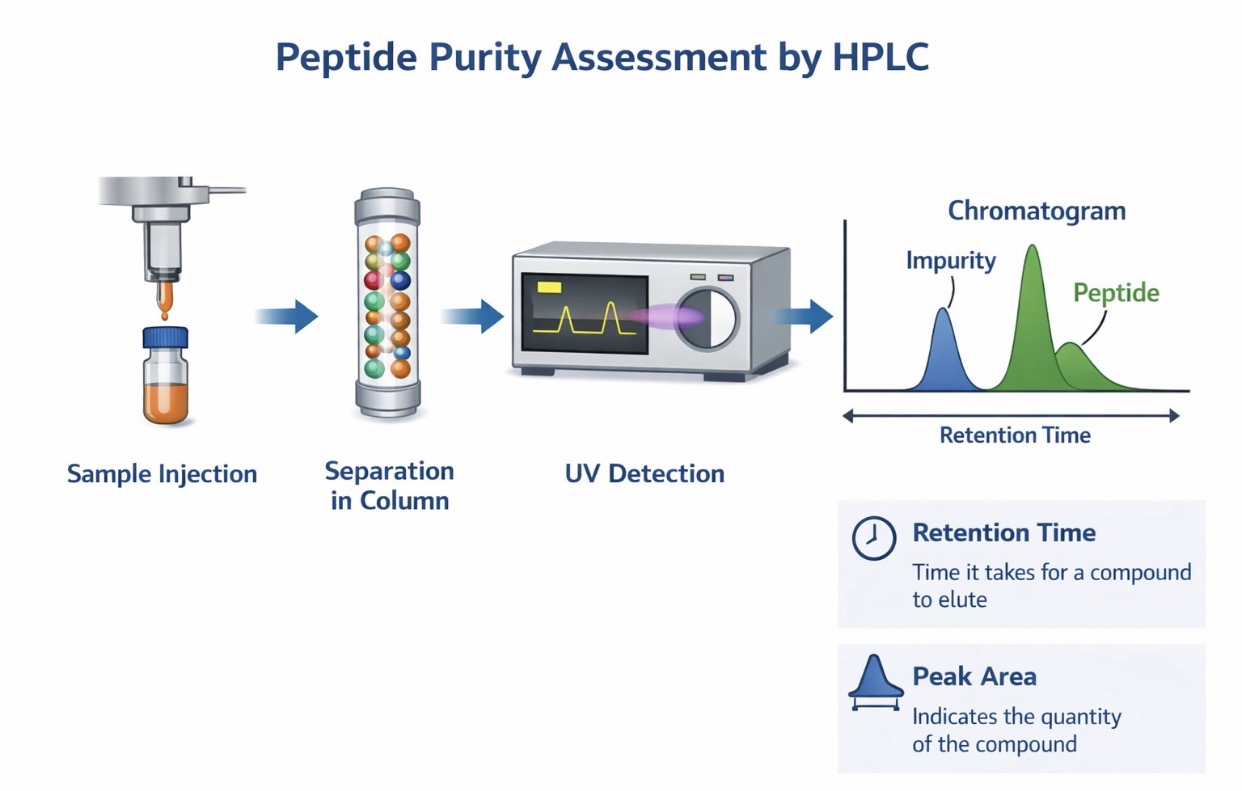
The gold standard method for measuring peptide purity is High-Performance Liquid Chromatography .. commonly abbreviated as HPLC.
The name sounds complex. The concept is straightforward.
Imagine you have a mixture of different colored liquids and you pour them into a long tube filled with a special material. Each colored liquid travels through the tube at a different speed based on its chemical properties.
By the time each component exits the other end, they have separated from each other and you can measure how much of each is present.
HPLC works on exactly this principle, applied to molecular compounds.
Here is what happens during HPLC testing:
A small sample of the peptide is dissolved in a solvent and injected into a column a narrow tube packed with microscopic particles. A liquid mobile phase pushes the sample through the column.
Different molecules in the sample interact with the column material differently. The target peptide and each impurity travel through at their own rate. As they exit, a UV detector records a signal each time a compound passes through.
The result is a chromatogram a visual graph showing peaks. Each peak represents a different compound in the sample. The height and area of each peak corresponds to how much of that compound is present.
Purity is then calculated as:
Purity (%) = Area of the main peak ÷ Total area of all peaks × 100
A clean, high-purity sample shows one dominant peak and very small or absent secondary peaks. A contaminated sample shows multiple significant peaks visible evidence that substantial impurities are present alongside the target compound.
HPLC is run at specific UV wavelengths typically 214 nm or 220 nm which are the wavelengths at which peptide bonds absorb light. This makes the method specifically sensitive to peptide compounds.
HPLC answers the question: how pure is it?
Mass Spectrometry (MS) answers a different but equally important question: is it actually the right compound?
A sample could theoretically show a single clean HPLC peak appearing highly pure but still be the wrong peptide entirely. A different compound with similar chemical properties might pass through the HPLC column at the same rate as the intended peptide.
Mass spectrometry closes this gap by measuring the precise molecular weight of the compound in the sample and comparing it to the theoretical molecular weight of the intended peptide sequence.
Every peptide has a specific molecular weight determined by the exact combination and sequence of its amino acids. If the mass spectrometry reading matches the theoretical weight, identity is confirmed. If it does not match, the compound is not what it claims to be regardless of what the HPLC purity percentage shows.
This is why the scientific community and researchers reviewing documentation published on peer-reviewed research databases consistently emphasize that HPLC and mass spectrometry must be used together. HPLC without MS leaves identity unverified. MS without HPLC leaves purity unquantified.
Together they answer both questions purity and identity which is the complete picture.
HPLC vs Mass Spectrometry Quick Comparison
| — | HPLC | Mass Spectrometry |
|---|---|---|
| What it measures | Purity percentage | Molecular identity |
| Question it answers | How pure is it? | Is it the right compound? |
| What it detects | Impurities and byproducts | Molecular weight match |
| Result format | Chromatogram + % | Observed vs theoretical mass |
| Used alone sufficient? | ❌ No | ❌ No |
| Used together sufficient? | ✅ Yes | ✅ Yes |
Purity Levels What the Numbers Mean
| Purity Level | Classification | What It Means |
|---|---|---|
| Below 90% | Crude / Unacceptable | Significant impurities present not suitable for research |
| 90% – 95% | Low Grade | May be used in early screening only not reliable |
| 95% – 97% | Below Standard | Falls short of research grade minimum threshold |
| 98% – 99% | Research Grade ✅ | Accepted industry standard for reliable research use |
| 99%+ | Premium Grade ✅ | Highest quality preferred for precise research conditions |
Third-Party vs In-House Testing Key Differences
| — | Third-Party Testing | In-House Testing |
|---|---|---|
| Who performs it | Independent accredited laboratory | The manufacturer itself |
| Conflict of interest | ❌ None | ✅ Exists |
| Credibility | High externally verifiable | Lower self-reported |
| Accreditation | ISO 17025 or equivalent | Varies often unverified |
| Recommended? | ✅ Always preferred | ⚠️ Treat with caution |
A Certificate of Analysis commonly called a COA is the formal document that summarizes the analytical testing performed on a specific batch of a peptide compound.
Think of it as the test report card for a particular lot of peptide. It records what was tested, how it was tested, and what the results showed.
A standard COA for a research-grade peptide contains several key elements:
The issuing laboratory is one of the most important elements on any COA. A document produced by the same organization that manufactured the compound is significantly less reliable than one produced by an independent, third-party accredited laboratory.
Independent testing eliminates the conflict of interest that exists when a supplier evaluates its own product. Third-party laboratory accreditation such as ISO 17025 certification means the testing facility itself meets verified international standards for analytical competence.
Many people encounter a COA and find it dense and confusing. Here is how to read one systematically.
Step 1: Verify the batch number.
The lot or batch number on the COA must match the lot number on the product you are evaluating. A COA from a previous batch is not documentation for the current product. This is a basic but frequently overlooked check.
Step 2 : Check the testing date.
Testing date matters because peptides can degrade over time. A COA from 18 months ago tells you about the compound as it was then not necessarily as it is now.
Step 3: Read the HPLC purity percentage.
The accepted industry standard for research-grade peptides is 98% or higher. Results from independent research have shown that anything below this threshold introduces meaningful uncertainty into experimental conditions.
A result such as:
Peptide purity (HPLC): Spec ≥98% Result: 99.3%
Means the batch exceeded the minimum specification. That is the format you should expect to see.
Step 4: Confirm mass spectrometry identity.
Look for a section showing the theoretical molecular weight of the peptide alongside the observed molecular weight from MS testing. They should match within a very small margin. A match confirms you have the correct compound.
Step 5: Identify the testing laboratory.
Look for the name and accreditation of the laboratory that issued the document. Search for that laboratory independently to confirm it exists and holds the credentials listed. A legitimate third-party laboratory can be verified externally its documentation is not self-referential.
Step 6: Look at the appearance entry.
Research-grade peptides are almost always lyophilized freeze-dried into a powder. The appearance entry should reflect this. Visible contamination or unexpected physical characteristics noted on the COA are a signal worth examining carefully.
COA Checklist Strong vs Weak Documentation
| COA Element | Strong COA ✅ | Weak COA ⚠️ |
|---|---|---|
| Batch number | Matches product lot number exactly | Generic or missing |
| Testing date | Recent and specific | Old, vague, or absent |
| HPLC purity | ≥98% with chromatogram included | Below 98% or no chromatogram |
| Mass spectrometry | Observed mass matches theoretical | Missing or incomplete |
| Testing laboratory | Independent, accredited, verifiable | In-house or unverifiable |
| Appearance | Matches expected lyophilized powder | Inconsistent or absent |
| Storage conditions | Clearly stated | Missing |
Understanding what is peptide purity helps you Know what a strong COA looks like also means recognizing what a weak or misleading one looks like.
Red flag: No batch-specific data. A COA that lists only the compound name and a generic purity claim without a specific lot number and dated test results is not verifiable. It cannot be confirmed as applying to the product in question.
Red flag: In-house testing only.
When the manufacturer and the testing laboratory are the same entity, the independence that makes third-party testing meaningful is absent. This does not automatically mean results are inaccurate but it removes the external verification that makes documentation credible.
Red flag: HPLC without mass spectrometry.
Purity data without identity confirmation leaves the fundamental question is this actually the right compound unanswered.
Red flag: Purity below 98%.
Research-grade peptides are held to a minimum standard of 98% purity by the scientific community. Documentation showing results below this threshold warrants careful consideration before use in any research context.
Red flag: No laboratory accreditation visible.
Legitimate analytical laboratories hold verifiable accreditation. If the issuing laboratory cannot be independently verified, the document’s credibility is limited.
What is peptide purity and why is it important?
Peptide purity is the percentage of a sample that consists of the intended target compound versus impurities and byproducts from synthesis. It matters because impure compounds introduce uncontrolled variables, affect dosing accuracy, and compromise research reproducibility.
What purity level is considered research grade?
The accepted standard for research-grade peptides is 98% or higher by HPLC analysis. Premium documentation often shows 99% or above.
What is HPLC and how does it measure purity?
HPLC stands for High-Performance Liquid Chromatography. It separates the components of a sample as they pass through a column, then measures the relative amount of each component using UV detection. Purity is calculated as the area of the main peak divided by the total area of all peaks.
What does mass spectrometry confirm on a COA?
Mass spectrometry confirms the molecular identity of the compound by comparing its measured molecular weight to the theoretical weight of the intended peptide sequence. It answers whether the compound is actually what it claims to be.
What should a Certificate of Analysis include?
A complete COA should include the peptide name and sequence, batch number, testing date, HPLC purity percentage with chromatogram, mass spectrometry identity confirmation, appearance, storage conditions, and the name and accreditation of the issuing laboratory.
What is the difference between HPLC purity and peptide content?
HPLC purity measures the proportion of the target peptide relative to other detectable compounds. Peptide content measures the actual mass of peptide present in the total sample weight which also accounts for moisture, counter-ions such as TFA salts, and other non-peptide mass. Both figures together give a complete picture of compound quality.
Continue Learning
This post is part of a growing educational library on peptide science. Related reading:
• [What Is a Peptide?]: The foundational guide to understanding what peptides are and how they work as biological signals
• [What Is BPC-157?] : A deep look at one of the most researched recovery peptides and what the science actually shows
• What Does “Research Use Only” Mean? Understanding the regulatory language that surrounds research peptides
Subscribe for updates as we continue building this evidence-based resource designed to give you clarity without the hype.
What is peptide purity comes down to one number the percentage of your sample that is the correct compound.
It is the process of using HPLC and mass spectrometry to verify that number.
Research grade means what is peptide purity reads at 98% or higher on a verified Certificate of Analysis.
This content is for educational and informational purposes only. It does not constitute medical advice, diagnosis, or treatment recommendations. Always consult a qualified healthcare professional before making any decisions related to your health.
10-vial kits • Capsule packs as listed • Research use only
© 2026 Pepkitshop. All rights reserved.
Vial product prices are per kit of 10 vials. Quantity 1 = 10 vials. Capsule products retain the pack size stated on their listing.
All products are supplied strictly for laboratory research. They are not intended for human or veterinary use, consumption, diagnosis, or treatment.
WhatsApp us
 Optimized by Seraphinite Accelerator
