

By Pepkitshop | Peptide Research Education
Updated August 2026 | Educational Content, Not Medical Advice
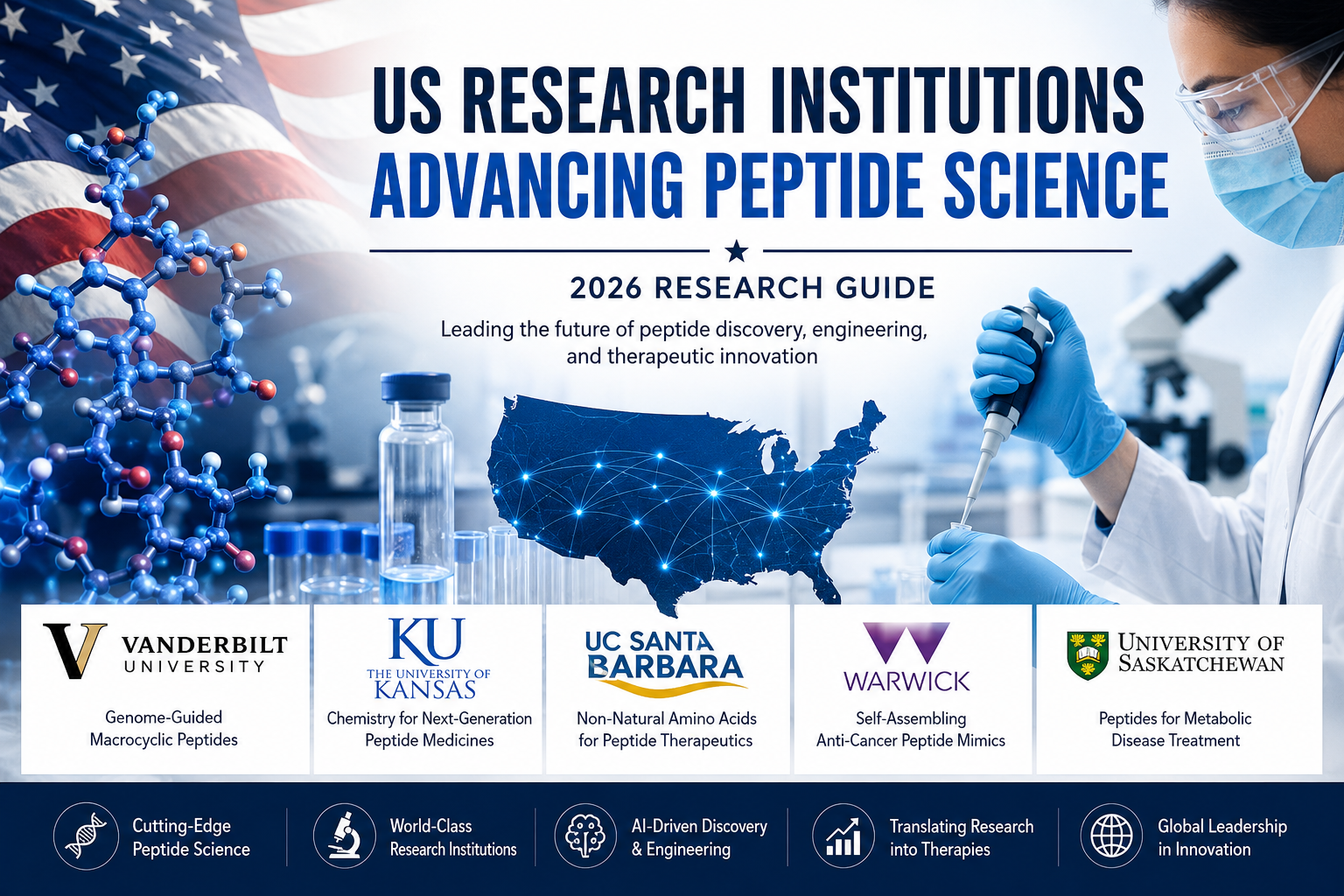
US research Institutions advancing peptide science
The United States is home to some of the world’s most active research programs in peptide science. Researchers are exploring macrocyclic peptides, ribosomally synthesized and post-translationally modified peptides (RiPPs), non-natural amino acids, peptide engineering, molecular self-assembly, and computational approaches to discovery.
This guide highlights selected research programs and institutions contributing to modern peptide science, including work at Vanderbilt University, the University of Kansas, UC Santa Barbara, and other international institutions whose research provides important context for peptide development.
If you are new to the subject, start with our guide to peptide research in the United States before exploring the institutions and research programs discussed below.
Table of Contents
Vanderbilt University: Genome-Guided Macrocyclic Peptide Discovery
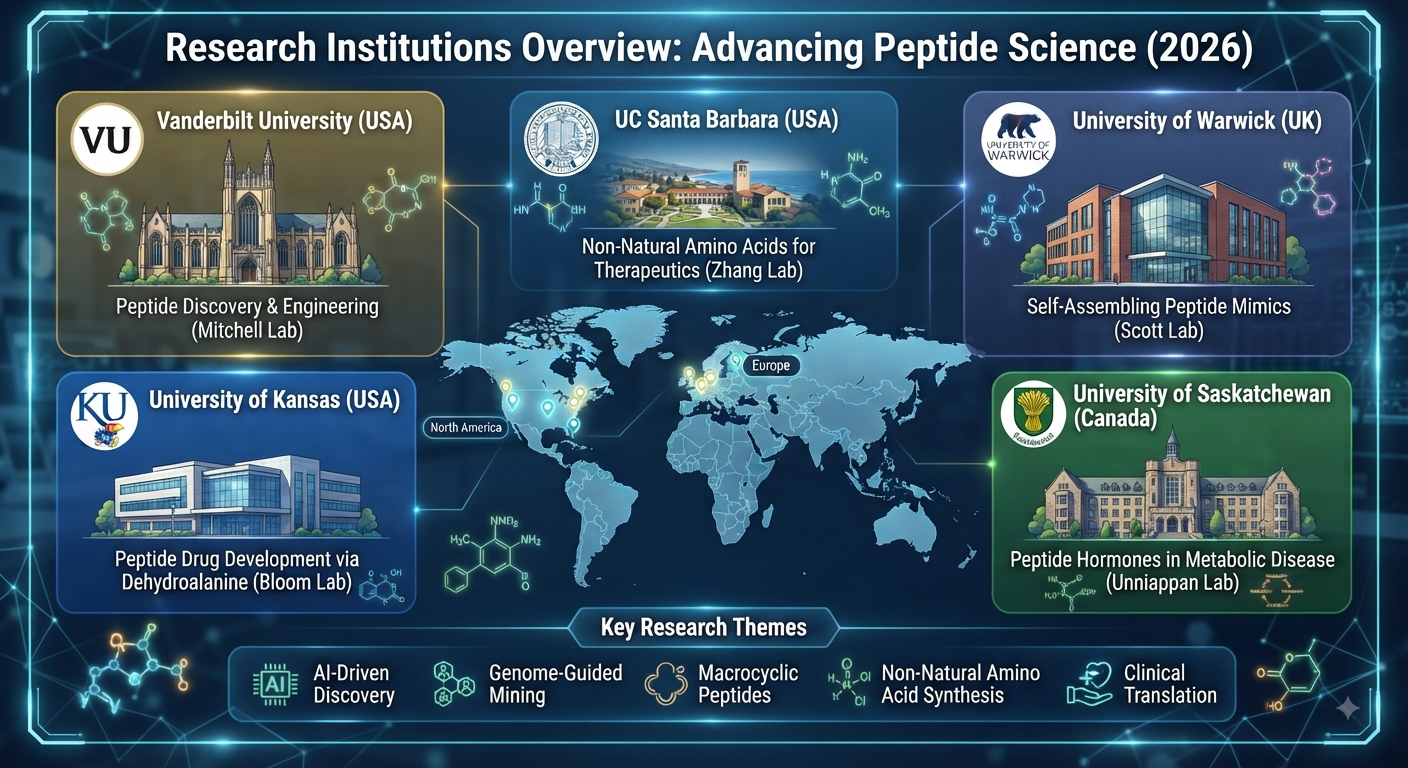
Vanderbilt University is home to the Mitchell Lab, led by Professor Douglas A. Mitchell, Ph.D. The laboratory investigates peptide natural products and develops approaches for discovering and engineering new peptide scaffolds.
Mitchell Lab Research Focus
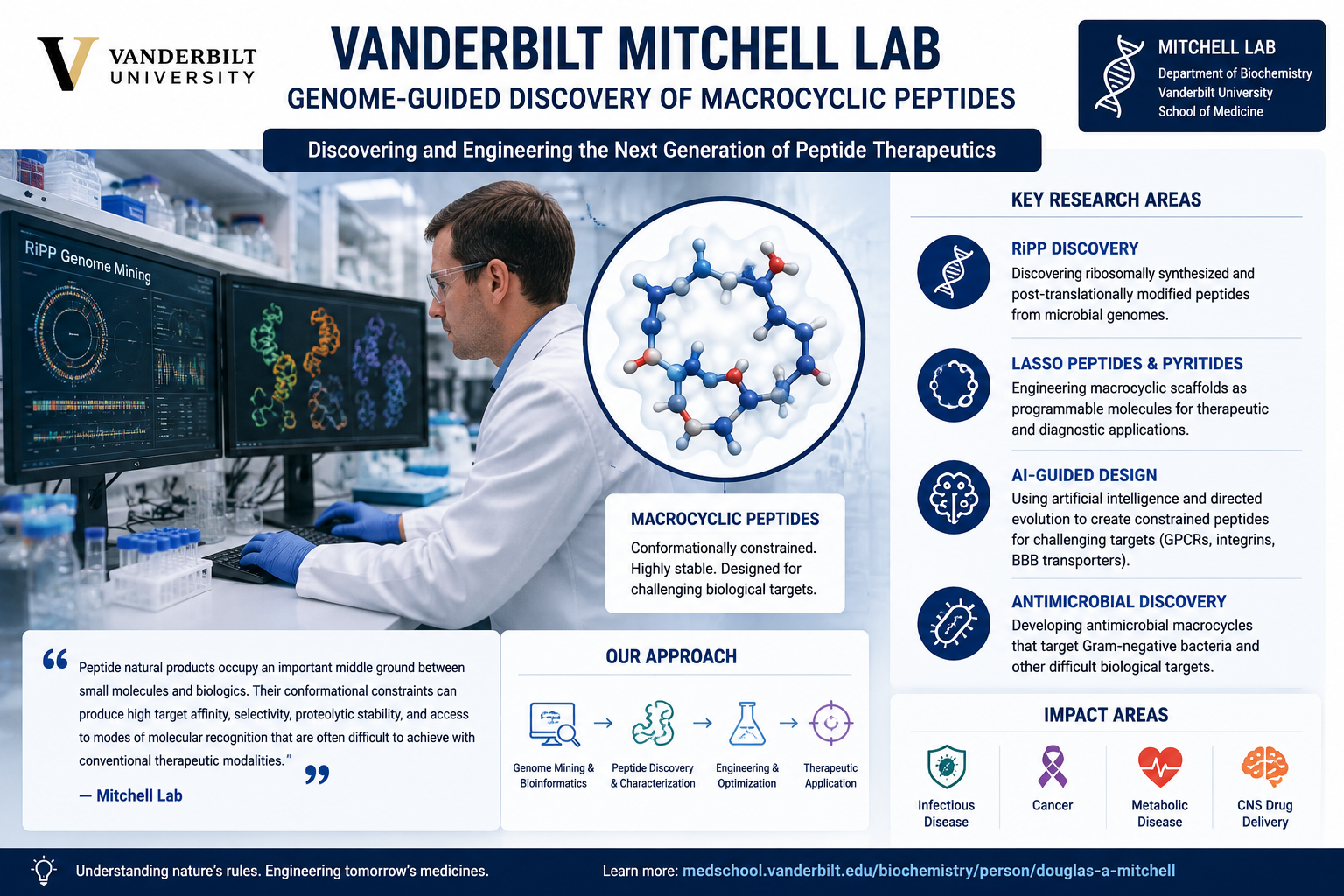
The Mitchell Lab combines bioinformatics, biochemistry, structural biology, synthetic biology, and protein engineering to investigate peptide natural products and their biosynthetic pathways.
Major areas of interest include:
- RiPP discovery: Ribosomally synthesized and post-translationally modified peptides are natural products initially produced on the ribosome and subsequently modified by enzymes.
- Macrocyclic peptides: Constrained peptide structures can provide researchers with useful properties for investigating molecular recognition and biological activity.
- Lasso peptides and related scaffolds: These unusual peptide structures are studied for their biosynthesis, engineering potential, and biological properties.
- Peptide engineering: Researchers investigate ways to modify peptide scaffolds and develop molecules with desired structural and functional characteristics.
- Computational and AI-assisted approaches: Modern computational tools can support peptide discovery, sequence analysis, and molecular design.
The lab’s work contributes to a broader scientific effort to understand how naturally occurring peptide molecules can be discovered, modified, and studied for applications in biotechnology and biomedical research.
More information is available through the Vanderbilt Mitchell Lab.
University of Kansas: Chemistry for Next-Generation Peptide Research
The University of Kansas School of Pharmacy is home to research exploring new chemical strategies for peptide discovery and development.
Research associated with Dr. Steven Bloom’s laboratory focuses on using chemical methods to modify peptide structures and investigate new possibilities for peptide-based therapeutics.
Bloom Lab Research Focus
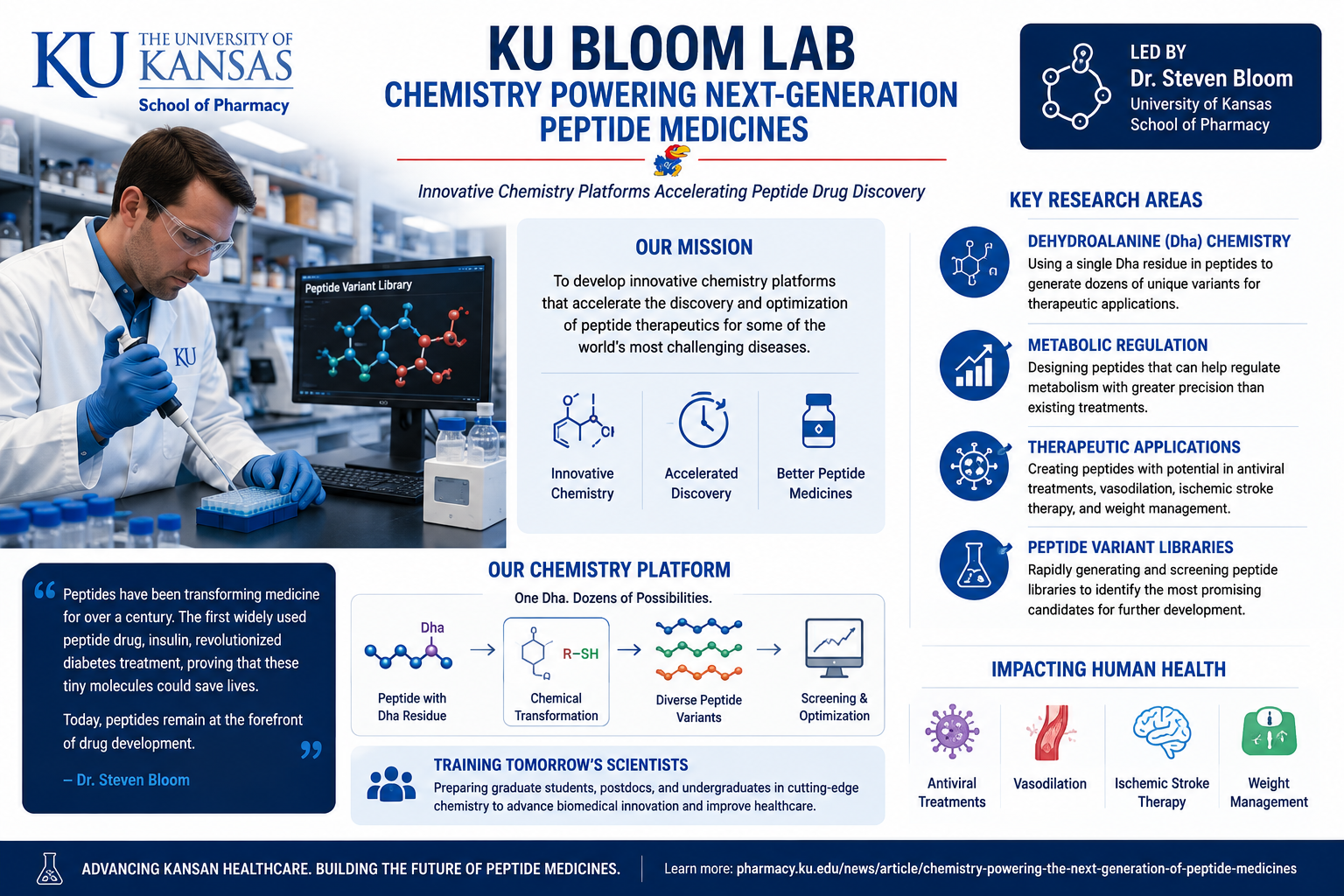
One important area involves dehydroalanine (Dha) chemistry. Researchers can use this specialized amino-acid residue as a chemical starting point for generating peptide variants.
Key areas include:
- Dehydroalanine chemistry: Chemical modification of peptide structures can create new variants for research.
- Peptide diversification: Generating multiple peptide variants can help researchers investigate relationships between molecular structure and biological activity.
- Therapeutic research: Chemical peptide-engineering approaches are being explored in areas including metabolism, vascular biology, infectious disease, and other biomedical applications.
- Research training: University laboratories also contribute to peptide science by training students and researchers in modern medicinal and synthetic chemistry.
This type of chemistry illustrates how researchers are expanding beyond naturally occurring peptide structures to investigate new molecular designs.
More information is available through the KU Bloom Lab research feature.
UC Santa Barbara: Non-Natural Amino Acids and Peptide Chemistry
Researchers at UC Santa Barbara have investigated new approaches for synthesizing non-natural amino acids that can expand the chemical building blocks available to peptide researchers.
Zhang Lab Research Focus
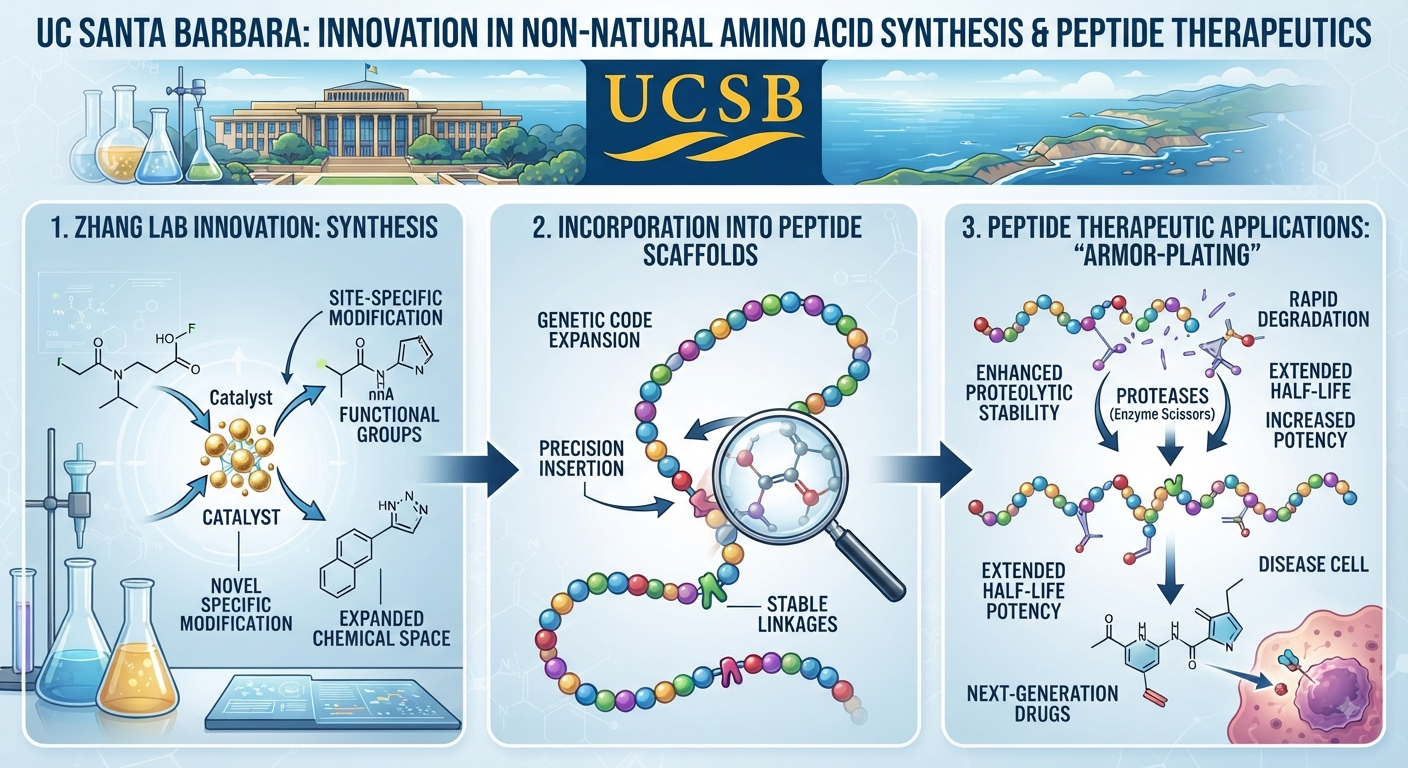
Professor Liming Zhang’s research includes synthetic chemistry approaches for producing structurally diverse amino acids.
Important areas include:
- Non-natural amino acid synthesis: Researchers can create amino-acid building blocks that differ from those commonly found in natural proteins.
- Stereoselective synthesis: Controlling molecular stereochemistry is important because different molecular arrangements can have substantially different chemical and biological properties.
- Peptide construction: Specialized amino acids can be incorporated into peptides to investigate new molecular structures and properties.
- Peptide stability research: Non-natural amino acids may be useful for investigating ways to alter peptide stability and resistance to enzymatic degradation.
Expanding the available amino-acid building blocks gives scientists a larger chemical toolkit for studying peptide structure and function.
The research has been reported through EurekAlert’s UC Santa Barbara research release.
University of Warwick: Self-Assembling Peptide Mimics
The University of Warwick has also contributed to research into synthetic molecules that mimic structural characteristics of naturally occurring peptides.
Professor Peter Scott and collaborators have investigated self-assembling molecular systems designed to form helical structures.
Scott Lab Research Focus
The research explores:
- Artificial peptide mimics: Synthetic molecules can be designed to reproduce selected structural characteristics of natural peptides.
- Self-assembly: Some molecular systems can spontaneously organize into larger structures under appropriate chemical conditions.
- Helical structures: Researchers have investigated molecules capable of forming structures resembling peptide or protein helices.
- Biomedical research: Laboratory studies have explored the biological activity of some of these synthetic systems, including experiments involving cancer cells.
These studies remain part of laboratory-stage research. Results observed in cell-based experiments do not automatically establish safety or effectiveness in humans, and additional research is required before clinical applications can be considered.
More information is available from the University of Warwick research release.
University of Saskatchewan: Peptide Research in Metabolic Disease
Although the University of Saskatchewan is outside the United States, its peptide research provides useful international context for understanding how peptide biology is being investigated in metabolic disease.
Researchers associated with Dr. Suraj Unniappan’s laboratory have investigated nesfatin-1-like peptide (NLP) and its potential role in lipid metabolism.
Unniappan Lab Research Focus
Research areas include:
- Peptide regulation of metabolism: Researchers investigate how signaling peptides may influence metabolic processes.
- Lipid metabolism: Studies have examined the relationship between peptide signaling and lipid accumulation in cells.
- Animal research: Experimental models can help researchers investigate biological pathways and potential mechanisms.
- Metabolic disease research: Such work may contribute to the understanding of disorders involving obesity, lipid metabolism, and liver health.
Importantly, laboratory findings should not be interpreted as evidence that an experimental peptide is an established treatment for a disease. Translating laboratory discoveries into safe and effective human therapies requires extensive additional research.
More information is available through the University of Saskatchewan research report.
Research and Funding Trends in Peptide Science
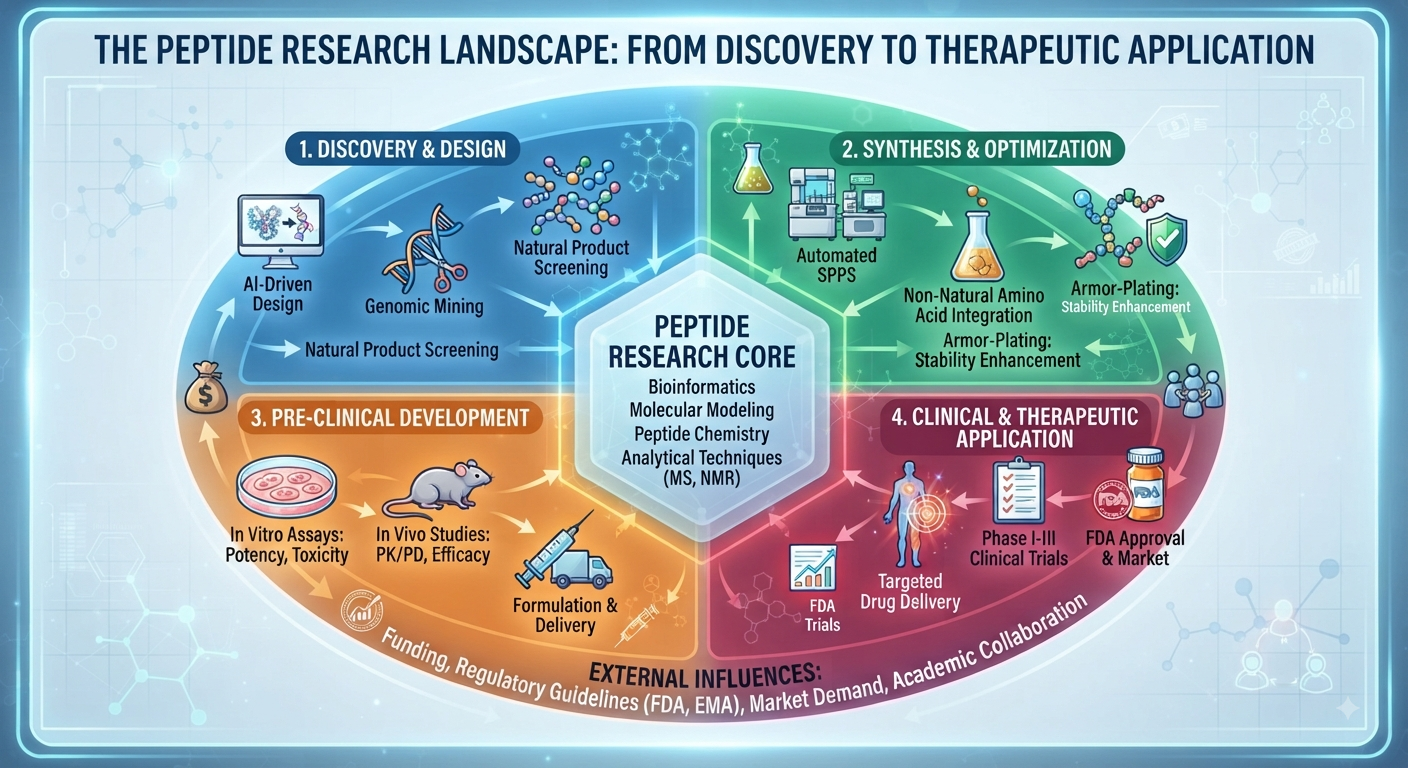
Peptide research is evolving rapidly as advances in chemistry, biology, computation, and drug discovery converge.
Major Research Trends in 2026
1. AI-Assisted Peptide Discovery
Machine learning and other computational methods are increasingly being investigated for peptide sequence analysis, structure prediction, molecular design, and candidate prioritization.
2. Macrocyclic Peptides
Macrocyclic and otherwise constrained peptides are attracting interest because their structures can provide different properties from conventional linear peptides.
3. Non-Natural Amino Acids
Synthetic amino acids expand the chemical diversity available to peptide researchers and can be used to investigate structure, stability, activity, and molecular interactions.
4. Peptide Engineering
Researchers are developing increasingly sophisticated approaches for modifying peptide sequences and structures to investigate biological function and improve experimental properties.
5. Antimicrobial Peptides
Antimicrobial peptide research remains an important area of investigation as scientists explore new approaches to addressing antimicrobial resistance.
Major Funding and Research Participants
| Funding or Research Sector | Typical Research Areas |
|---|---|
| National Institutes of Health (NIH) | Biomedical and therapeutic research |
| National Science Foundation (NSF) | Fundamental chemistry, biology, and materials science |
| Universities | Basic research, translational science, and researcher training |
| Pharmaceutical companies | Drug discovery, development, and clinical research |
| Academic-industry partnerships | Translational and applied research |
| Government agencies | Biomedical research and specialized health programs |
Frequently Asked Questions
Which US institutions are active in peptide research?
The United States has numerous universities and research centers studying peptide chemistry, biology, engineering, drug discovery, and related fields. Vanderbilt University and the University of Kansas are two examples highlighted in this guide. Other institutions across the country also contribute to peptide science through chemistry, biomedical research, computational biology, and pharmaceutical research.
What is the Mitchell Lab at Vanderbilt known for?
natural products, including RiPPs and macrocyclic peptide systems. Its research combines approaches such as bioinformatics, biochemistry, structural biology, synthetic biology, and peptide engineering.
More information is available through the Vanderbilt Mitchell Lab.
What is the Bloom Lab at the University of Kansas known for?
The Bloom Lab investigates chemical strategies for peptide diversification and drug discovery, including approaches involving dehydroalanine chemistry.
More information is available through the University of Kansas research feature.
What is the Zhang Lab at UC Santa Barbara researching?
Research associated with Professor Liming Zhang includes synthetic methods for producing non-natural amino acids. These building blocks can expand the chemical diversity available to researchers studying peptide structures and functions.
More information is available through EurekAlert’s research release.
What is the Scott Lab at the University of Warwick researching?
The Scott Lab has investigated synthetic molecules capable of self-assembling into helical structures that mimic selected characteristics of natural peptide systems. Some laboratory studies have explored their biological activity.
More information is available through the University of Warwick research release.
What is the Unniappan Lab at the University of Saskatchewan researching?
The Unniappan Lab investigates peptide signaling and metabolic biology, including research into nesfatin-related peptides and lipid metabolism.
More information is available through the University of Saskatchewan research report.
How is AI being used in peptide research?
AI and machine-learning approaches can assist researchers with peptide sequence analysis, molecular design, structure prediction, candidate prioritization, and optimization. These computational techniques are generally used alongside laboratory experimentation rather than replacing experimental validation.
For published biomedical research, researchers can search the National Library of Medicine’s PubMed database.
Key Takeaways
- Peptide science spans chemistry, molecular biology, synthetic biology, computational research, and drug discovery.
- Vanderbilt University’s Mitchell Lab is investigating peptide natural products, RiPPs, macrocyclic peptides, and peptide engineering.
- Research at the University of Kansas demonstrates how chemical approaches can diversify peptide structures.
- UC Santa Barbara research highlights the importance of non-natural amino acids in expanding peptide chemistry.
- University of Warwick researchers have investigated self-assembling synthetic peptide mimics.
- University of Saskatchewan research provides an example of peptide biology being investigated in metabolic research.
- AI and computational methods are becoming increasingly important tools for peptide discovery and molecular design.
- Laboratory discoveries are only one stage of the research process; potential therapies require extensive preclinical and clinical evaluation before they can be considered safe and effective for human use.
Continue Learning
This article is part of Pepkitshop’s educational library covering peptide science, research, and regulatory topics.
Related reading:
- US research Advancing peptide science An overview of peptide research and development across the United States.
- FDA Peptide Regulations: What Researchers Need to Know An educational overview of the US regulatory environment surrounding peptide-related research and products.
- What Is a Research Grade Peptide? An explanation of research-grade terminology, laboratory use, and how it differs from pharmaceutical-grade materials.
Explore these resources to continue learning about peptide research, scientific development, and regulatory considerations.
Educational Disclaimer
This content is provided for educational and informational purposes only. It does not constitute medical advice, diagnosis, or treatment recommendations. Experimental research compounds should not be assumed to be approved for human use or therapeutic purposes. Readers should consult qualified healthcare and scientific professionals for advice appropriate to their circumstances.