
No products in the cart.

Vial products: price per kit of 10 vials. Quantity 1 = 10 vials. Capsule products are priced per capsule pack as listed. Dismiss
BPC-157 as an example often discussed in research and online peptide communities you can read our full deep-dive on it here.
If you’ve spent any time in wellness, fitness, or longevity circles recently, you’ve almost certainly heard the word “peptide.” Maybe it came up in a podcast, a gym conversation, or buried inside a product label. And yet, for something that’s generating so much attention, the answer to the most basic question what is a peptide? is surprisingly hard to find without wading through either dense academic language or oversimplified marketing claims.
This post is written to close that gap.
After several years studying peptide science and working with people who are navigating this space, the single most valuable thing I can give someone starting out is a clear, honest foundation. Not hype. Not shortcuts. Just the science explained plainly.
Before we get into biology, here’s the analogy I use most often when explaining peptides to people who are entirely new to the subject:
Think of your cells as constantly sending and receiving text messages. Cells need to coordinate with each other to trigger recovery, regulate hunger, release hormones, or repair tissue. They don’t use language.
They use molecules. And peptides are among the most precise, targeted messages in that system.
Just as a text message triggers a specific response in the person who receives it, a peptide triggers a specific biological response in the cell or receptor it reaches. The message is short. The instruction is clear. The result is targeted.
That’s the core of it.
When people first explore this topic and ask what is a peptide, they are often surprised to learn the body already produces hundreds of them naturally
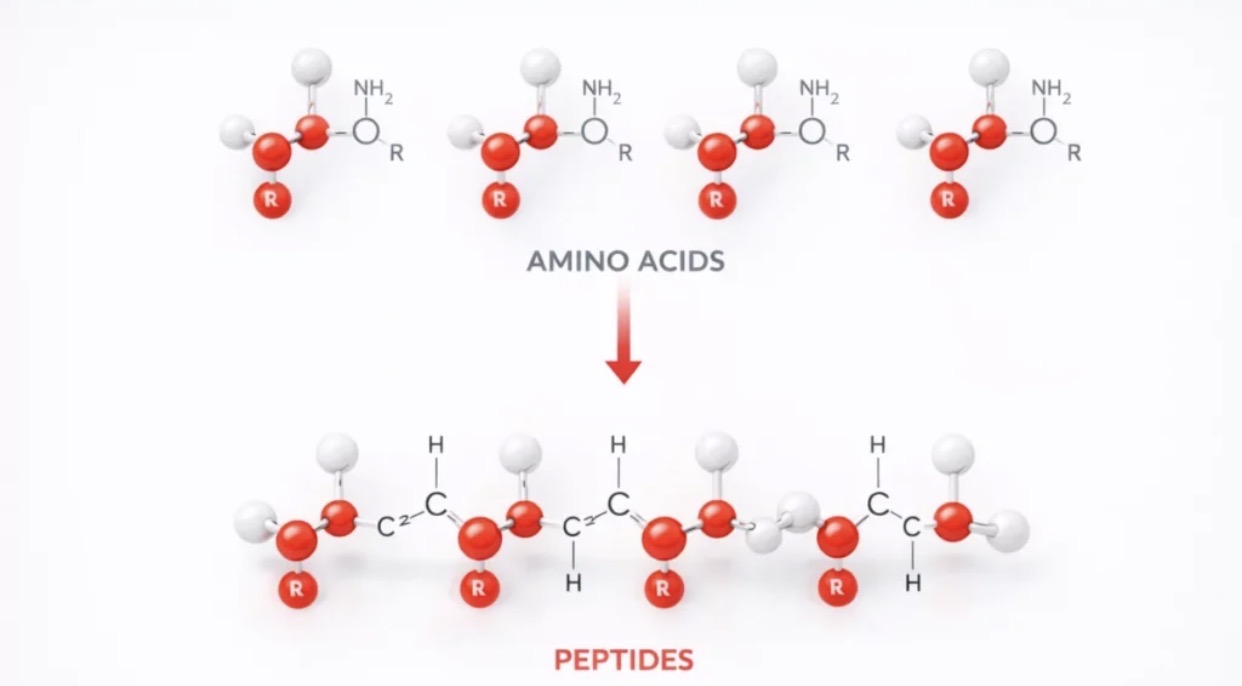
A peptide is a short chain of amino acids linked together by peptide bonds.
You may already know that amino acids are the building blocks of proteins. When amino acids link together in a long chain typically 50 or more the result is a protein. When the chain is shorter, usually between 2 and 50 amino acids, it’s called a peptide.
Here’s a simple breakdown:
• Amino acids → the individual building blocks
• Peptides → short chains of amino acids (2–50)
• Proteins → longer chains of amino acids (50+)
The distinction isn’t just about length. It’s about function. Proteins tend to serve structural roles, such as collagen in your skin and myosin in your muscles. Peptides tend to serve signaling roles. They carry instructions between cells and tissues.
This signaling function is precisely what makes peptides so interesting to researchers. A small molecule that can communicate with a specific biological pathway, influencing recovery, metabolism, cellular repair, or hormonal release, is a very precise tool.
This is one of the first things I clarify with anyone who approaches peptides with suspicion or unfamiliarity: your body already produces hundreds of peptides naturally. They are not foreign to human biology. They are part of it.
Some well-known naturally occurring peptides include:
• Insulin, a peptide hormone that regulates blood glucose
• Glucagon-like peptide-1 (GLP-1), a peptide released in the gut that signals fullness and influences insulin secretion
• Oxytocin, a peptide hormone involved in bonding, trust, and stress response
• Endorphins, peptides that modulate pain and mood
Each of these is a short chain of amino acids doing a very specific job inside the body’s signaling network. When researchers or clinicians talk about “peptide therapy” or “research peptides,” they are referring to synthetic versions of, or compounds that interact with, these same kinds of biological messengers.
Peptides appear across an enormous range of contexts. Three of the most commonly discussed are worth understanding early:
Collagen is one of the most abundant proteins in the human body, found in skin, joints, tendons, and connective tissue. When collagen is broken down through digestion or processing into shorter chains, the result is collagen peptides, sometimes called hydrolyzed collagen.
These are widely used in supplements and are one of the most familiar examples of peptides for the general public. They represent peptides at their most accessible and well-researched consumer level.
GLP-1 Receptor Agonists
GLP-1 (glucagon-like peptide-1) is a naturally occurring gut peptide that plays a key role in metabolic regulation. Synthetic versions and analogs of GLP-1, such as Semaglutide and Tirzepatide, have become some of the most widely discussed pharmaceutical compounds in recent years due to their applications in metabolic health research and treatment.
These are peptide-based therapeutics operating through a very specific receptor interaction, a clear illustration of how targeted peptide signaling can be.
BPC-157
BPC-157 (Body Protection Compound-157) is a synthetic peptide derived from a protein found in gastric juice.
It has attracted significant attention in research communities focused on tissue repair, healing, and recovery. It remains a subject of ongoing scientific investigation and is one of the most searched peptides in online communities.
It’s a useful example of how peptides move from early laboratory research into broader awareness, and also a reminder that being widely discussed is not the same as being fully understood or clinically validated.
In my work as a coach, the most common misunderstanding I encounter is straightforward:
People believe peptides are a shortcut.
They hear about BPC-157 accelerating recovery, or GLP-1 analogs affecting body composition, and they arrive at the conclusion that the peptide itself is the solution. The logic is understandable, but it’s wrong.
Peptides operate within your body’s existing biological systems. They interact with receptors, influence signaling pathways, and modulate processes that are already underway. They do not override poor sleep, inadequate nutrition, chronic stress, or the absence of consistent training. They work, where they work, in context.
I’ve seen this play out directly. An individual came to me focused entirely on identifying the “right peptide” for recovery and body composition. Their sleep was inconsistent, their nutrition was unstructured, and their training lacked progression.
After understanding how peptides actually function, as signals within a broader system, they shifted focus. They built the foundation first: sleep quality, nutrition, stress management, and training consistency. The outcome was more meaningful and more durable, not because of a peptide, but because they stopped looking for a single intervention to solve a system-level problem.
That shift in mindset, from shortcut to systems thinking, is, in my experience, the most valuable thing peptide education can produce.
Understanding what a peptide is changes how you evaluate everything else in this space.
When you know that peptides are short-chain amino acid sequences that act as biological signals, you can ask better questions:
• What receptor or pathway does this peptide interact with?
• What does the existing research actually show, versus what is being claimed?
• What would need to be true in my biology for this signal to produce a meaningful effect?
• Am I building the conditions that make this signal relevant?
Those questions separat evidence-based curiosity from wishful thinking. They’re the questions worth asking, and they start with a solid foundation in understanding what peptides are.
• What is a peptide? A peptide is a short chain of amino acids, typically between 2 and 50 amino acids in length, that often functions as a biological signaling molecule.
• The human body naturally produces hundreds of peptides that help regulate processes ranging from hunger and metabolism to tissue repair and hormone release.
• Synthetic and research peptides are designed to interact with the same biological pathways as naturally occurring peptides, often in more targeted ways.
• Peptides are not substitutes for foundational health habits. They are signaling molecules that operate within existing biological systems and are influenced by factors such as sleep, nutrition, stress, and training.
• Meaningful understanding of peptide science begins with realistic expectations, critical thinking, and a strong grounding in the available evidence.
This post is the first in a series designed to build a solid foundation in peptide science. Coming next:
• What Is BPC-157? A closer look at one of the most discussed peptides in recovery-focused research
• What Does Peptide Purity Mean? How to read a Certificate of Analysis and why purity matters
• What Does “Research Use Only” Mean? Understanding the regulatory language surrounding peptides and peptide research
If you found this valuable, subscribe for updates and follow along as we continue building this educational library, designed to provide clarity, not hype.
What is a peptide in simple terms? A peptide is a short chain of amino acids typically between 2 and 50 that acts as a signaling molecule inside the body.
This content is for educational purposes only. It does not constitute medical advice. Always consult a qualified healthcare professional before making decisions about your health.
10-vial kits • Capsule packs as listed • Research use only
© 2026 Pepkitshop. All rights reserved.
Vial product prices are per kit of 10 vials. Quantity 1 = 10 vials. Capsule products retain the pack size stated on their listing.
All products are supplied strictly for laboratory research. They are not intended for human or veterinary use, consumption, diagnosis, or treatment.
WhatsApp us
 Optimized by Seraphinite Accelerator
