
No products in the cart.

Vial products: price per kit of 10 vials. Quantity 1 = 10 vials. Capsule products are priced per capsule pack as listed. Dismiss
If you’re new here, start with our guide on what a peptide actually is before diving into this specific compound. This post cuts through the noise. We’ll cover what BPC-157 actually is, where it comes from, what the research shows, and critically what it doesn’t show yet.
By Pepkitshop | Peptide Coach & Educator
Updated June 2026 | Educational Content Not Medical Advice
If you’ve spent any time in recovery, sports medicine, or wellness communities recently, you’ve almost certainly come across the term BPC-157. It appears in gym conversations, biohacking podcasts, and research forums often surrounded by bold claims and very little scientific context.
This post cuts through the noise. We’ll cover what BPC-157 actually is, where it comes from, what the research shows, and critically what it doesn’t show yet. By the end, you’ll have a clear, evidence-grounded understanding of one of the most researched peptides in the recovery science space.
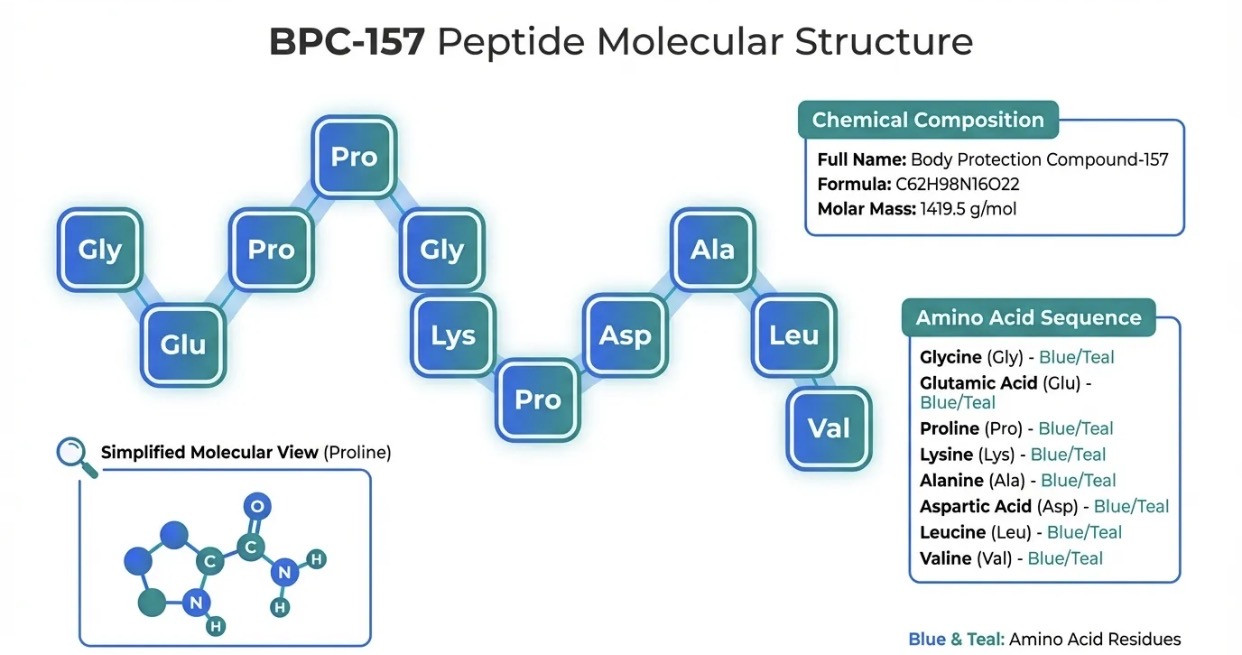
BPC-157 stands for Body Protection Compound-157. It is a synthetic pentadecapeptide meaning it is a chain of 15 amino acids derived from a protein naturally found in human gastric juice.
In plain terms: it is a short, man-made amino acid sequence modeled on a compound the body already produces in the stomach. It is not a hormone, not a steroid, and not a stimulant. It is a peptide a biological signaling molecule that researchers have been studying for its potential role in tissue repair, recovery, and protection across multiple organ systems.
BPC-157 has accumulated one of the most substantial preclinical research portfolios of any peptide in this space. Over two decades of published studies, primarily in rodent models, have consistently documented its effects across multiple tissue types and administration routes.
BPC-157 was isolated from a protein found in human gastric juice the same digestive fluid your stomach uses to break down food. The compound was identified and extensively studied by a research group at the University of Zagreb, Croatia, led by Professor Predrag Sikiric, whose lab has produced the majority of the published BPC-157 literature.
The fact that it originates from a naturally occurring human gastric protein is relevant for one important reason: it provides a degree of inherent biological plausibility. The body already produces related compounds in this family. BPC-157 is a synthetic fragment of that naturally occurring protein, engineered for research purposes.
It is important to note that BPC-157 is currently classified as a research compound. It has not been approved by the FDA for any clinical use, and no large-scale human clinical trials have been completed to date.
the BPC-157 mechanism of action is where the science becomes genuinely interesting and where most online content falls short.
BPC-157 does not work through a single pathway. Research has identified several interconnected biological mechanisms through which it appears to exert its effects:
One of the most heavily replicated findings in BPC-157 research is its ability to upregulate VEGFR2 (Vascular Endothelial Growth Factor Receptor 2), which stimulates the formation of new blood vessels at injury sites. This process called angiogenesis is fundamental to tissue repair. Without adequate blood supply, healing tissue cannot receive the oxygen and nutrients it needs to regenerate.
BPC-157 interacts with the nitric oxide (NO) system, which regulates blood flow, inflammation, and cellular signaling throughout the body. Research has shown it can activate eNOS (endothelial nitric oxide synthase), improving microvascular function and supporting the delivery of healing resources to damaged tissue.
Studies have documented that BPC-157 promotes collagen synthesis and stimulates fibroblast activity the cells responsible for producing the structural proteins that rebuild tendons, ligaments, and connective tissue after injury.
BPC-157 has been shown to influence ERK1/2 signaling pathways, which play a role in cell survival, proliferation, and differentiation all critical processes in tissue regeneration.
Research has also identified interaction with the FAK-paxillin pathway, which governs how cells migrate during tissue repair essentially directing the cellular “construction crew” to where it needs to go.
Think of BPC-157 as sending several coordinated messages simultaneously: build new blood supply here, synthesize structural proteins here, reduce excessive inflammation here. Rather than one signal, it appears to activate a network of repair-related responses.
A 2026 peer-reviewed paper published in the International Journal of Molecular Sciences by researchers from Cambridge, Johns Hopkins, Brown University, and UTHealth summarized the current state of BPC-157 evidence. The paper confirmed that across preclinical models, BPC-157 supports:
This is where honest, evidence-based communication matters most. Here is what the research actually shows and what it does not.
Tendon research represents the most densely studied area. Multiple rodent studies using the Achilles tendon model have documented accelerated tendon fiber organization, increased collagen type I deposition, and measurable upregulation of VEGF and EGF at injury sites.
Muscle repair research has also shown higher satellite cell counts and larger myofiber cross sectional areas in BPC-157-treated tissue compared to untreated tissue at post-injury day 7, 14, and 21 consistent with faster regeneration of contractile tissue.
BPC-157 has additionally shown protective effects against NSAID-induced gut damage and alcohol-induced gastric lesions in preclinical models, and early research suggests potential osteogenic effects in bone repair.
This is the part most online sources skip and it is essential context:
No large-scale human clinical trials have been completed. The evidence base, while substantial, is almost entirely preclinical meaning it comes from animal models, primarily rodents.
A 2025 pilot study examined the safety of intravenous BPC-157 administration in humans and reported no major adverse effects. Small human pilot studies on musculoskeletal pain and interstitial cystitis have also been conducted. But as researchers at Irvine Health noted in a 2026 clinical review: “Translation to humans is uncertain. Many promising preclinical findings fail to replicate in humans this is the unfortunate norm in pharmacology.”
The preclinical signal is unusually consistent. The mechanism is biologically plausible. But the honest answer to “does BPC-157 work in humans?” is: we don’t yet have the clinical trial data to know with confidence.
That distinction between a strong preclinical rationale and confirmed human efficacy is the most important thing to understand about BPC-157 in 2026.
Based on the published research literature, BPC-157 has demonstrated interactions across multiple biological systems:
Musculoskeletal System
Tendons, ligaments, muscle tissue, and bone have all been studied in preclinical BPC-157 healing models. The tendon and ligament research portfolio is particularly deep.
Gastrointestinal System
As a compound derived from gastric protein, BPC-157 has been extensively studied in GI models including protection against gut mucosal damage, ulceration, and drug-induced gastric injury.
Vascular System
The angiogenesis and nitric oxide research points to meaningful interactions with the vascular system, particularly in the context of wound healing and microvascular repair.
Neurological System
More recent research has begun exploring BPC-157’s effects on neurological tissue, though this area is less developed than the musculoskeletal and GI research.
Given how widely BPC-157 is discussed online, several persistent misconceptions are worth addressing directly.
Misconception 1: “BPC-157 is proven to work in humans.”
The preclinical evidence is strong and consistent. The human evidence is limited to small pilot studies. These are very different things. Strong animal data is a promising signal not a clinical confirmation.
Misconception 2: “BPC-157 will heal injuries on its own.”
Even in the preclinical studies where BPC-157 showed effects, it was acting within biological systems that were already attempting to repair themselves. It doesn’t replace the body’s healing processes it appears to modulate and potentially accelerate them. Sleep, nutrition, load management, and rehabilitation are not optional extras. They are the foundation.
Misconception 3: “More is better.”
Peptides interact with biological signaling systems. Those systems have feedback mechanisms and thresholds. The research literature does not support the idea that higher doses produce proportionally better outcomes. Dosing in research compounds is a topic that requires careful attention to the available evidence.
Misconception 4: “It’s completely safe because it’s natural.”
BPC-157 is derived from a naturally occurring protein but it is a synthetic research compound. The limited human safety data has not identified serious signals, which is encouraging. But “no known serious adverse effects in small studies” is not the same as an established long-term safety profile.
Perhaps the most important frame for understanding BPC-157 or any research peptide is this:
Biological signaling compounds work within the body’s existing systems.They do not override them.
A person with chronic poor sleep, inadequate protein intake, unmanaged stress, and no structured rehabilitation protocol is not going to experience meaningful benefit from any signaling molecule because the downstream systems those signals are supposed to activate are already compromised.
The most common pattern in peptide education is someone arriving focused entirely on finding the right compound, while the foundational variables sleep, nutrition, training, stress management are not in place. Understanding how BPC-157 actually works at a mechanistic level tends to shift that mindset. The question stops being “which peptide should I take?” and starts being “what are the conditions under which any intervention peptide or otherwise would actually produce results?”
That shift in thinking is, consistently, where the most sustainable outcomes come from.
What does BPC-157 stand for?
BPC-157 stands for Body Protection Compound-157. It is a synthetic pentadecapeptide (15 amino acid chain) derived from a protein found in human gastric juice.
How does BPC-157 work mechanically?
BPC-157 works through several interconnected biological pathways including VEGFR2-mediated angiogenesis, nitric oxide system modulation, collagen synthesis promotion, fibroblast activation, ERK1/2 signaling, and the FAK-paxillin cell migration pathway.
What is the mechanism of action of BPC-157?
The primary mechanisms documented in preclinical research include angiogenesis stimulation (new blood vessel formation), upregulation of growth factors at injury sites, collagen and connective tissue synthesis, and anti-inflammatory cytokine modulation.
Is BPC-157 approved by the FDA?
No. BPC-157 is not FDA-approved for any clinical indication. It is currently classified as a research compound and is not approved for human therapeutic use.
What tissues has BPC-157 been studied in?
Preclinical research has documented BPC-157 effects in tendon, ligament, muscle, bone, gastrointestinal mucosa, skin, cornea, and more recently, neurological tissue.
What is BPC-157 gastric peptide research?
This refers to the study of BPC-157’s protective effects on the gastrointestinal tract one of the original areas of research given that the compound was derived from a gastric protein. Studies have documented protection against NSAID-induced gut damage and gastric ulceration in animal models.
How does BPC-157 relate to angiogenesis?
BPC-157 has been shown in multiple studies to upregulate VEGFR2, a key receptor in the angiogenic signaling cascade, promoting the formation of new blood vessels at injury sites a critical component of tissue repair and healing.
This post is part of a growing library of evidence based peptide education. Coming next:
If you found this valuable, subscribe for updates. Our focus is always education first making peptide science understandable without oversimplifying it or making exaggerated claims.
This content is for educational and informational purposes only. It does not constitute medical advice, diagnosis, or treatment recommendations. BPC-157 is a research compound not approved for human therapeutic use by the FDA. Always consult a qualified healthcare professional before making any decisions related to your health.
10-vial kits • Capsule packs as listed • Research use only
© 2026 Pepkitshop. All rights reserved.
Vial product prices are per kit of 10 vials. Quantity 1 = 10 vials. Capsule products retain the pack size stated on their listing.
All products are supplied strictly for laboratory research. They are not intended for human or veterinary use, consumption, diagnosis, or treatment.
WhatsApp us
 Optimized by Seraphinite Accelerator
