
No products in the cart.

Vial products: price per kit of 10 vials. Quantity 1 = 10 vials. Capsule products are priced per capsule pack as listed. Dismiss
By Pepkitshop | Peptide Coach and Educator
Updated July 2026 | Educational Content, Not Medical Advice
How to read a peptide certificate of analysis is one of the most practical and important skills any researcher working with peptide compounds needs to develop.
A Certificate of Analysis is the most important document associated with any research peptide. It is more important than the product label, the supplier’s marketing claims, or the compound’s online reputation. It is the only objective evidence that what is in the vial matches what is on the label and the vast majority of researchers receive COAs from suppliers without knowing how to evaluate whether the document is legitimate, complete, or even relevant to the specific batch they received.
Recent industry events have made this skill more urgent than ever. After multiple high-profile enforcement actions in the research peptide space, including federal charges against suppliers whose products were found to contain entirely different compounds than labeled, knowing how to read a peptide certificate of analysis is no longer optional for anyone taking research seriously.
This guide walks through every section of a peptide COA, explains what each number means, identifies the red flags that indicate an inadequate or fraudulent document, and shows you how to independently verify results before using any research compound.
If you are not yet familiar with what peptide purity actually measures or how HPLC works, read our foundational guide on [peptide purity] first. This post builds directly on that foundation.
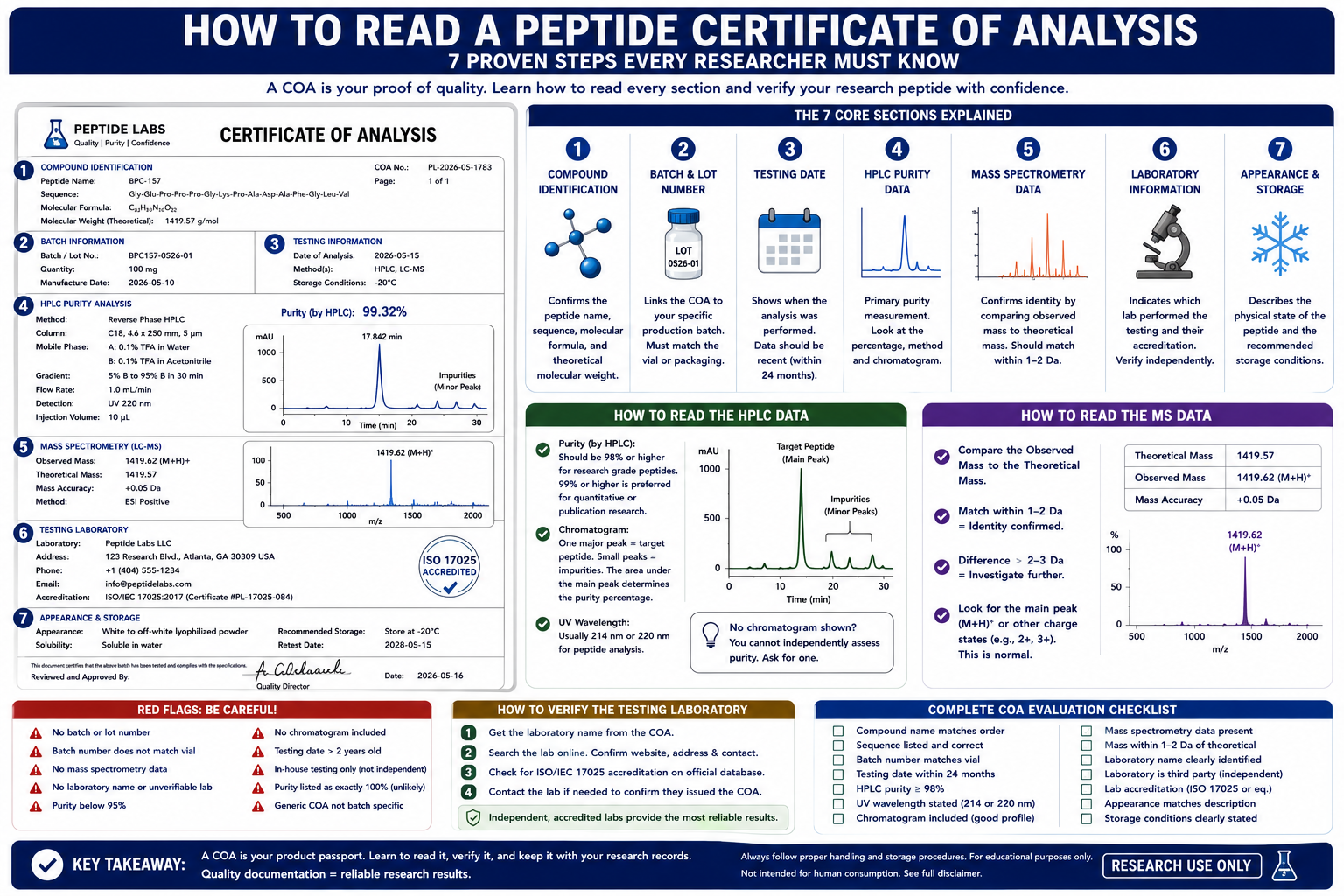
How to read a peptide certificate of analysis starts with understanding what it actually is.
A Certificate of Analysis is a technical document generated from analytical testing of a specific batch of a compound. It certifies that the batch has been tested by a qualified laboratory and provides the actual measured data from that testing. A COA is not a guarantee it is a record of what testing showed for that specific batch.
In practical terms, a COA is the test report for a specific production batch of a peptide compound. Every time a legitimate peptide manufacturer produces a batch, that batch should be sent to a laboratory for analytical testing. The laboratory tests the compound for purity, identity, and potentially other quality parameters, then issues a document reporting the results. That document is the Certificate of Analysis.
A Certificate of Analysis serves as the peptide equivalent of a product passport, documenting critical quality metrics that determine whether a compound meets acceptable standards for research use. Every legitimate peptide supplier should provide a COA for each batch produced, and the absence of this documentation represents a significant red flag regarding product quality and supplier credibility.
Understanding how to read a peptide certificate of analysis means being able to take this document and extract from it a reliable answer to three fundamental questions: Is this compound what it claims to be? Is it pure enough for the intended research use? And is the documentation itself trustworthy?
How to read a peptide certificate of analysis has become more critical than ever in the current research landscape.
After the Peptide Sciences shutdown, Paradigm Peptides federal charges where products contained testosterone instead of the labeled compounds, and FDA enforcement actions across the industry, the ability to evaluate a certificate of analysis is no longer optional for serious researchers.
The research peptide market operates largely outside the regulatory frameworks that govern pharmaceutical manufacturing. This means quality control is not externally mandated to the same standard as licensed drug products. The COA is the primary mechanism through which a researcher can independently verify compound quality.
Most COAs that circulate in the research peptide market are technically compliant and practically useless. They report purity, confirm an observed molecular weight, and carry a lab name. What they do not do is give you the information needed to catch the failure modes that actually show up in this industry. Knowing the difference between a COA that passes the checklist and one that confirms what you are actually holding is the skill this guide covers.
The 2026 research environment makes this particularly relevant because:
The FDA enforcement activity of 2025 and 2026 has pushed some lower quality suppliers out of the market but has also created uncertainty about documentation standards. Understanding how to read a peptide certificate of analysis allows researchers to evaluate suppliers independently rather than relying on reputation alone.
For detailed regulatory and enforcement documentation, consult the National Library of Medicine and peer reviewed research databases.
Understanding [research use only] designations and the documentation standards that accompany them is part of operating responsibly in this research space.
How to read a peptide certificate of analysis requires knowing what a complete document should contain. A COA missing any of these seven sections is incomplete and provides less than full quality assurance.
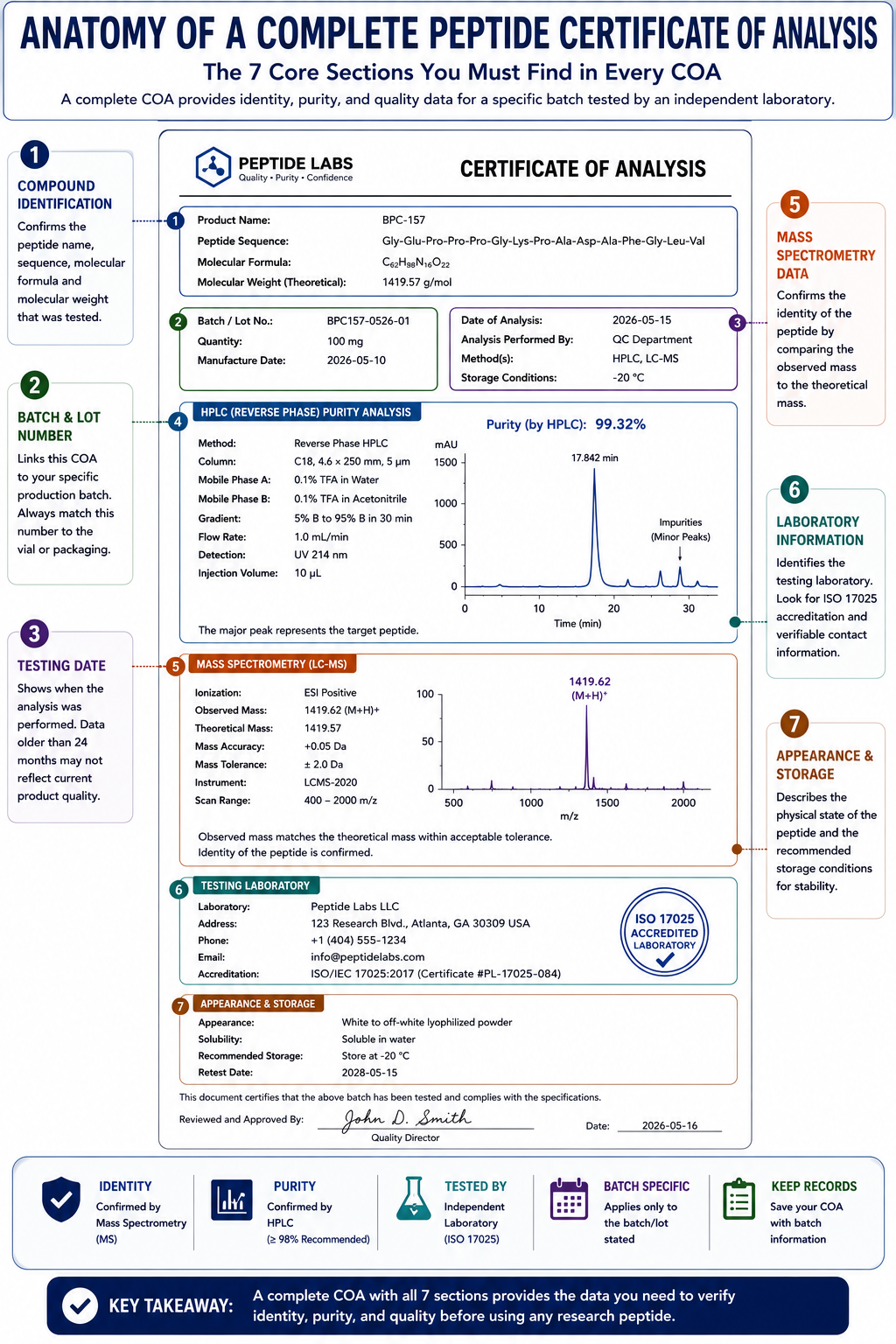
Complete COA Section Checklist
| Section | What It Contains | Why It Matters |
|---|---|---|
| 1. Compound identification | Peptide name, sequence, molecular formula, molecular weight | Confirms what compound was tested |
| 2. Batch and lot number | Unique identifier for the specific production batch | Links document to your specific product |
| 3. Testing date | When the analysis was performed | Confirms freshness of data |
| 4. HPLC purity data | Purity percentage, chromatogram, UV wavelength used | Primary purity measurement |
| 5. Mass spectrometry data | Observed molecular weight vs theoretical weight | Identity confirmation |
| 6. Laboratory information | Testing laboratory name, accreditation, contact details | Enables independent verification |
| 7. Appearance and storage | Physical description, recommended storage conditions | Quality and stability guidance |
Each section plays a specific role. The compound identification section tells you what was tested. The batch number links the document to your specific product. The testing date tells you how current the data is. HPLC tells you how pure it is. Mass spectrometry tells you whether it is actually the right compound. Laboratory information tells you whether the testing was independent and credible. Appearance and storage tell you what to expect physically and how to maintain compound integrity.
When you receive a new batch of research peptide, follow this verification process before use: check batch number matches between COA and packaging, verify the testing laboratory is named and identifiable, confirm purity meets your minimum threshold of 98% or higher for most research, check that molecular weight matches the theoretical molecular weight for the peptide, examine the chromatogram if included, confirm sterility and endotoxin data if your application requires it, and file the COA with your research records alongside the batch number for documentation purposes.
A COA that fails any of the first four checks provides no reliable information about the compound in your possession. A COA that passes all thirteen checks provides strong evidence of quality and authenticity.
At Pepkitshop, every compound is accompanied by a third party COA covering all of the above elements. Our documentation standards are built around exactly this checklist because we believe researchers deserve to know precisely what they are working with.
How to read a peptide certificate of analysis HPLC section is the most important practical skill in evaluating research peptide quality.
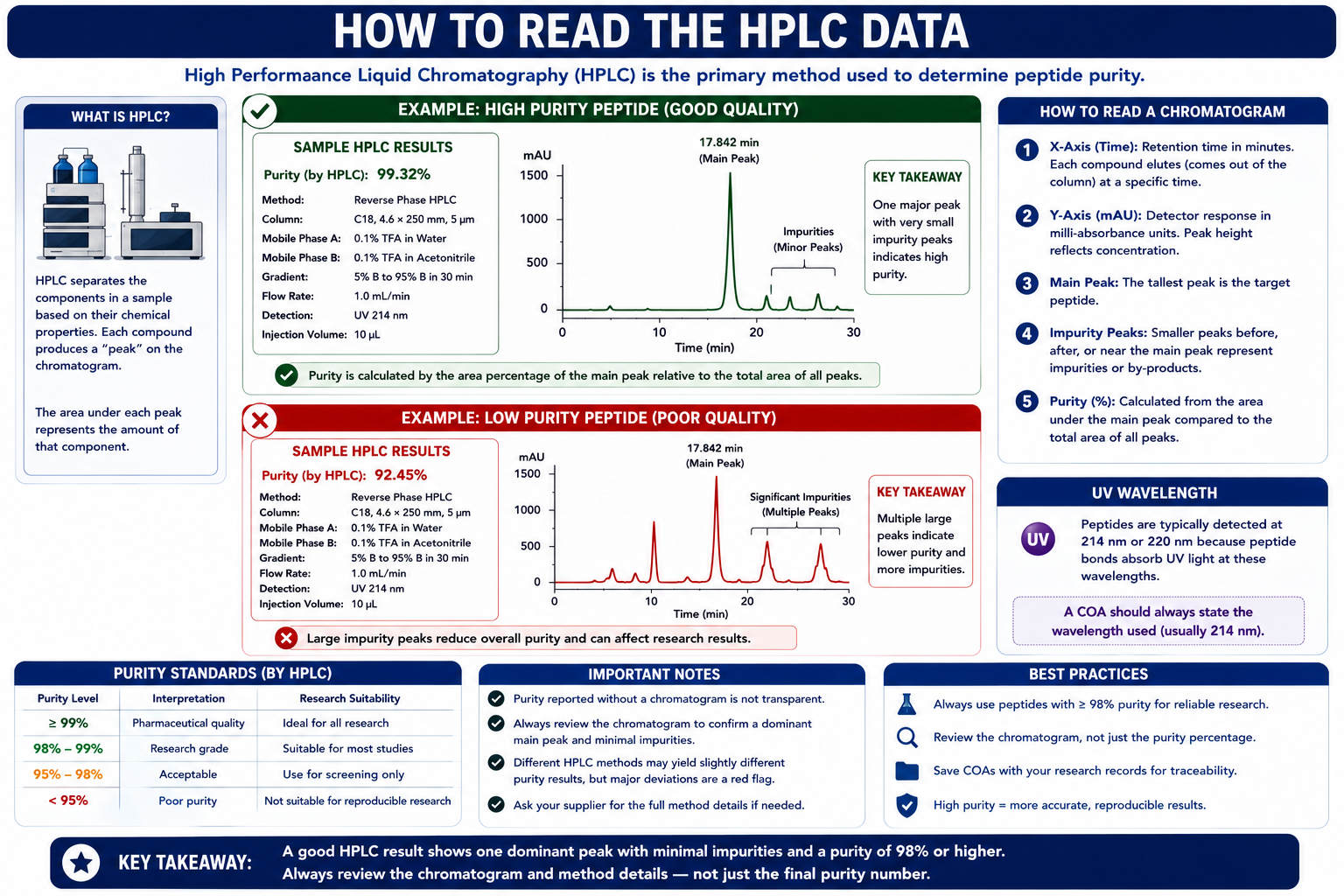
HPLC stands for High-Performance Liquid Chromatography. As covered in our guide on [peptide purity], it is the primary method for measuring what percentage of a sample is actually the intended compound versus impurities and synthesis byproducts.
What the HPLC section should show:
A complete HPLC entry in a COA includes the purity percentage, the UV wavelength at which the analysis was run, and ideally a chromatogram image showing the actual peaks.
Reading the purity percentage:
The stated peptide purity should be 99% or higher for pharmaceutical quality research standards. Numbers between 95% and 98% may be acceptable for screening studies but are inadequate for quantitative dose-response work or publication-grade research. Below 95% indicates a product that should not be used for reproducible research.
HPLC Purity Standards Reference Table
| Purity Level | Research Suitability | What It Means |
|---|---|---|
| 99% and above | ✅ Pharmaceutical quality, suitable for all research | Highest standard, minimal impurity load |
| 98% to 99% | ✅ Research grade, suitable for most studies | Accepted industry standard minimum |
| 95% to 98% | ⚠️ Acceptable for screening only | Not suitable for quantitative or publication research |
| Below 95% | ❌ Not suitable for reproducible research | Significant impurity load, unreliable results |
Reading the chromatogram:
A chromatogram is the visual graph produced by the HPLC analysis. It shows peaks, where each peak represents a different compound detected in the sample. The horizontal axis shows retention time and the vertical axis shows detector signal intensity.
A high quality peptide shows one dominant tall peak representing the target compound, with small or absent secondary peaks representing impurities. Multiple significant secondary peaks indicate substantial impurity content regardless of what the purity percentage states.
When a supplier provides the purity percentage but no chromatogram, you are relying entirely on their reported number without the underlying data to verify it. A chromatogram included in the COA allows independent assessment.
The UV wavelength:
HPLC for peptides is typically run at 214 nm or 220 nm wavelengths. These wavelengths are where peptide bonds absorb light. A COA that does not state the wavelength used is missing a standard piece of documentation.
How to read a peptide certificate of analysis mass spectrometry section is the second critical skill.
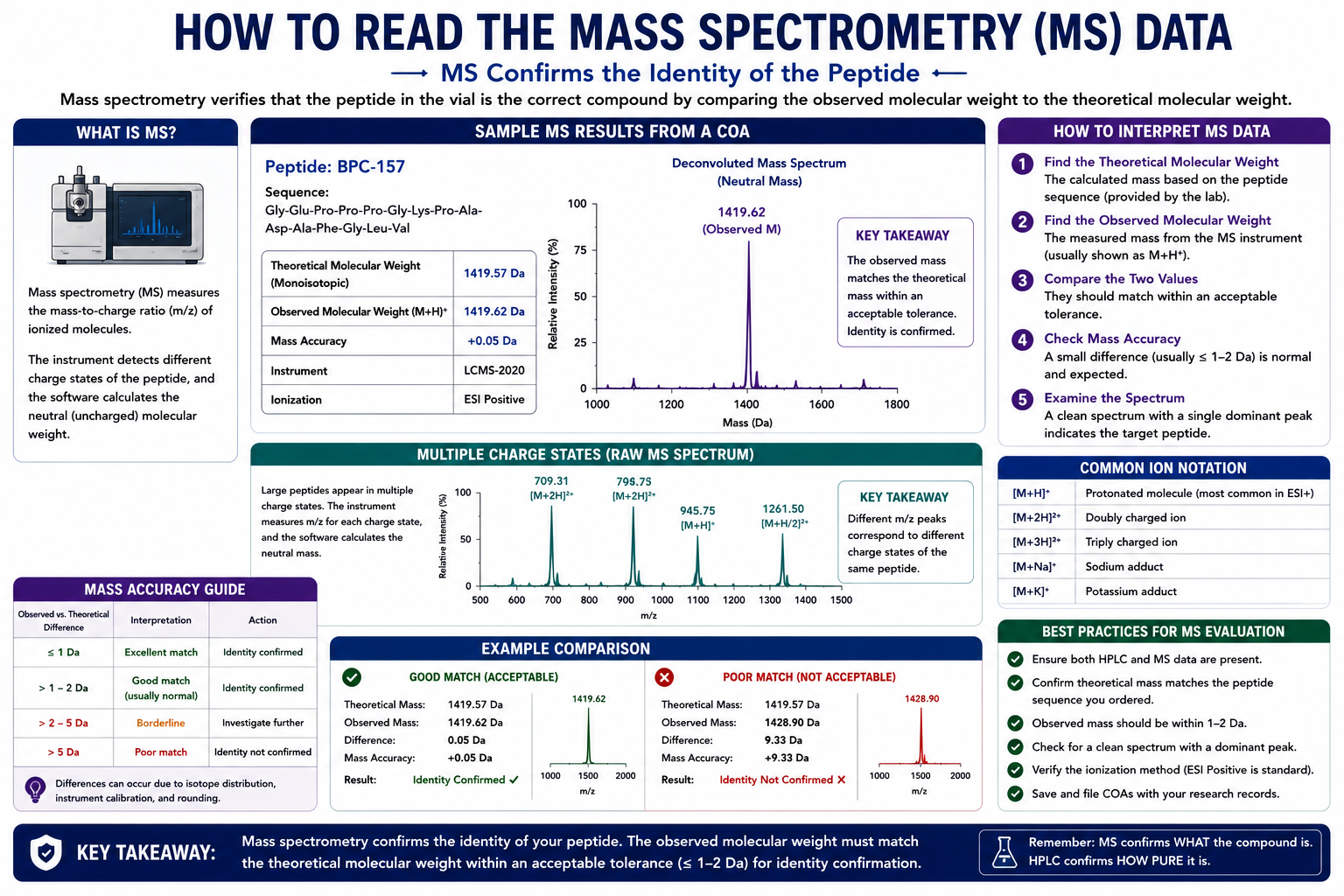
If only HPLC data is present, the certificate of analysis provides quantitative purity but no identity verification. If only MS data is present, identity is confirmed but the purity percentage is not documented. Both are required for full quality assurance.
Mass spectrometry confirms that the compound in the vial is actually the peptide claimed, not a structurally different compound that might have similar HPLC behavior.
What the MS section should show:
The mass spectrometry section should display two numbers side by side:
How to evaluate the match:
These two numbers should match within an acceptable tolerance. A difference of 1 dalton or less is typically acceptable and can result from isotope distribution effects in the measurement. A difference of more than 2 to 3 daltons suggests the compound may not be the claimed peptide.
Mass Spectrometry Evaluation Guide
| Observed vs Theoretical MW | Interpretation | Action |
|---|---|---|
| Match within 1 dalton | ✅ Identity confirmed | Proceed with confidence |
| Difference of 1 to 2 daltons | ✅ Generally acceptable | Note but likely within normal variation |
| Difference of 2 to 5 daltons | ⚠️ Borderline, investigate further | Request clarification from supplier |
| Difference greater than 5 daltons | ❌ Identity not confirmed | Do not use, contact supplier |
| MS data absent entirely | ❌ Identity unverified | Significant quality concern |
The mass spectrometry section may also show multiple charge states of the same peptide, labeled as [M+H]+, [M+2H]2+, and similar notation. This is normal and expected for larger peptides. Each charge state produces a different observed mass, and the testing laboratory calculates the neutral mass from these readings. The neutral mass is what should match the theoretical molecular weight.
How to read a peptide certificate of analysis independently requires verifying that the testing laboratory is real, independent, and credible.
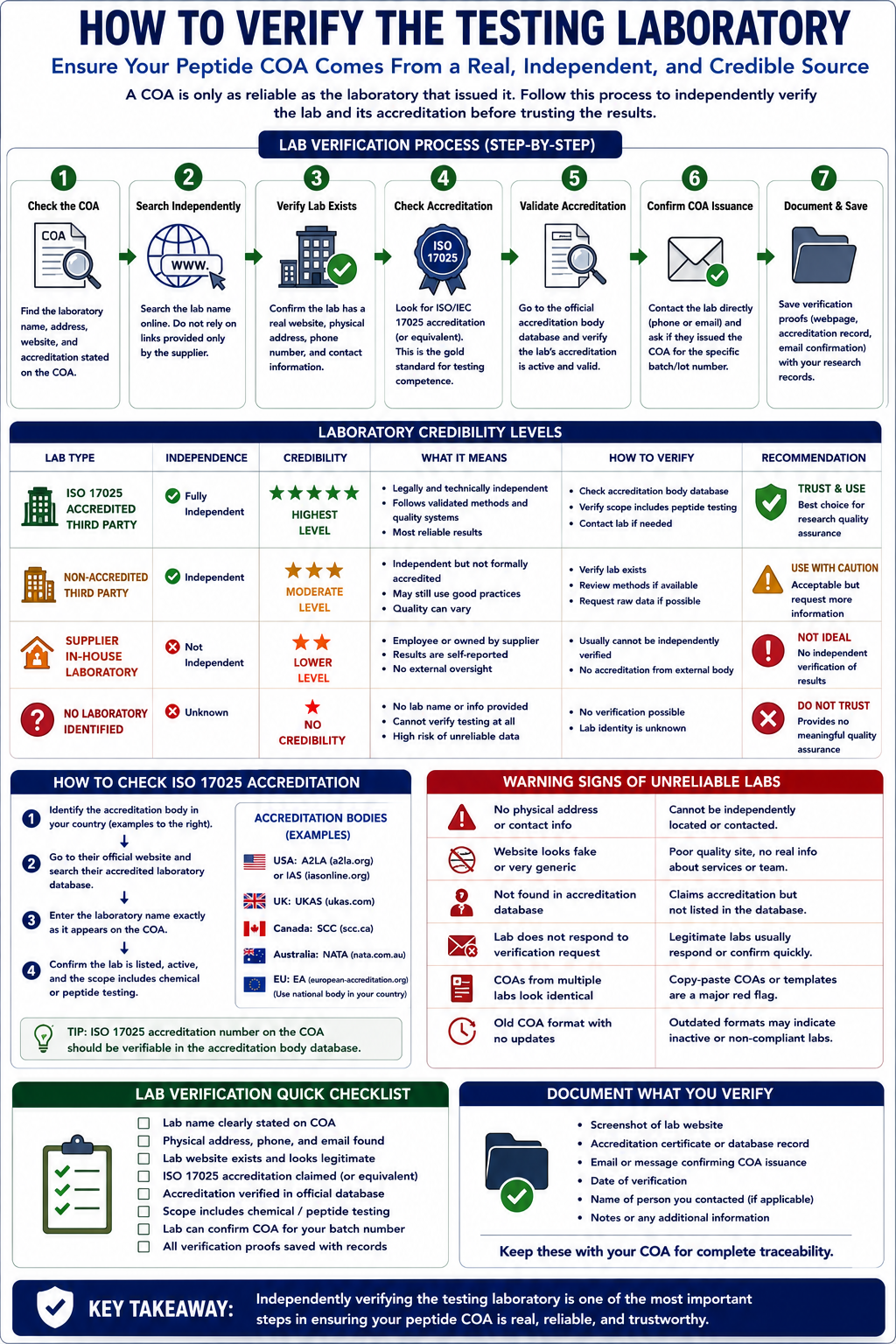
Always check that the COA is real by verifying the lab and contacting it directly if needed.
A COA is only as credible as the laboratory that issued it. Three levels of laboratory credibility exist in the research peptide documentation landscape:
Laboratory Credibility Comparison Table
| Laboratory Type | Independence | Credibility | How to Verify |
|---|---|---|---|
| ISO 17025 accredited third party | ✅ Fully independent | ✅ Highest | Search accreditation body database |
| Non-accredited third party | ✅ Independent | ⚠️ Moderate | Verify lab exists, request raw data |
| Supplier in-house laboratory | ❌ Not independent | ⚠️ Lower | Self-reported, no external verification |
| No laboratory identified | ❌ Unknown | ❌ No credibility | Document provides no assurance |
How to verify a third party laboratory:
A legitimate accredited laboratory will have verifiable credentials and will be able to confirm its own documentation on request. A fictional or unverifiable laboratory name on a COA is one of the clearest red flags in the research peptide supply space.
How to read a peptide certificate of analysis means knowing what warning signs indicate a document that should not be trusted.
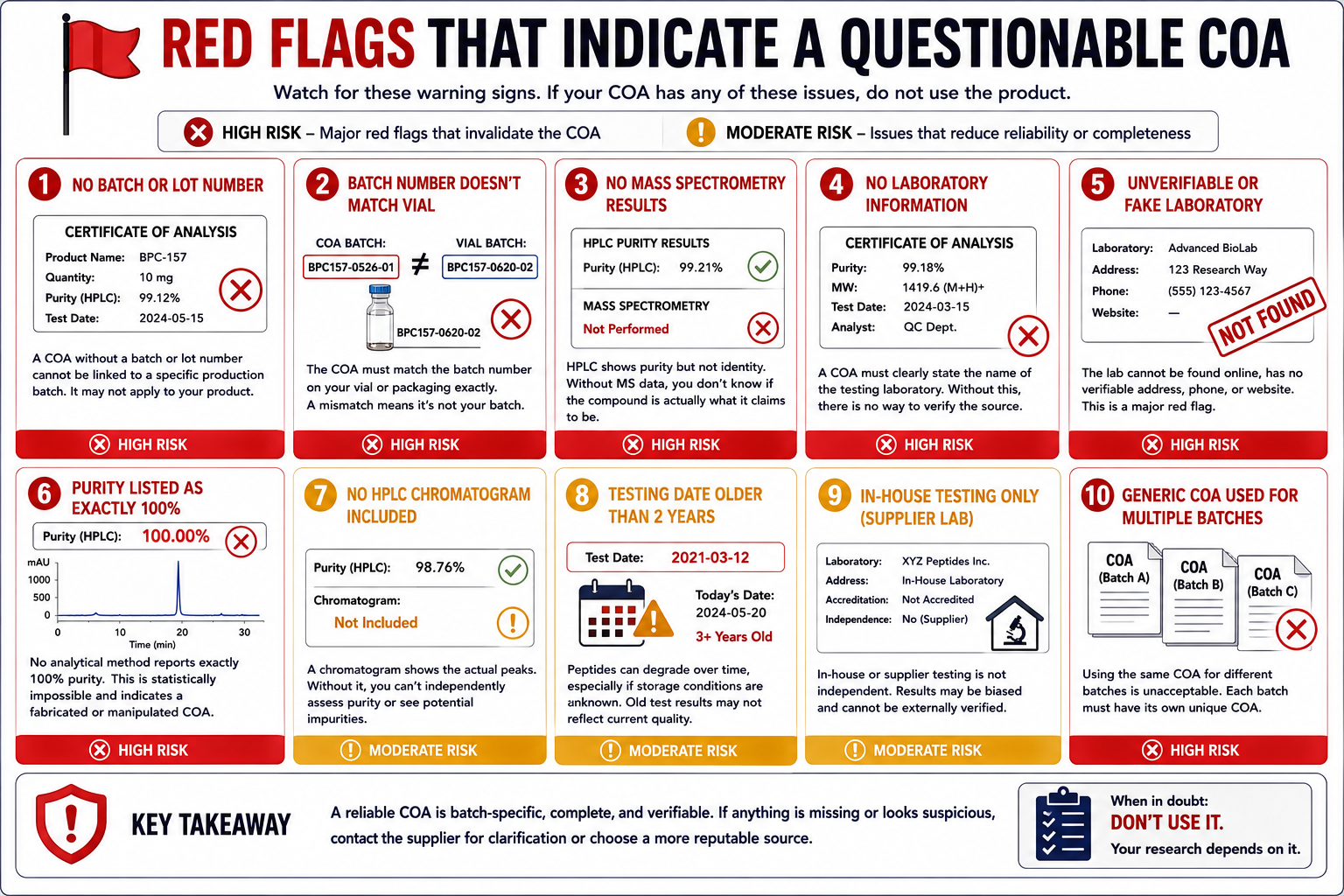
COA Red Flags Reference Table
| Red Flag | What It Suggests | Risk Level |
|---|---|---|
| No batch or lot number | Document may not apply to your specific product | ❌ High |
| Batch number does not match vial | COA from a different or unrelated batch | ❌ High |
| No mass spectrometry data | Identity of compound unverified | ❌ High |
| No laboratory name or unverifiable lab | Testing cannot be independently confirmed | ❌ High |
| Purity below 95% | Significant impurity load | ❌ High |
| No chromatogram included | Purity number cannot be independently assessed | ⚠️ Moderate |
| Testing date more than 2 years old | Compound may have degraded since testing | ⚠️ Moderate |
| In-house testing only | No independent verification of results | ⚠️ Moderate |
| Purity listed as exactly 100% | Statistically implausible, likely fabricated | ❌ High |
| Generic COA not batch specific | Single document applied to multiple batches | ❌ High |
The most dangerous red flag is a COA that appears complete and professional but contains a batch number that does not match the product received. This document tells you nothing about what is actually in your vial. It is documentation of a different batch entirely.
The second most dangerous situation is a purity percentage of exactly 100 percent. No analytical method produces exactly 100 percent purity results. This number almost certainly indicates a fabricated document.
How to read a peptide certificate of analysis in a systematic process using this checklist before accepting any research compound:
Complete COA Verification Checklist
| Check | What to Verify | Pass or Fail |
|---|---|---|
| Compound name | Matches what you ordered exactly | Pass / Fail |
| Amino acid sequence | Listed and matches known sequence for compound | Pass / Fail |
| Batch number on COA | Matches batch number on vial or packaging | Pass / Fail |
| Testing date | Within the past 24 months | Pass / Fail |
| HPLC purity | 98% or higher | Pass / Fail |
| HPLC wavelength | 214 nm or 220 nm stated | Pass / Fail |
| Chromatogram | Included, shows dominant single peak | Pass / Fail |
| Mass spectrometry | Present, observed mass within 1 to 2 daltons of theoretical | Pass / Fail |
| Laboratory name | Clearly identified, independently verifiable | Pass / Fail |
| Laboratory independence | Third party, not supplier in-house | Pass / Fail |
| Laboratory accreditation | ISO 17025 or equivalent stated | Pass / Fail |
| Appearance description | Matches expected lyophilized powder description | Pass / Fail |
| Storage conditions | Clearly stated | Pass / Fail |
A COA that fails any of the first four checks provides no reliable information about the compound in your possession. A COA that passes all thirteen checks provides strong evidence of quality and authenticity.
At Pepkitshop, every compound is accompanied by a third party COA covering all of the above elements. Our documentation standards are built around exactly this checklist because we believe researchers deserve to know precisely what they are working with.
How to read a peptide certificate of analysis as a first step is to confirm the batch number on the document matches the batch number on your product. Then check the HPLC purity percentage is 98% or higher. Then confirm mass spectrometry identity data is present and the observed molecular weight matches the theoretical weight. Finally verify the testing laboratory is independently identifiable.
How to read a peptide certificate of analysis HPLC data requires finding the purity percentage, confirming it is 98% or higher, checking the UV wavelength is stated as 214 nm or 220 nm, and examining the chromatogram if included to confirm one dominant peak with minimal secondary peaks.
How to read a peptide certificate of analysis MS section requires finding the theoretical molecular weight for the peptide and comparing it to the observed molecular weight reported by the laboratory. A match within 1 to 2 daltons confirms identity. A larger discrepancy requires investigation.
The accepted minimum for research grade peptides is 98% purity by HPLC analysis. For quantitative research or publication-grade work, 99% or higher is preferred. Below 95% is not considered suitable for reproducible research.
How to read a peptide certificate of analysis and verify its authenticity requires independently confirming the testing laboratory exists, holds appropriate accreditation, and can confirm issuing the specific document if contacted. A COA from an unverifiable laboratory source provides no meaningful quality assurance regardless of the numbers it contains.
Most research peptide COAs in circulation lack one or more of: a batch-specific lot number, mass spectrometry identity confirmation, an included chromatogram, or verifiable third party laboratory accreditation. A COA missing any of these elements provides incomplete quality assurance.
Key Takeaways
Continue Learning
This post is part of a growing educational library on research peptide science and quality evaluation. Related reading:
10-vial kits • Capsule packs as listed • Research use only
© 2026 Pepkitshop. All rights reserved.
Vial product prices are per kit of 10 vials. Quantity 1 = 10 vials. Capsule products retain the pack size stated on their listing.
All products are supplied strictly for laboratory research. They are not intended for human or veterinary use, consumption, diagnosis, or treatment.
WhatsApp us
 Optimized by Seraphinite Accelerator
