
No products in the cart.

Vial products: price per kit of 10 vials. Quantity 1 = 10 vials. Capsule products are priced per capsule pack as listed. Dismiss
By Pepkitshop | Peptide Research Education
Updated July 2026 | Educational Content, Not Medical Advice
What makes a research peptide supplier trustworthy and how do you verify trustworthiness when the market contains both legitimate suppliers and vendors that look identical to them on the surface?
This question became significantly more urgent in early 2026. Science.bio shut down in January 2026. Peptide Sciences, one of the most widely used and ostensibly reputable suppliers in the research peptide community, shut down in March 2026. Both closures left researchers who had depended on them searching for alternatives under time pressure, often without a structured framework for evaluating new suppliers.
The peptide vendor closures of 2025 and 2026 taught the market a painful lesson. Vendor self-promotion is not trust verification. Peptide Sciences looked trustworthy. They had a professional website, large catalog, and years of operation. Then they shut down overnight.
Understanding what makes a research peptide supplier trustworthy requires moving beyond website professionalism and catalog size. It requires understanding the specific, verifiable criteria that distinguish a supplier with genuine quality systems from one that has invested in the appearance of quality without the substance.
This guide provides exactly that framework. Seven proven criteria, grounded in the 2026 research peptide landscape, that allow any researcher to evaluate any supplier before placing an order.
What makes a research peptide supplier trustworthy is not an abstract question in 2026.
With FDA enforcement ramping up and gray market sellers flooding search results, learning how to evaluate a research peptide supplier is now a basic skill for anyone running in vitro studies. Knowing how to evaluate a research peptide supplier means running structured due diligence confirming a vendor’s product matches the label, was synthesized and shipped to preserve integrity, and operates within legal research use only boundaries. Buyers who skip this end up with underdosed or contaminated material that ruins experiments and burns budgets.
The 2025 and 2026 enforcement and closure events demonstrated that longevity in the market is not a proxy for trustworthiness. Multiple suppliers that had operated for years and had large customer bases were found to have documentation or product quality issues that only became apparent when enforcement action or independent testing revealed them.
Reliable suppliers are transparent about sourcing, testing, storage, and legal status. The biggest red flags are human dosing advice, therapeutic claims, and pressure driven marketing. Suspiciously low prices, missing lot numbers, and peptides shipped without cold chain or lyophilization are strong signals of degraded or misrepresented product. Regulatory oversight of research peptides is limited, so the burden of verification falls on the buyer.
What makes a research peptide supplier trustworthy is therefore something the researcher must evaluate independently. There is no regulatory certification that guarantees research peptide supplier quality. The seven criteria below provide the framework for that independent evaluation.
What makes a research peptide supplier trustworthy can be evaluated through seven specific, verifiable criteria.

The 7 Trustworthiness Criteria Overview
| Criterion | What It Verifies | How to Check |
|---|---|---|
| 1. Independent third party testing | Quality claims are verified externally | Identify testing laboratory, verify it independently |
| 2. Batch specific public documentation | COAs apply to your actual product | Check lot number match, confirm COAs are publicly accessible |
| 3. Verifiable business identity | Supplier is a real, accountable entity | Verify legal registration, physical address, contact information |
| 4. Research use only compliance | Supplier operates within legal RUO framework | Check for human use claims, dosing guidance, therapeutic language |
| 5. Cold chain and shipping integrity | Compound arrives in preserved condition | Confirm cold pack shipping, appropriate packaging for temperature sensitive compounds |
| 6. Technical responsiveness | Supplier has genuine expertise and accountability | Test with technical questions before purchasing |
| 7. Independent community verification | Real researchers vouch for compound quality | Check independent review platforms, research community forums |
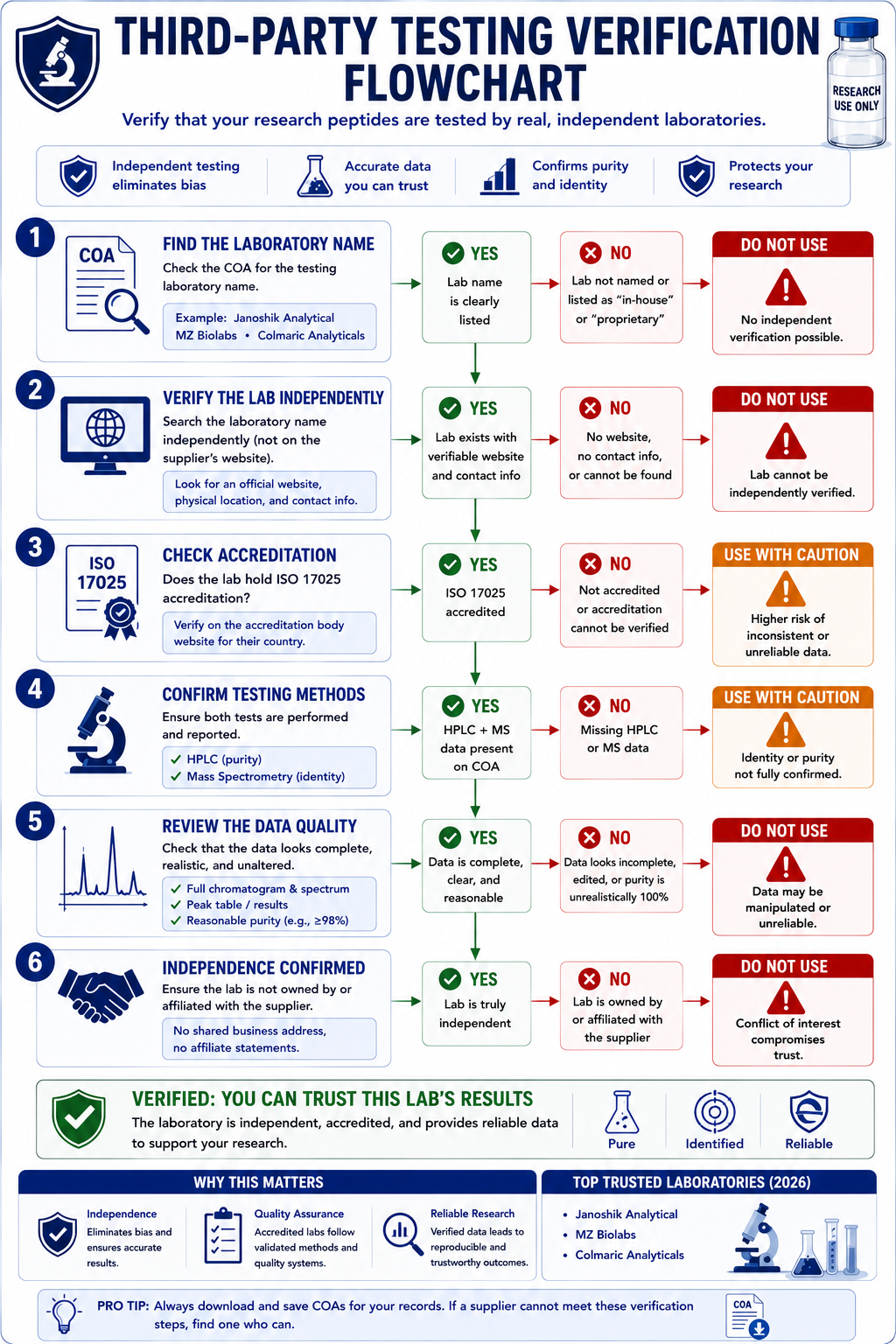
What makes a research peptide supplier trustworthy at the most fundamental level is independent analytical verification of their compounds.
A trustworthy research peptide supplier is transparent about its production methods, testing standards, and policies, and makes that information easy to find without requiring you to ask.
The community trusted analytical laboratories in 2026 are Janoshik Analytical, MZ Biolabs, and Colmaric Analyticals. Identity and purity verified by an accredited laboratory the vendor does not own is the standard that separates legitimate research suppliers from resellers.
What makes a research peptide supplier trustworthy at this criterion requires that the third party laboratory used for testing be:
Named specifically on every COA, not just referenced generically as an external laboratory. Independently verifiable through a search that confirms the laboratory’s existence, physical location, and contact information. Not owned by, affiliated with, or financially connected to the supplier. Ideally holding ISO 17025 accreditation from a recognized national accreditation body.
The information in our guide on [how to read a peptide COA] covers exactly how to verify a testing laboratory independently. What makes a research peptide supplier trustworthy at this criterion is straightforward to check: find the laboratory name, search for it independently, confirm it exists and holds the credentials stated.
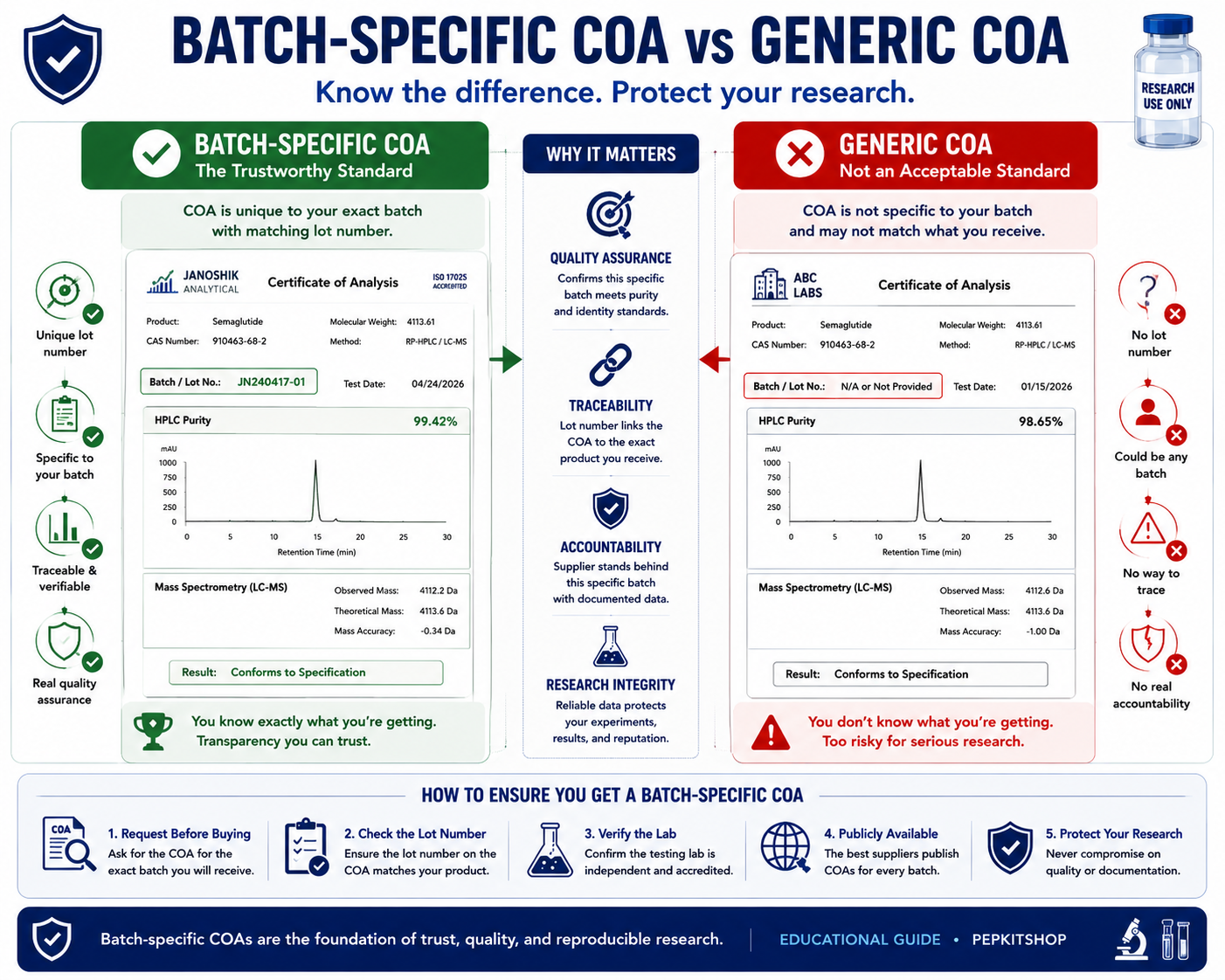
What makes a research peptide supplier trustworthy at the documentation level is publicly accessible, batch specific COAs.
Confirm that batch specific COAs are publicly accessible and that the documentation includes full methodology details. A vendor worth your business should meet every one of these criteria: verify that the research peptide supplier provides both HPLC and mass spectrometry data for every product, and that purity is consistently at or above 99 percent.
A genuinely reliable supplier will let you request the COA for the exact lot you are buying, and increasingly the best vendors publish batch COAs openly. If a seller cannot or will not produce a batch specific certificate, treat that as disqualifying regardless of how professional the website looks.
The distinction between generic COAs and batch specific COAs is critical. What makes a research peptide supplier trustworthy is that every product, every batch, has its own unique COA with a lot number that matches the product shipped. Suppliers who provide a single generic COA for a compound regardless of batch are not providing meaningful quality documentation.
Batch Documentation Trustworthiness Comparison
| Documentation Practice | Trustworthiness Signal |
|---|---|
| Batch specific COA published publicly for every product | ✅ Highest trust signal |
| Batch specific COA available on request | ✅ Acceptable, request before purchasing |
| Generic COA with no lot number | ❌ Not meaningful quality documentation |
| COA available only after purchase | ⚠️ Cannot evaluate before committing |
| No COA provided | ❌ Disqualifying |
What makes a research peptide supplier trustworthy at the business level is accountability.
A supplier that cannot be independently identified as a real, legally registered business entity cannot be held accountable for the quality of what it sells. In a market where anonymous online vendors exist alongside legitimate suppliers, verifiable business identity is a prerequisite for trust.
What makes a research peptide supplier trustworthy at this criterion includes:
A verifiable legal business name registered in its claimed jurisdiction. A physical address that can be independently confirmed. Working contact information including a phone number or email that reaches a real person capable of answering technical questions. No history of enforcement actions from the FDA or other regulatory bodies in their operating jurisdiction.
The most trustworthy vendors in 2026 share three characteristics: independent third party testing with verifiable COAs, transparent US based manufacturing under consistent regulatory oversight, and a track record that can be verified through independent community sources rather than self-reported metrics.
What makes a research peptide supplier trustworthy at the regulatory level is strict adherence to [research use only] designation standards.
Reliable suppliers are transparent about sourcing, testing, storage, and legal status. The biggest red flags are human dosing advice, therapeutic claims, and pressure driven marketing.
A supplier that provides human dosing guidance, makes therapeutic or health benefit claims, or uses marketing language implying personal use is operating outside the legal framework that governs research peptide supply. This is not merely a legal issue. It is a trust signal. A supplier willing to violate regulatory boundaries in its marketing is a supplier whose quality documentation should also be viewed with skepticism.
Research Use Only Compliance Signals
| Supplier Behavior | Trust Signal |
|---|---|
| Clear RUO designation on all products | ✅ Compliant |
| No dosing guidance for human use | ✅ Compliant |
| No therapeutic or health benefit claims | ✅ Compliant |
| Disclaimer language on website and documentation | ✅ Compliant |
| Age verification or researcher qualification check | ✅ Additional compliance signal |
| Human dosing guidance provided | ❌ Regulatory violation, major red flag |
| Health benefit claims made | ❌ Regulatory violation, major red flag |
| Before and after photos or testimonials | ❌ Implied therapeutic claims, major red flag |
At Pepkitshop, all products carry clear research use only designations and our educational content is designed to inform rather than to make claims. This compliance is not simply a legal requirement. It reflects a genuine commitment to operating responsibly in this research space.
What makes a research peptide supplier trustworthy at the physical product level is shipping that preserves compound integrity.
Research peptides are temperature sensitive compounds. As covered in our guide on [evaluating peptide quality], heat is one of the four primary enemies of peptide stability. A compound that arrives having spent 48 hours in an unprotected package in summer heat may have degraded significantly from its tested purity level before the researcher even opens the vial.
What makes a research peptide supplier trustworthy at this criterion includes the use of cold packs or dry ice for shipments in warm conditions, insulated packaging appropriate for the transit time and ambient temperature conditions, lyophilized form for all shipped compounds rather than pre-reconstituted solutions, and shipment tracking that allows the researcher to identify if a package was significantly delayed or exposed to extreme conditions.
Shipping Integrity Standard Comparison
| Shipping Practice | Trust Signal |
|---|---|
| Cold packs included in warm weather shipping | ✅ Appropriate |
| Insulated packaging | ✅ Appropriate |
| Lyophilized compounds only | ✅ Most stable shipping form |
| Tracking provided | ✅ Accountability for delivery conditions |
| No temperature protection in summer | ❌ Compound integrity not assured |
| Pre-reconstituted solutions shipped | ❌ Most unstable form for shipping |
| No tracking provided | ⚠️ Reduced accountability |
What makes a research peptide supplier trustworthy at the service level is the ability to answer genuine technical questions accurately.
A supplier with real expertise in peptide chemistry and genuine quality control systems can answer specific technical questions about their compounds, their testing methodology, their laboratory relationships, and their storage and shipping protocols. A supplier who is primarily a reseller without genuine quality involvement typically cannot.
Scientific suppliers should offer guidance, data sheets, and proper documentation. Industry experts emphasize that trustworthy peptide vendors focus on quality assurance, proper testing protocols, and consistent delivery standards.
Before placing a first order with any supplier, consider asking the following questions and evaluating the quality of the response:
What laboratory performs your third party testing and how can I verify their accreditation? What is the lot number of the current batch of the compound I am considering, and can you provide the batch specific COA? What salt form are your compounds supplied in? What are your cold chain protocols for summer shipping? What is your policy if I receive a compound that does not match its documented specifications?
A trustworthy supplier answers these questions specifically and accurately without evasion. An untrustworthy supplier provides vague marketing language, cannot answer technical specifics, or becomes defensive about documentation requests.
What makes a research peptide supplier trustworthy is ultimately verified by researchers who have used their products independently.
After the 2025 and 2026 vendor shutdowns, researchers evaluate trusted suppliers through a stricter lens. The new trust criteria include independent reviews from real people, not testimonials on the vendor’s own website which can be fabricated, not anonymous forum posts which can be manipulated, but real reviews on platforms where vendors cannot delete or filter negative feedback.
The vendors that win in 2026 are the ones whose quality is verifiable in public, not buried behind an email us for a COA wall.
Independent community verification includes reviews on platforms where vendors cannot control or delete negative feedback, research community forum discussions where compound quality is evaluated by actual users, and social media presence with genuine two-way engagement rather than purely promotional content.
What makes a research peptide supplier trustworthy is not what they say about themselves. It is what independently verifiable sources say about them over time and across multiple transactions.
What makes a research peptide supplier trustworthy becomes clearest when you understand what untrustworthy looks like.
Research Peptide Supplier Red Flags Reference Table
| Red Flag | What It Indicates | Risk Level |
|---|---|---|
| Human dosing guidance provided | Regulatory violation, potential liability | ❌ Critical |
| Therapeutic or health benefit claims | Regulatory violation, misleading marketing | ❌ Critical |
| No batch specific COA available | No meaningful quality verification | ❌ Critical |
| Testing laboratory unverifiable | COA credibility cannot be confirmed | ❌ Critical |
| Purity consistently listed as exactly 100% | Statistically implausible, likely fabricated | ❌ Critical |
| Prices dramatically below market | Quality corners being cut somewhere | ❌ High |
| No physical address or verifiable identity | No accountability mechanism | ❌ High |
| In-house testing only | No independent verification | ❌ High |
| HPLC data without mass spectrometry | Identity not confirmed | ⚠️ Significant |
| No cold chain shipping | Compound integrity not maintained | ⚠️ Significant |
| Slow or evasive response to technical questions | Lack of genuine expertise | ⚠️ Significant |
| No research use only designation | Operating outside appropriate legal framework | ⚠️ Significant |
Be wary of documents that show only a company logo and a purity claim with no underlying data. That is marketing dressed as science, not a real analysis.
The critical red flags in the table above are disqualifying individually. A supplier that provides dosing guidance, makes health claims, or cannot produce verifiable batch specific documentation should not be used regardless of any other positive signals they present.
The significant red flags are serious individually and disqualifying in combination. Two or more significant red flags from the same supplier indicate a pattern of cutting corners that should make a researcher look elsewhere.
What makes a research peptide supplier trustworthy evaluated in a single structured checklist:
Complete Supplier Verification Checklist
| Category | Check | Pass or Fail |
|---|---|---|
| Testing | Third party laboratory named on COAs | Pass / Fail |
| Testing | Laboratory independently verifiable | Pass / Fail |
| Testing | HPLC and mass spectrometry both present | Pass / Fail |
| Testing | Purity consistently 98% or higher | Pass / Fail |
| Documentation | Batch specific COAs available | Pass / Fail |
| Documentation | COAs publicly accessible before purchase | Pass / Fail |
| Documentation | Lot numbers match products | Pass / Fail |
| Business | Legal business entity verifiable | Pass / Fail |
| Business | Physical address confirmable | Pass / Fail |
| Business | No enforcement action history | Pass / Fail |
| Compliance | Research use only designation clear | Pass / Fail |
| Compliance | No human dosing guidance | Pass / Fail |
| Compliance | No therapeutic claims | Pass / Fail |
| Shipping | Cold chain protocols confirmed | Pass / Fail |
| Shipping | Lyophilized compounds only | Pass / Fail |
| Service | Technical questions answered specifically | Pass / Fail |
| Community | Independent reviews verifiable | Pass / Fail |
A supplier that passes all 17 checks meets the full trustworthiness standard for 2026. A supplier that fails any of the first four testing checks should not be considered regardless of other factors.

What makes a research peptide supplier trustworthy as the most important first check is whether they provide batch specific COAs from named, independently verifiable third party laboratories with both HPLC purity and mass spectrometry identity data. This single criterion separates the vast majority of trustworthy suppliers from untrustworthy ones.
Science.bio shut down in January 2026 and Peptide Sciences shut down in March 2026, leaving many researchers searching for alternative suppliers. Both closures demonstrated that even long-established suppliers with professional appearances can close or face quality issues. What makes a research peptide supplier trustworthy cannot rely on reputation or longevity alone. Verifiable documentation standards are the only reliable proxy for quality.
Pricing that is dramatically below market rates for comparable compounds is a red flag rather than a benefit. Research grade peptide production with legitimate third party testing, appropriate synthesis quality, and proper documentation has a real cost. Prices that appear impossible to justify through legitimate quality production typically reflect corners being cut in synthesis, testing, or documentation.
What makes a research peptide supplier trustworthy at the laboratory level can be verified by taking the laboratory name from their COA, searching for it independently, confirming it has a verifiable physical presence and contact information, and checking whether it holds ISO 17025 accreditation through your country’s national accreditation body database. Our guide on [how to read a peptide COA] covers this verification process in detail.
What makes a research peptide supplier trustworthy at the compliance level is a strict research use only designation applied to all products and communications, with no human dosing guidance, no therapeutic or health benefit claims, and no marketing language that implies personal use. More detail on the regulatory framework is available in our guide on [what does research use only mean] and through FDA official guidance.
Community forum discussions can provide useful signal about researcher experience with specific suppliers, but they should be combined with independent verification of documentation rather than relied on alone. What makes a research peptide supplier trustworthy is ultimately verifiable through their documentation, not through community discussion which can be influenced by astroturfing or outdated experiences.
What makes a research peptide supplier trustworthy cannot be assumed from longevity, catalog size, or professional website appearance. The supplier closures of 2025 and 2026 demonstrated that these surface level signals are insufficient. Verifiable quality documentation, independent testing, and regulatory compliance are the only reliable indicators of trustworthiness. More context on the regulatory environment is available through National Library of Medicine published research on peptide quality standards.
This post is part of a growing educational library on research peptide quality and supplier evaluation. Related reading:
Subscribe for updates as this educational library continues to grow, evidence based peptide research guidance explained clearly and practically.
This content is for educational and informational purposes only. It does not constitute medical advice, diagnosis, or treatment recommendations. Research peptides are for laboratory use only and are not approved for human consumption or therapeutic use. Always consult a qualified healthcare professional before making any decisions related to your health.
10-vial kits • Capsule packs as listed • Research use only
© 2026 Pepkitshop. All rights reserved.
Vial product prices are per kit of 10 vials. Quantity 1 = 10 vials. Capsule products retain the pack size stated on their listing.
All products are supplied strictly for laboratory research. They are not intended for human or veterinary use, consumption, diagnosis, or treatment.
WhatsApp us
 Optimized by Seraphinite Accelerator