
No products in the cart.

Vial products: price per kit of 10 vials. Quantity 1 = 10 vials. Capsule products are priced per capsule pack as listed. Dismiss
By Pepkitshop | Peptide Research Education
Updated July 2026 | Educational Content, Not Medical Advice
What is a research grade peptide and does the label actually tell you anything meaningful about what is in the vial?
This question matters more than most researchers realize. The term research grade appears on product pages, supplier websites, and documentation throughout the peptide supply chain. It sounds technical. It sounds like a quality designation. But understanding what is a research grade peptide requires confronting an uncomfortable reality: the term itself is not a regulatory standard. It is a category description that exists within a spectrum of quality that ranges from genuinely excellent to entirely unreliable.
This guide explains what is a research grade peptide completely and honestly. What the label actually designates, how it differs from pharmaceutical grade and other classifications, what the three recognized purity tiers mean in practice, what the 2026 regulatory framework requires, and most importantly what additional verification steps researchers need to take beyond accepting the label at face value.
If you are not yet familiar with peptide purity measurement and HPLC testing, read our guide on [peptide purity] first. Understanding how purity is measured is essential context for understanding what the research grade label does and does not mean.
What is a research grade peptide in plain terms?
Research grade peptides are synthesized for in vitro or animal model applications under laboratory grade quality standards that prioritize batch consistency and analytical verification but are not cleared for human administration.
Research grade is the most misunderstood designation in the peptide market, because the label sounds technical and reassuring while describing the least-overseen product category. Research grade or for research use only peptides are chemicals sold with an explicit disclaimer that they are not intended for human use. That disclaimer is partly a legal shield for the seller, and it signals the reality: these products are made and sold outside the drug regulatory system, with no approval, often no enforced manufacturing standard, and quality that ranges from genuinely good to underdosed or counterfeit. This is why research grade cannot be read as a quality tier. It is the absence of a quality guarantee, dressed in scientific sounding language.
This is the honest foundation for understanding what is a research grade peptide. The designation tells you the intended use context laboratory research rather than clinical administration but it does not guarantee any specific quality standard by itself. A peptide labeled research grade from a supplier with genuine third party testing and rigorous quality systems is an entirely different product from a peptide labeled research grade from a supplier with no independent verification, even though both carry the same label.
For research use, the minimum acceptable purity is 98%. In 2026, serious suppliers publish to 99% HPLC purity as standard. Anything below 98% is not research grade. It is industrial or reagent grade, suitable only for method development or preliminary work where compound identity is less critical than availability.
What is a research grade peptide at its best? A compound produced through validated synthesis methods, purified to 98% or higher HPLC purity, verified for molecular identity through mass spectrometry, tested for heavy metals through ICP-MS, documented with batch specific COAs from independent accredited laboratories, and labeled clearly as for research use only.
What is a research grade peptide at its worst? A compound with no independent quality verification, potentially significant impurity load, unknown identity confirmation, no heavy metal testing, and documentation that cannot be verified.
The label alone does not tell you which you have. The documentation does.
What is a research grade peptide within the broader hierarchy of peptide quality classifications?
Research institutions ordering peptides for the first time often make the same critical error: they assume pharmaceutical grade and research grade are marketing terms for the same underlying product at different price points. The two classifications operate under entirely separate regulatory frameworks, are manufactured to different purity thresholds, and are intended for fundamentally distinct applications.
Complete Peptide Quality Grade Hierarchy
| Grade | Regulatory Framework | Manufacturing Standard | Purity Requirement | Intended Use | Human Use Permitted? |
|---|---|---|---|---|---|
| Pharmaceutical Grade | FDA approved drug pathway | cGMP (current Good Manufacturing Practice) | Greater than 99% with full impurity characterization | Licensed therapeutic use | ✅ Yes, with prescription |
| Compounded Grade (503A/503B) | State pharmacy board and FDA | Pharmacy compounding standards | 98% or higher | Patient specific compounding with prescription | ✅ Yes, physician supervised |
| Research Grade | Research use only framework | Laboratory quality standards, no enforced cGMP | 95% minimum, 98% to 99% preferred | In vitro and animal model research | ❌ No |
| Reagent Grade | No specific framework | Basic laboratory chemical standards | Below 95% | Preliminary screening only | ❌ No |
| Industrial Grade | No specific framework | Industrial chemical standards | Variable, often below 90% | Non-biological industrial applications | ❌ No |
Research Use Only peptides are chemical compounds sold exclusively for in vitro laboratory assays, cell based studies, and animal model research. RUO peptides are not subject to FDA pharmaceutical compounding regulations but must carry explicit not for human use research use only labeling and meet quality standards appropriate for scientific reproducibility, typically 98% or higher HPLC purity, third party COA, and ICP-MS heavy metal panel.
The hierarchy above clarifies that what is a research grade peptide sits in a specific position. It is above reagent and industrial grades in quality expectation but below pharmaceutical and compounded grades in regulatory oversight and manufacturing standards. This positioning has direct consequences for what documentation you should expect and what additional verification steps are necessary.
What is a research grade peptide at the purity level is not a single standard. Three recognized tiers exist within the research grade category.
Three purity tiers define the grading system for research grade peptides: 95% or higher standard grade, 98% or higher premium grade, and 99% or higher ultra pure grade.

The 3 Research Grade Purity Tiers
| Tier | HPLC Purity | Suitable For | 2026 Status |
|---|---|---|---|
| Standard Research Grade | 95% to 97% | Preliminary screening, method development only | ⚠️ Below serious research standard |
| Premium Research Grade | 98% to 98.9% | Most research applications, accepted industry minimum | ✅ Acceptable minimum for reproducible research |
| Ultra Pure Research Grade | 99% or higher | Quantitative research, publication grade, critical experiments | ✅ Preferred standard in 2026 |
For research grade peptides, 95% or higher HPLC purity is the minimum acceptable standard, 98% or higher is the preferred benchmark for serious research applications, and 99% or higher is reserved for critical experiments and reference standards. But purity percentage alone does not determine dosing accuracy. Net peptide content is the missing variable most buyers overlook.
Purity standards differ substantially. Research grade peptides typically reach 95 to 98% purity via HPLC, while pharmaceutical grade products must exceed 99% purity with full characterization of all impurities above 0.1%. Even small peptide impurities of 2 to 5% can alter biological response in tissue assays, meaning research grade purity is not merely a paperwork issue but a pharmacological one.
This last finding is significant. Impurities at even research grade purity levels have been demonstrated in published research to alter biological response in tissue assays. This is why the movement toward 99% or higher as the expected standard for serious research, reflected in the June 2026 EMA guideline, represents a meaningful quality improvement rather than simply raising the bar arbitrarily.
Understanding which tier a specific compound falls into requires reading the COA not the product marketing label. A product page may describe a compound as research grade without specifying which tier. The COA HPLC purity percentage tells you precisely where in the spectrum your compound falls.
What is a research grade peptide does not include several things that the label might imply.
Research grade cannot be read as a quality tier. It is the absence of a quality guarantee, dressed in scientific sounding language. Some research grade peptides from conscientious vendors with real third party testing are high purity. Others are not, and the label itself tells you nothing about which you have.
Research grade does not mean cGMP manufactured.
Good Manufacturing Practice standards that apply to pharmaceutical production do not apply to research grade peptides. Manufacturing conditions, equipment calibration, starting material qualification, and process validation may vary significantly between suppliers without affecting their ability to use the research grade label.
Research grade does not mean sterile.
Pharmaceutical grade products intended for injection are required to meet sterility standards. Research grade peptides have no such requirement. A research grade peptide may or may not be sterile, and the label does not indicate either way.
Research grade does not mean safe for human use.
The research use only designation exists precisely because these compounds have not been evaluated for human safety through the clinical trial process required for pharmaceutical approval. The label indicates the appropriate use context, not a safety guarantee.
Research grade does not mean the compound is what it claims to be.
Without mass spectrometry identity confirmation, a compound can carry a research grade label while being an entirely different molecule. Identity verification through MS is a separate requirement from purity measurement through HPLC.
Research grade does not mean heavy metal free.
Unless ICP-MS testing for heavy metals is specifically documented in the COA, the compound has not been verified to be free from lead, arsenic, cadmium, or mercury contamination from synthesis raw materials or equipment.
What is a research grade peptide expected to have as documentation in 2026?
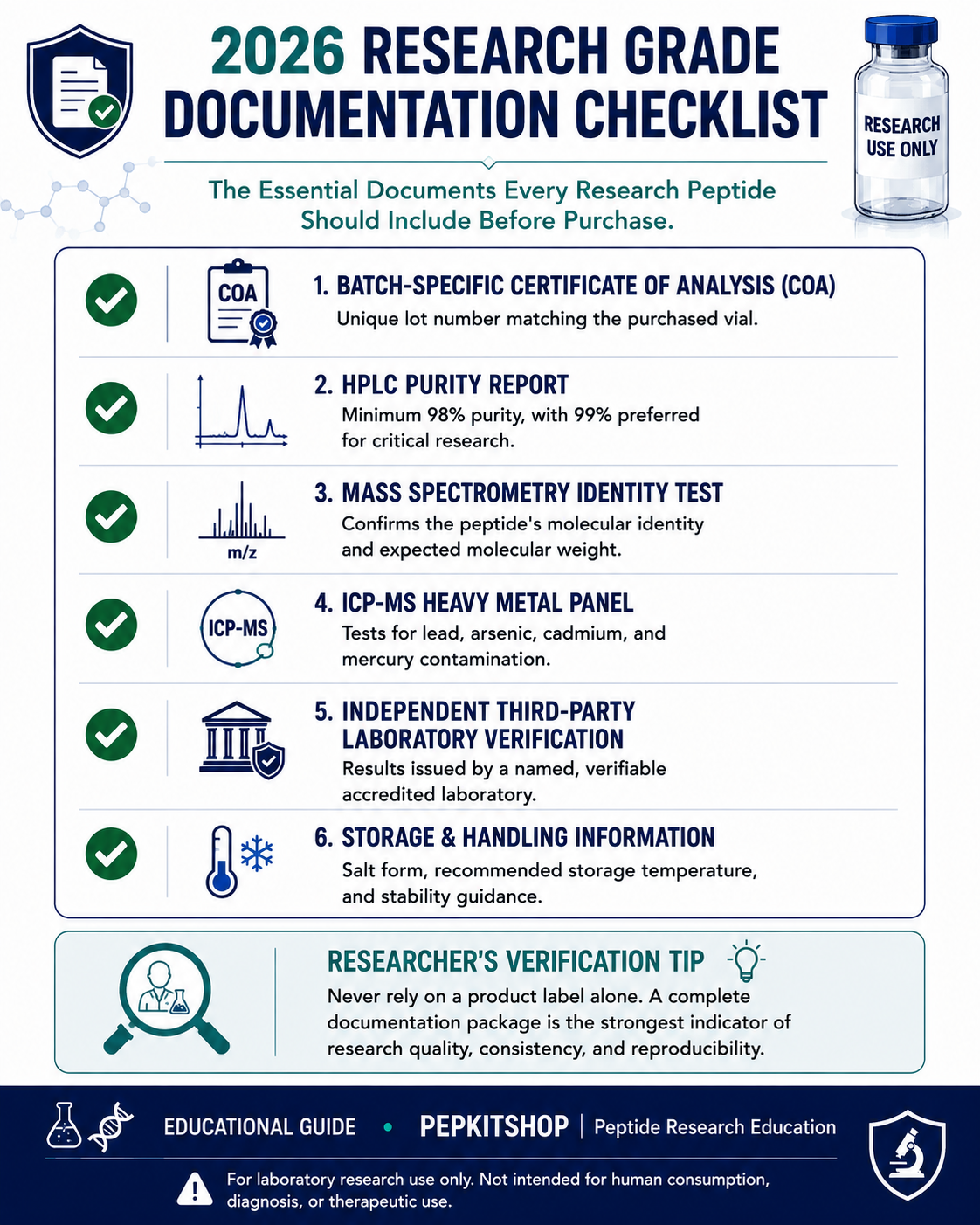
In 2026 a standard COA is no longer sufficient to meet modern compliance standards. To meet current standards, a COA must include: High Performance Liquid Chromatography to verify purity at 98% or higher, Mass Spectrometry to confirm molecular identity, and ICP-MS testing to verify heavy metal levels below detectable limits for lead, arsenic, cadmium, and mercury.
2026 Research Grade Documentation Standard
| Documentation Element | 2026 Standard | Previous Standard |
|---|---|---|
| HPLC purity | 99% preferred, 98% minimum | 95% minimum |
| Mass spectrometry identity | Required, batch specific | Recommended |
| ICP-MS heavy metal panel | Required for serious research | Rarely provided |
| Third party laboratory | Named, accredited, verifiable | Recommended |
| Batch specific lot number | Required | Common but not universal |
| Salt form specification | Required | Often omitted |
| Storage conditions | Required | Common |
The addition of ICP-MS heavy metal testing to the expected documentation standard is one of the most significant developments in what is a research grade peptide documentation in 2026. Heavy metal contamination can arise from synthesis raw materials, reaction vessels, and purification equipment. At research peptide scales, even trace contamination can represent biologically significant concentrations in experimental contexts.
One of the most significant developments in recent years is the application of GMP style quality principles to research grade peptide materials, even where work is strictly non-clinical. Although research grade peptides are not manufactured for therapeutic use, regulated laboratories increasingly expect suppliers to align with internationally recognized quality frameworks such as ICH Q7 and ICH Q11. These guidelines help ensure better control over starting materials, synthesis processes, and impurity profiles, which is particularly important for reproducibility.
What is a research grade peptide missing without ICP-MS testing?
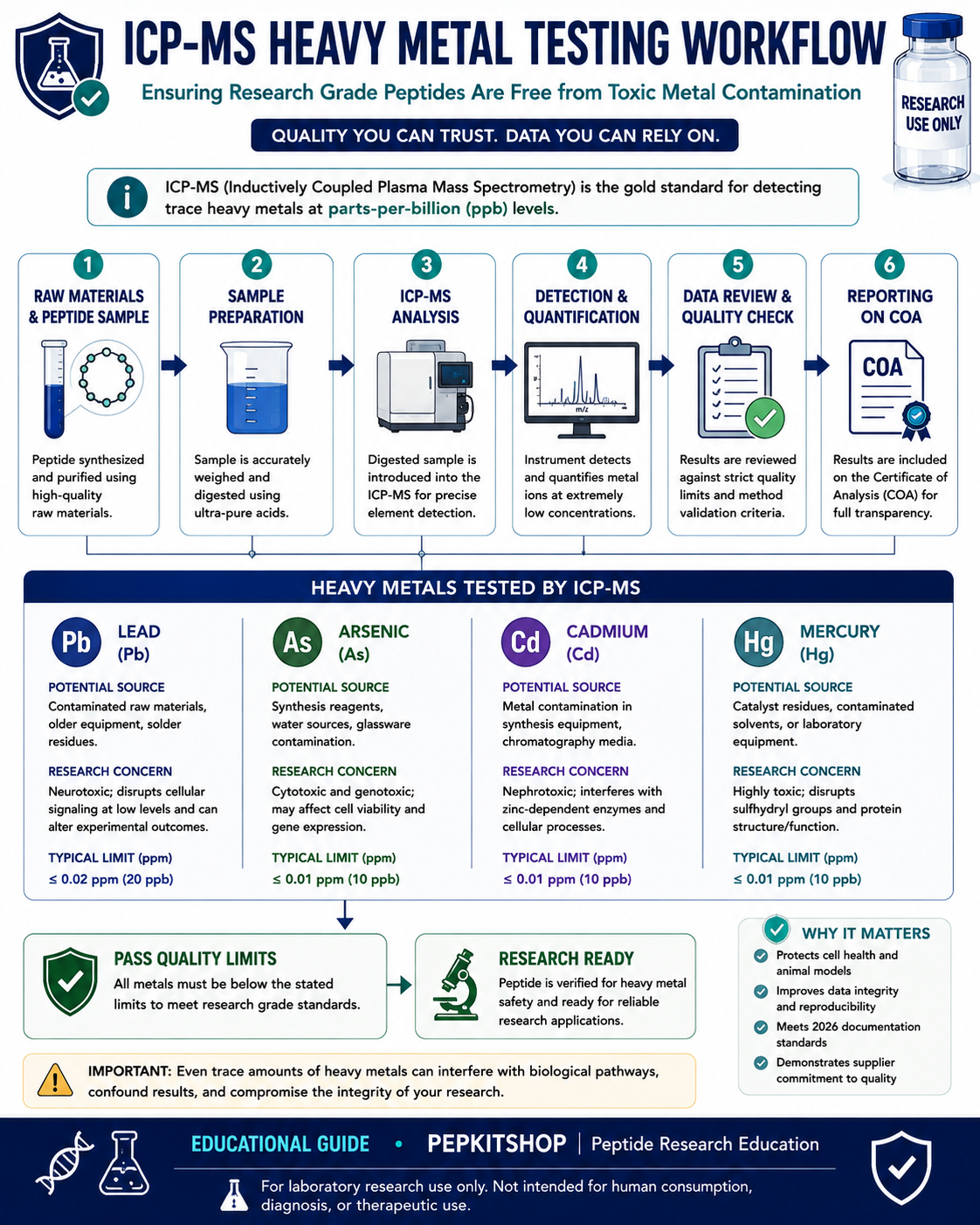
ICP-MS stands for Inductively Coupled Plasma Mass Spectrometry. It is the analytical method used to detect and quantify trace heavy metal contamination in chemical compounds.
Research grade peptides must undergo ICP-MS testing to ensure that levels of lead, arsenic, cadmium, and mercury are below detectable limits. Vendors who cannot provide these specific data points pose a significant risk to the integrity of any longitudinal study.
Heavy Metals Tested by ICP-MS and Their Research Relevance
| Heavy Metal | Source in Peptide Synthesis | Research Concern |
|---|---|---|
| Lead (Pb) | Contaminated raw materials, older equipment | Neurotoxic, disrupts cellular signaling at low concentrations |
| Arsenic (As) | Synthesis reagents, water sources | Cytotoxic, genotoxic, confounds cell viability assays |
| Cadmium (Cd) | Metal contamination in synthesis equipment | Nephrotoxic, disrupts zinc dependent enzyme systems |
| Mercury (Hg) | Catalyst residues, contaminated solvents | Highly toxic, disrupts sulfhydryl containing peptide structures |
The research relevance of heavy metal contamination extends beyond toxicity concerns to data integrity concerns. In cell based assays, even sub-toxic concentrations of heavy metals can alter cell behavior, enzyme activity, and signaling pathways in ways that confound experimental results. A researcher attributing an observed biological effect to the peptide compound when that effect is actually caused by trace cadmium or arsenic contamination would draw incorrect scientific conclusions.
This is precisely why what is a research grade peptide in 2026 increasingly requires ICP-MS documentation as part of the complete quality assurance package. A compound without this documentation has not been verified to be free from a category of contaminant that can directly affect research outcomes.
At Pepkitshop, ICP-MS heavy metal documentation is part of our complete quality package because we recognize that serious researchers need complete verification, not partial documentation.
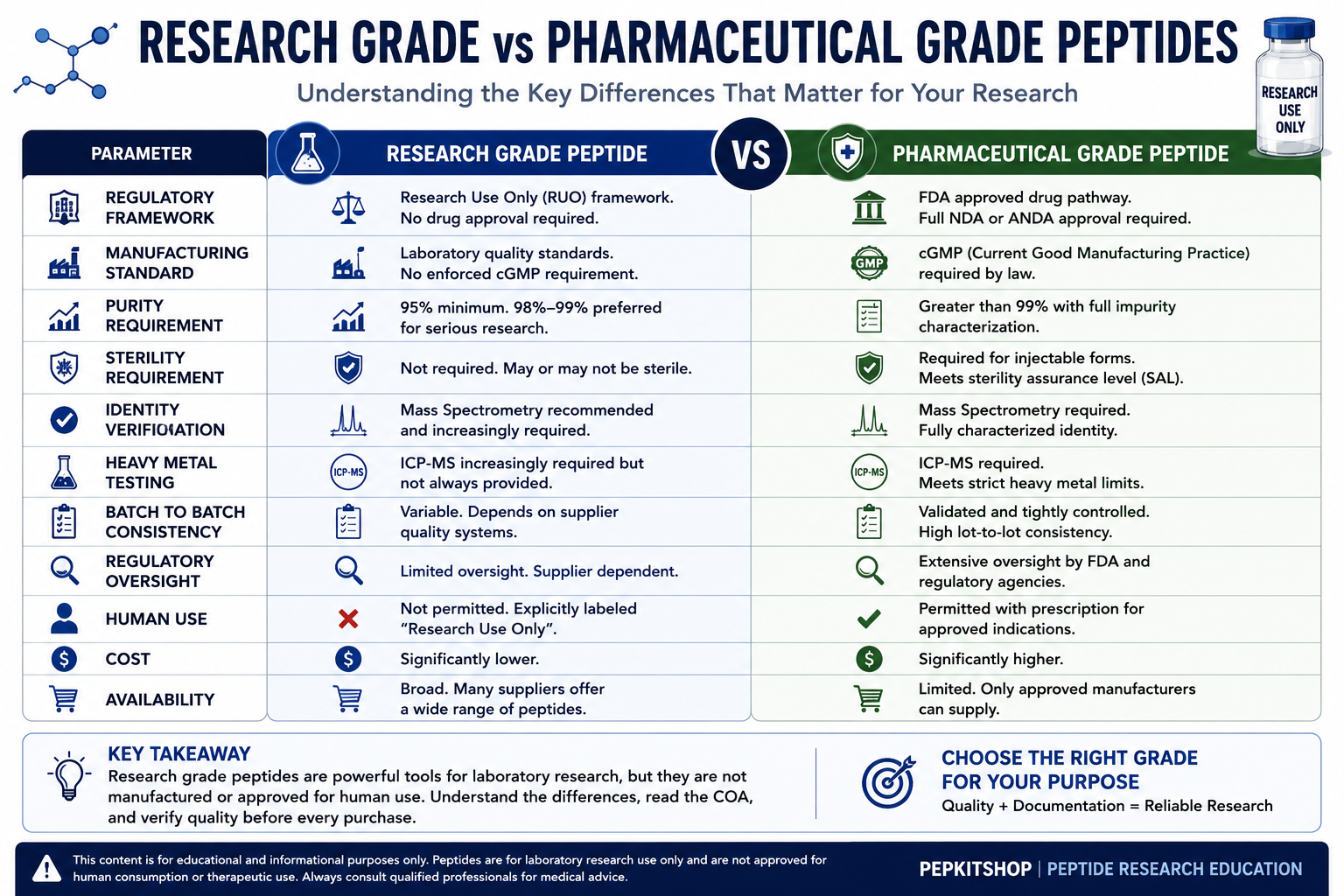
What is a research grade peptide compared to pharmaceutical grade is one of the most important distinctions in peptide science.
The label tells you what protections you are paying for or giving up. Pharmaceutical grade is the top of the ladder and the most clearly defined. A pharmaceutical grade product is an approved drug manufactured under Good Manufacturing Practice standards, with documented purity, sterility, potency, and consistency, and it has been through the regulatory approval process for human use. Sterility, consistency, and accountability guarantees built into regulated channels cannot be fully replaced by a purity test.
Research Grade vs Pharmaceutical Grade Complete Comparison
| Parameter | Research Grade | Pharmaceutical Grade |
|---|---|---|
| Regulatory framework | Research use only, no drug approval required | FDA approved drug pathway, full NDA or ANDA |
| Manufacturing standard | Laboratory quality, no enforced cGMP required | Current Good Manufacturing Practice required |
| Purity requirement | 95% minimum, 98 to 99% preferred | Greater than 99% with full impurity characterization |
| Sterility requirement | Not required | Required for injectable forms |
| Identity verification | MS recommended, increasingly required | Required, fully characterized |
| Heavy metal testing | ICP-MS increasingly required | Required |
| Batch to batch consistency | Variable, supplier dependent | Validated, controlled |
| Regulatory oversight | Limited | Extensive |
| Human use | ❌ Not permitted | ✅ With prescription for approved indications |
| Cost | Significantly lower | Significantly higher |
| Availability | Broad, multiple suppliers | Limited to approved manufacturers |
The gap between research grade and pharmaceutical grade is not paperwork. It is the difference between a product tested for what it contains and one that is not. The 2023 FDA Category 2 restrictions and the 2026 partial reversal illustrate the regulatory uncertainty in this space.
This honest characterization of the gap between research grade and pharmaceutical grade is important context for understanding what is a research grade peptide and what it is not. The lower cost and broader availability of research grade compounds reflect real differences in manufacturing oversight and quality guarantee, not just marketing positioning.
What is a research grade peptide in practical terms for a researcher making sourcing decisions in 2026?
From a functional perspective, research grade peptides are commonly grouped as tool peptides which are agonists, antagonists, enzyme substrates, inhibitors, and pathway mimetics used to dissect biological mechanisms; analytical and assay standards which are calibration materials and internal standards for mass spectrometry and chromatography; and materials and scaffolds which are self assembling peptides used in tissue engineering and drug delivery research.
For each of these functional uses, the quality of the compound directly affects the reliability of the research. Understanding what is a research grade peptide and demanding documentation that verifies the specific tier and complete quality profile is not optional for reproducible research.
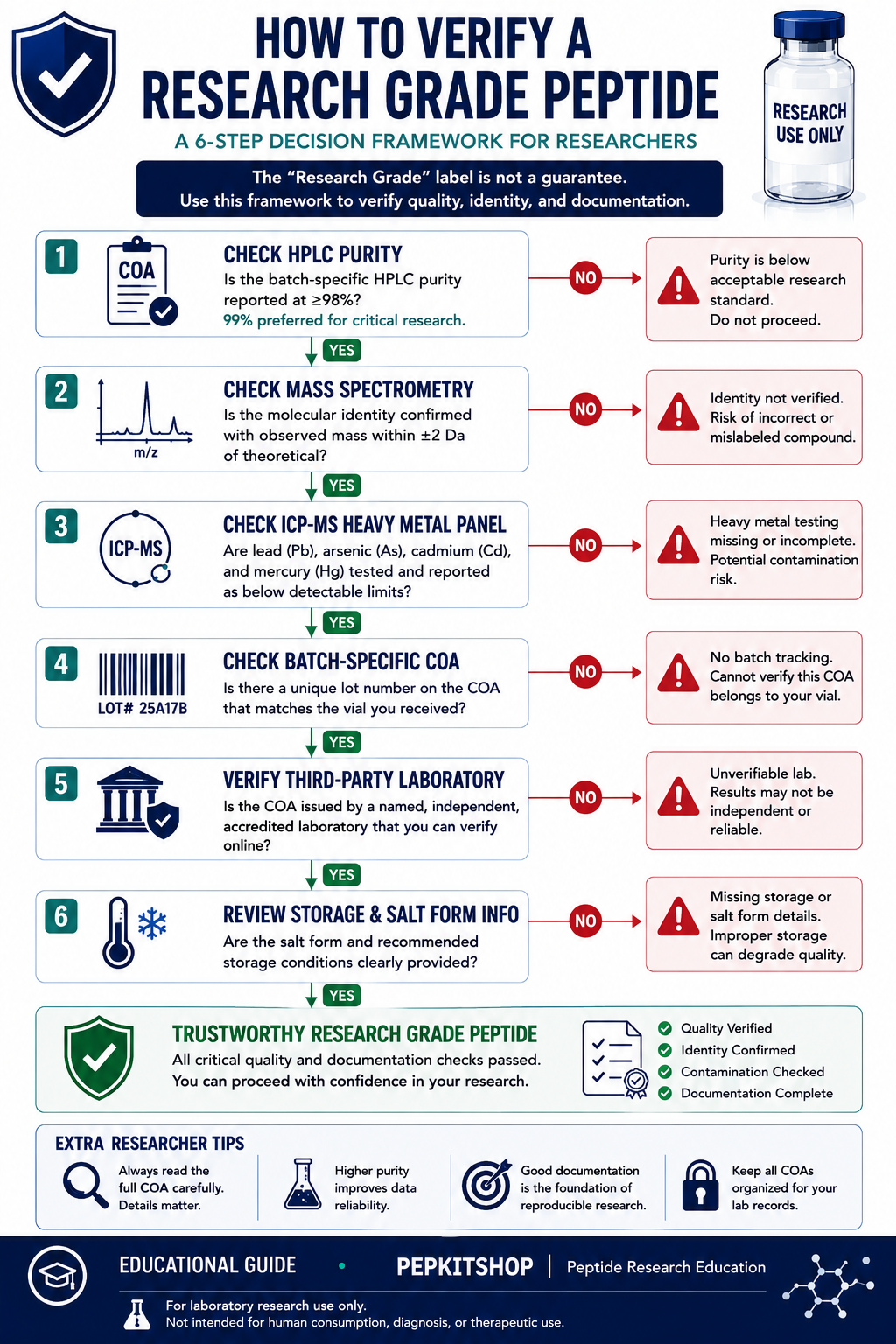
The practical sourcing guidance for 2026 is straightforward:
Demand batch specific COAs that include HPLC purity of 98% or higher, mass spectrometry identity confirmation, and ideally ICP-MS heavy metal panel data. As covered in our guide on [what makes a research peptide supplier trustworthy], verify the testing laboratory independently before placing an order.
Do not accept the research grade label as a quality guarantee. It describes the intended use context, not the actual quality level. The documentation verifies the quality. The label does not.
Understand that 95% purity compounds, while technically within a broad definition of research grade, are not appropriate for serious reproducible research applications. The 98% to 99% tier is the functional minimum for research where results will be interpreted, published, or used to make further scientific decisions.
More detail on current quality standards and regulatory requirements is available through National Library of Medicine and FDA official guidance.
What is a research grade peptide is a synthetic peptide compound produced for laboratory research use only, not approved for human administration, and supplied under a research use only designation. The quality within this category varies significantly between suppliers. The label itself does not guarantee any specific quality standard. Documentation from independent testing determines actual quality.
What is a research grade peptide purity requirement has three tiers. Standard grade is 95% or higher, suitable only for preliminary work. Premium grade is 98% or higher, the accepted minimum for reproducible research. Ultra pure grade is 99% or higher, preferred for quantitative and publication grade research. The June 2026 EMA guideline established 99% or higher as the recommended standard.
What is a research grade peptide differs from pharmaceutical grade across several dimensions. Pharmaceutical grade is manufactured under cGMP, requires greater than 99% purity with full impurity characterization, must meet sterility requirements for injectable forms, and has gone through regulatory approval for human use. Research grade has no enforced manufacturing standard, typically reaches 95 to 99% purity, has no sterility requirement, and is not approved for human use.
ICP-MS is Inductively Coupled Plasma Mass Spectrometry, the method used to detect trace heavy metal contamination including lead, arsenic, cadmium, and mercury. What is a research grade peptide without ICP-MS documentation is a compound that has not been verified to be free from heavy metal contamination that can confound cell based and animal research results. In 2026, ICP-MS documentation is increasingly required as part of complete research grade quality assurance.
No. What is a research grade peptide designates a compound for laboratory research only. These compounds have not been evaluated for human safety through clinical trials, are not manufactured under pharmaceutical cGMP standards, may not be sterile, and carry explicit research use only designations that indicate they are not approved for human administration. More detail on the regulatory framework is available in our guide on [what does research use only mean].
What is a research grade peptide expected to have in 2026 includes a batch specific COA with HPLC purity of 98% or higher at minimum, mass spectrometry identity confirmation with observed mass within 2 daltons of theoretical, ICP-MS heavy metal panel showing lead, arsenic, cadmium, and mercury below detectable limits, and documentation from a named, independently verifiable third party laboratory.
This post is part of a growing educational library on research peptide quality and sourcing. Related reading:
Subscribe for updates as this educational library continues to grow, evidence based peptide research guidance explained clearly and practically.
This content is for educational and informational purposes only. It does not constitute medical advice, diagnosis, or treatment recommendations. Research peptides are for laboratory use only and are not approved for human consumption or therapeutic use. Always consult a qualified healthcare professional before making any decisions related to your health.
10-vial kits • Capsule packs as listed • Research use only
© 2026 Pepkitshop. All rights reserved.
Vial product prices are per kit of 10 vials. Quantity 1 = 10 vials. Capsule products retain the pack size stated on their listing.
All products are supplied strictly for laboratory research. They are not intended for human or veterinary use, consumption, diagnosis, or treatment.
WhatsApp us
 Optimized by Seraphinite Accelerator
