Vial products: price per kit of 10 vials. Quantity 1 = 10 vials. Capsule products are priced per capsule pack as listed. Dismiss
By Pepkitshop | Peptide Coach and Educator
Updated July 2026 | Educational Content, Not Medical Advice
How to store research peptides properly is one of the most practical and most frequently misunderstood aspects of working with research compounds.
A peptide that arrives with verified 99% purity, documented by a legitimate third party Certificate of Analysis, can be rendered unreliable or completely unusable within days if stored incorrectly. The compound itself has not changed. The documentation is still accurate. But the handling conditions between the vial arriving and being used in research have allowed degradation to occur that makes the compound unreliable for reproducible results.
Understanding how to store research peptides correctly protects both the research investment and the integrity of the data produced from that investment. This is not a minor procedural detail. Storage is one of the most significant variables determining whether a research peptide performs as documented in published literature.
This guide covers how to store research peptides at every stage, from arrival of a lyophilized vial through reconstitution and multi-session use, including the specific rules for temperature, light, humidity, and freeze thaw management that the 2026 stability literature supports.
How to store research peptides is not separate from the question of compound quality. They are the same question.
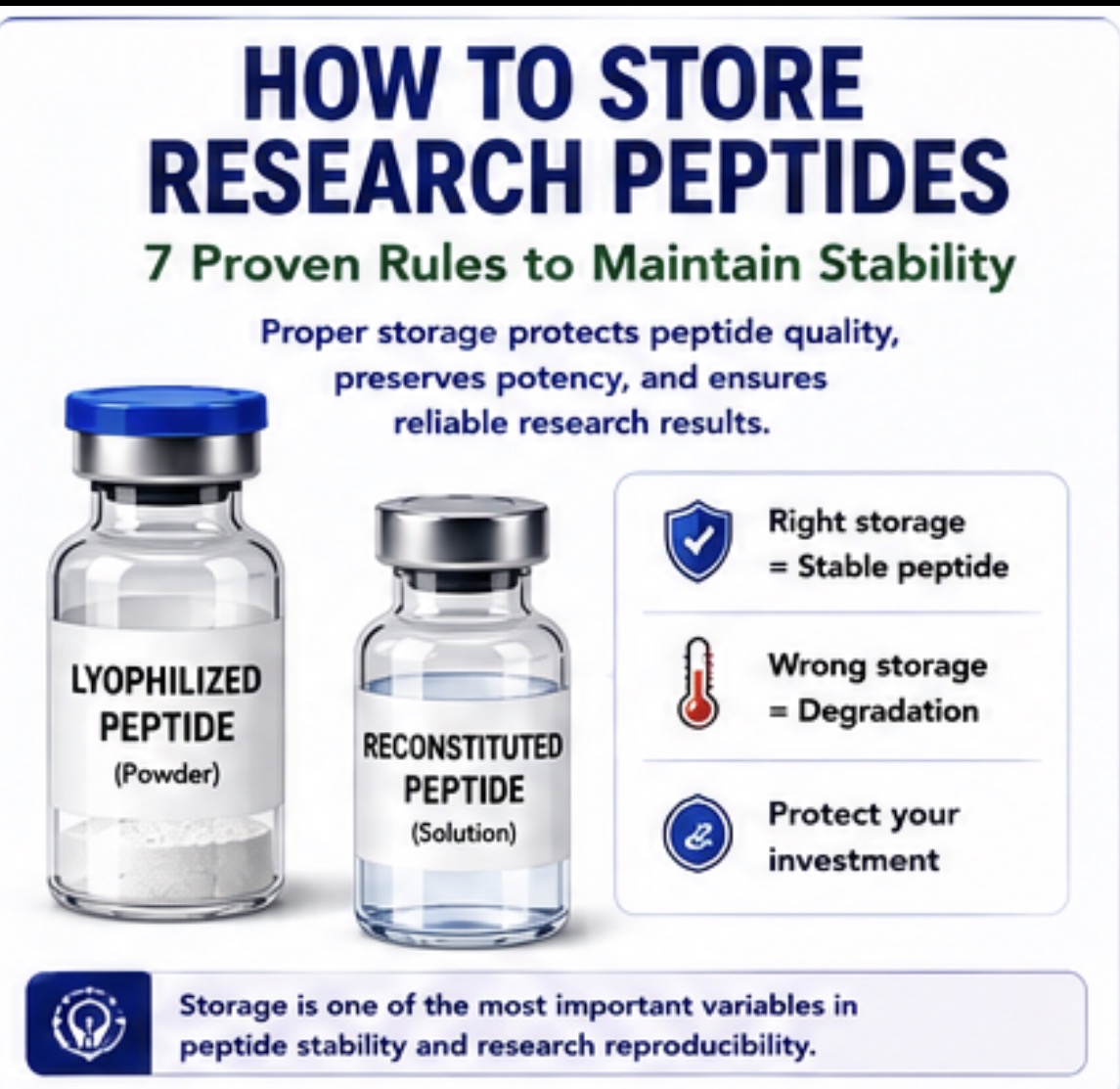
Peptide degradation does not announce itself. A solution can look perfectly clear while losing 30 to 40 percent of its active content to oxidation or aggregation. The research literature on peptide formulation stability is clear: storage conditions matter enormously, and the mistakes researchers make most often are entirely avoidable.
Proper storage is the single most important factor in maintaining the integrity of research peptides between synthesis and experimental use. A compound that was manufactured at 99% or higher purity can degrade to unusable levels within days if stored incorrectly, while the same compound stored properly can remain stable for months or even years.
This reality has direct implications for how to store research peptides in practice. The purity percentage on a Certificate of Analysis, as covered in our guide on [peptide purity], reflects what was measured at time of testing after synthesis. It does not guarantee what will be in the vial when you reconstitute it three months later. That outcome is determined by how the compound has been stored.
Three degradation pathways are most relevant to understanding how to store research peptides:
Hydrolysis — water molecules cleave peptide bonds, progressively fragmenting the amino acid chain into shorter, incorrect sequences. This is why dry storage is so critical for lyophilized peptides.
Oxidation — oxygen reacts with specific amino acid side chains, altering the chemical properties of the peptide. Certain amino acids including cysteine, methionine, and tryptophan are particularly vulnerable.
Aggregation — peptide molecules clump together into larger structures through hydrophobic interactions or disulfide bond formation. Aggregated peptides cannot interact normally with their target receptors and produce unreliable research results.
How to store research peptides depends first on which state the peptide is in. The storage requirements are fundamentally different between lyophilized powder and reconstituted solution.
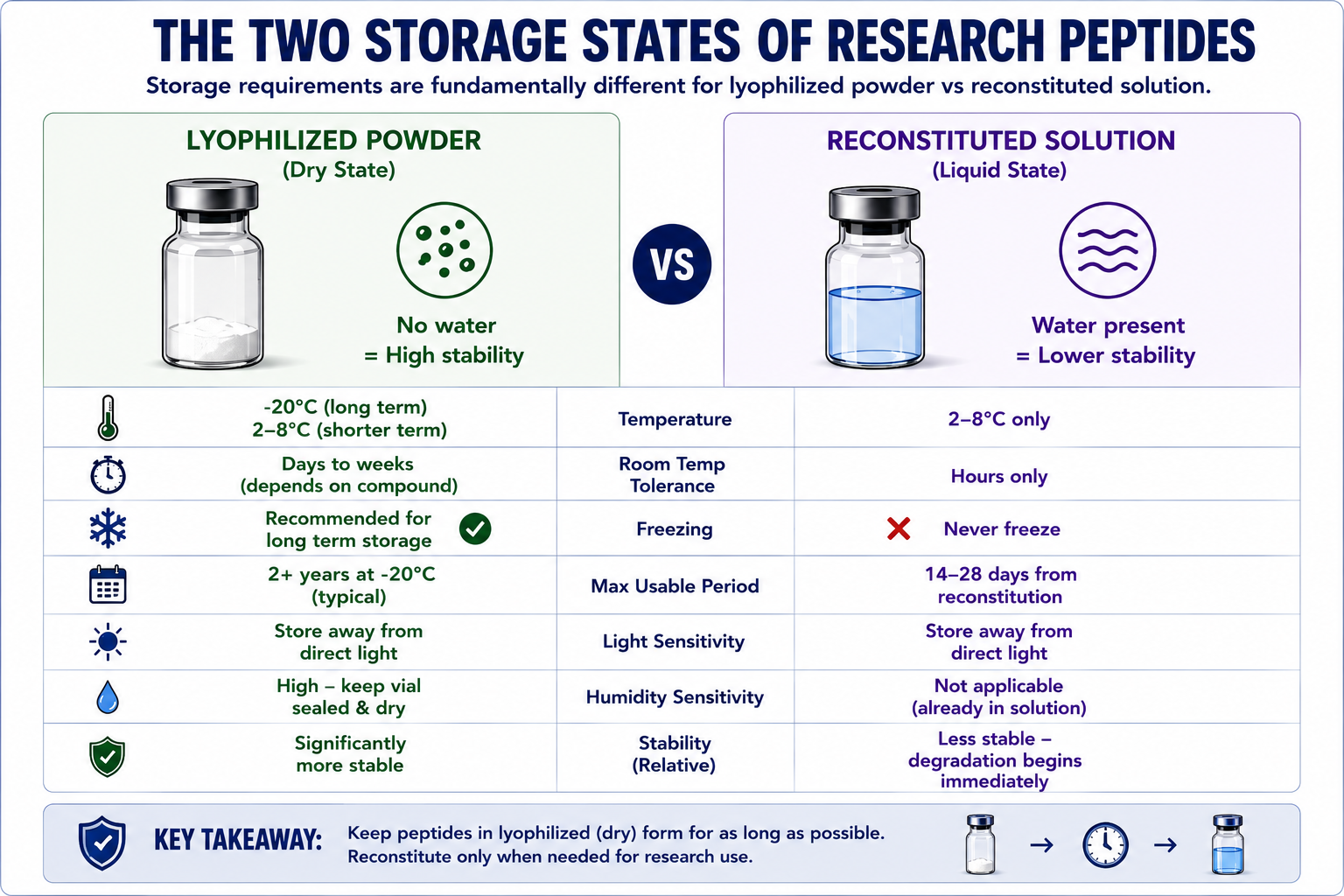
Lyophilized vs Reconstituted Storage Requirements
| Parameter | Lyophilized Powder | Reconstituted Solution |
|---|---|---|
| Primary temperature | Minus 20 degrees C (long term), 2 to 8 degrees C (shorter term) | 2 to 8 degrees C only |
| Room temperature tolerance | Days to weeks depending on compound | Hours only |
| Freezing | ✅ Recommended for long term storage | ❌ Never freeze reconstituted peptides |
| Maximum usable period | 2 or more years at minus 20 degrees C | 14 to 28 days from reconstitution |
| Light sensitivity | Store away from direct light | Store away from direct light |
| Humidity sensitivity | High, keep vial sealed and dry | Not applicable, already in solution |
| Stability relative to each other | Significantly more stable | Less stable, degradation begins immediately |
Understanding this fundamental difference is the starting point for knowing how to store research peptides correctly. As covered in our guide on [lyophilization], the freeze drying process exists precisely because peptides in liquid solution are inherently unstable. The lyophilized state removes the water that drives degradation, dramatically extending compound life. Reconstitution reintroduces water and restarts the degradation clock.
The practical implication is that lyophilized peptides should remain in their dry state for as long as possible and be reconstituted only when needed for research use.
How to store research peptides in their lyophilized form follows a tiered approach based on when you plan to use the compound.
Lyophilized freeze-dried research peptides are stable at room temperature for weeks and survive standard shipping without degradation. Long term storage of unreconstituted vials is at minus 20 degrees C.
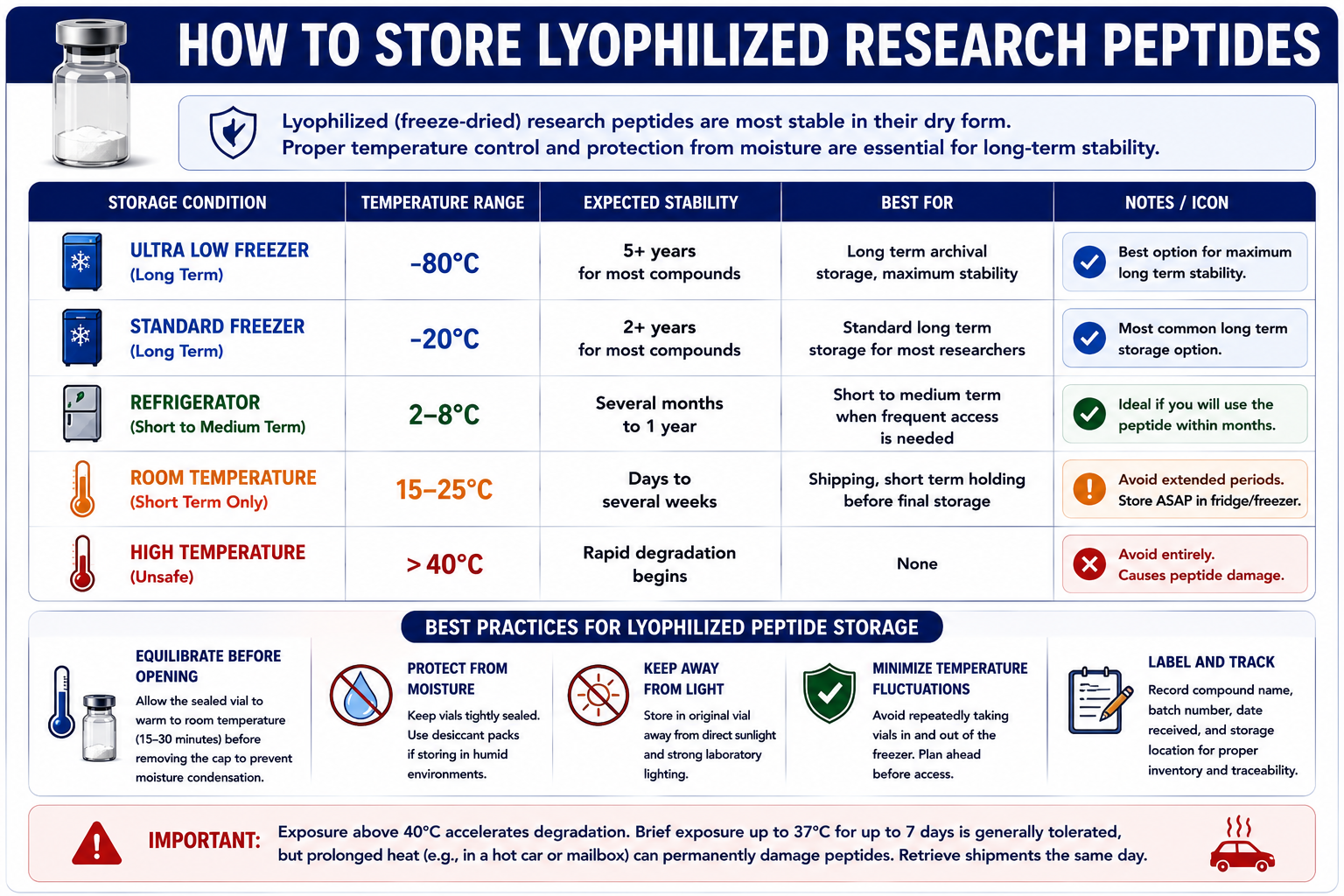
Lyophilized Peptide Storage Temperature Guide
| Storage Condition | Expected Stability | Best For |
|---|---|---|
| Minus 80 degrees C (ultra low freezer) | 5 or more years for most compounds | Long term archival storage, maximum stability |
| Minus 20 degrees C (standard freezer) | 2 or more years for most compounds | Standard long term storage for most researchers |
| 2 to 8 degrees C (refrigerator) | Several months to 1 year | Short to medium term when frequent access needed |
| Room temperature (15 to 25 degrees C) | Days to several weeks | Shipping, short term holding before storage |
| Above 40 degrees C | Rapid degradation begins | Avoid entirely |
How to store research peptides after reconstitution with [bacteriostatic water] follows strict rules that differ significantly from lyophilized storage.
Reconstituted peptides must be refrigerated at 2 to 8 degrees C and used within 28 days. Never freeze reconstituted peptides. The freeze thaw cycle damages the amino acid chain and reduces potency.
Reconstituted Peptide Storage Protocol
| Rule | Requirement | Consequence of Violation |
|---|---|---|
| Temperature | 2 to 8 degrees C immediately after reconstitution | Accelerated degradation at higher temperatures |
| Freezing | Never freeze reconstituted peptide | Ice crystal formation damages molecular structure |
| Location in refrigerator | Main compartment, not door or back wall | Door fluctuates in temperature, back wall may freeze |
| Light protection | Keep away from light sources | UV and visible light degrade peptide bonds |
| Usable window | 14 to 28 days from reconstitution date | Beyond this benzyl alcohol preservation reliability declines |
| Labeling | Date, compound name, concentration, operator | Unlabeled vials outlast their window without anyone realizing |
| Visual inspection | Check for cloudiness or particulates before each use | Turbid solution indicates contamination or degradation |
Store the reconstituted vial in the main compartment of the refrigerator, not the door which has temperature fluctuations, and not the back wall where there is risk of freezing in some refrigerators.
The prohibition on freezing reconstituted peptides is one of the most important rules in how to store research peptides and one of the most commonly violated. The reasoning is straightforward. When a peptide solution freezes, ice crystals form within the liquid. These crystals create physical stress on the peptide molecular structure and disrupt the solvent environment in ways that promote aggregation and denaturation. When the solution thaws, the damage is irreversible. The compound may still appear visually identical, but its research reliability has been compromised.
Repeated freeze thaw cycles are deleterious to peptides. If a protocol will use the same reconstituted material across multiple time points, many labs keep preserved working vials at 2 to 8 degrees C for days to a few weeks, while frozen single-use aliquots of lyophilized powder can extend usable research handling by reducing repeated warming and puncture events.
The correct approach for researchers who need to work with a compound across multiple sessions over an extended period is to aliquot the lyophilized powder into smaller vials before reconstituting anything. Then reconstitute each aliquot only when that session’s work begins. This preserves the most stable form, the dry powder, for as long as possible.
How to store research peptides requires understanding the four specific environmental factors that drive degradation.
The 4 Enemies of Peptide Stability
| Enemy | Effect on Peptide | Defense |
|---|---|---|
| Heat | Accelerates all degradation pathways, particularly hydrolysis and aggregation | Store at appropriate low temperature at all times |
| Light | UV and visible light energy breaks chemical bonds in peptide structures | Store in original vials away from direct light, use amber vials for sensitive compounds |
| Moisture and humidity | Water initiates hydrolysis and promotes microbial growth in lyophilized powder | Keep vials sealed, equilibrate to room temperature before opening, use desiccants if storing in humid environments |
| Oxygen | Drives oxidation of vulnerable amino acid residues including cysteine, methionine, tryptophan | Minimize air exposure, consider nitrogen purging for oxidation-sensitive sequences |
Humidity is the silent killer of lyophilized peptides. Once moisture enters the vial from repeatedly piercing the stopper with a needle, the powder begins absorbing water and degradation accelerates significantly.
Heat is the most controllable variable and the one with the most clearly documented effects. Every 10 degree Celsius increase in storage temperature approximately doubles the rate of most chemical degradation reactions. Moving a peptide from minus 20 degrees C storage to room temperature does not simply reduce stability. It increases the degradation rate by many orders of magnitude.
Light is the most overlooked enemy of how to store research peptides. Research peptides are typically supplied in clear glass or plastic vials that provide no light protection. Storing these vials in a drawer or refrigerator with the door closed provides adequate protection for most compounds. Prolonged exposure to direct sunlight or laboratory bench illumination is sufficient to cause measurable degradation in sensitive peptide sequences.
Peptide sequences containing cysteine, methionine, or tryptophan residues are prone to air oxidation. All cysteine containing peptides will slowly oxidize with time, the rate of which is largely dependent on the sequence and storage conditions. It is recommended to purge the air out of the vial and replace it with a blanket of nitrogen or argon for oxidation sensitive sequences.
How to store research peptides varies depending on which amino acids are present in the compound sequence.
Sequence Specific Storage Risk Table
| Amino Acid | Degradation Risk | Additional Storage Precaution |
|---|---|---|
| Cysteine (C) | High oxidation risk, disulfide bond formation | Store under nitrogen or argon atmosphere, minimize oxygen exposure |
| Methionine (M) | Moderate to high oxidation risk | Minimize oxygen exposure, consider antioxidant buffers in solution |
| Tryptophan (W) | Moderate oxidation and light sensitivity | Protect from light, minimize oxygen exposure |
| Asparagine (N) | Deamidation risk, particularly in solution | Avoid alkaline pH, use acidic buffer if storing in solution |
| Glutamine (Q) | Deamidation risk in solution | Avoid alkaline pH |
| Aspartate (D) and Glutamate (E) | Moisture absorption, deliquescence | Store in desiccator, keep vial tightly sealed |
| Lysine (K), Arginine (R), Histidine (H) | Moisture absorption | Store in desiccator in humid environments |
Most lyophilized peptides are stable for several years under proper conditions. However, certain amino acid residues in peptide sequences can reduce long term stability. Peptides containing cysteine, methionine, or tryptophan residues are prone to oxidation and require storage under anaerobic conditions to maintain stability. Peptides containing aspartate, glutamate, lysine, arginine, or histidine are prone to moisture absorption from the air, called deliquescence. These peptides should be stored in a desiccator in a tightly capped vial.
Understanding the amino acid composition of the specific compound you are working with allows you to apply targeted storage precautions rather than generic protocols. The sequence specific vulnerabilities above represent areas where standard storage conditions may be insufficient and additional precautions improve compound longevity.
How to store research peptides in a single practical framework:
The 7 Proven Storage Rules
| Rule | For Lyophilized Peptides | For Reconstituted Peptides |
|---|---|---|
| Rule 1: Temperature | Minus 20 degrees C for long term, 2 to 8 degrees C for short term | 2 to 8 degrees C only, never freeze |
| Rule 2: Light | Away from direct light sources | Away from direct light sources |
| Rule 3: Moisture | Keep sealed, equilibrate before opening | Not applicable, already in solution |
| Rule 4: Oxygen | Minimize exposure for oxidation sensitive sequences | Minimize headspace in vial between draws |
| Rule 5: Freeze thaw | Minimize cycles for lyophilized, avoid entirely for reconstituted | Never freeze reconstituted peptides |
| Rule 6: Labeling | Label with compound name and date received | Label with compound name, concentration, reconstitution date |
| Rule 7: Time limits | Follow manufacturer guidance, typically 2 or more years at minus 20 degrees C | 14 to 28 days maximum from reconstitution |
How to store research peptides starting from the moment of delivery:
Step 1: Inspect the packaging immediately
Check that vials arrived sealed and intact. Note the appearance of the lyophilized powder: white or off-white powder or cake is expected. Any discoloration or unusual appearance should be documented.
Step 2: Do not open the vials
Lyophilized peptides do not need to be opened for inspection. Opening exposes the powder to atmospheric moisture unnecessarily.
Step 3: Verify your COA
Cross reference the batch number on the vials against your Certificate of Analysis as described in our guide on [how to read a peptide certificate of analysis]. Confirm the documentation matches what arrived.
Step 4: Transfer to appropriate storage immediately
If you plan to use the compound within the next several weeks, refrigerate at 2 to 8 degrees C. If you will not use it for months, transfer to minus 20 degrees C storage immediately.
Step 5: Record receipt in your research documentation
Note the compound name, batch number, receipt date, and storage location. This documentation is important for research reproducibility and for tracking compound age.
Step 6: Do not reconstitute until needed
How to store research peptides for maximum longevity means keeping them in lyophilized form until the moment research use begins. Do not reconstitute in advance of need.
After reconstitution, label the vial with compound, solvent, concentration, date, and operator, then return it to 2 to 8 degrees C storage promptly unless the protocol calls for immediate aliquoting and freezing of the lyophilized stock. Keep the container upright, closed, and protected from light between withdrawals.
How to store research peptides immediately after purchase depends on your planned use timeline. For use within weeks, refrigerate lyophilized vials at 2 to 8 degrees C. For use months later, store at minus 20 degrees C. Do not reconstitute until you are ready to begin research use.
How to store research peptides after reconstitution with bacteriostatic water is at 2 to 8 degrees C in a refrigerator. Never freeze reconstituted peptides. Label with reconstitution date and use within 14 to 28 days.
How to store research peptides at room temperature is acceptable for lyophilized compounds only for short periods, typically days to a maximum of several weeks depending on the compound. Room temperature storage is never appropriate for reconstituted peptide solutions, which degrade rapidly above 8 degrees C.
How to store research peptides at minus 20 degrees C extends stability to 2 or more years for most compounds. At 2 to 8 degrees C, most lyophilized peptides remain stable for several months to one year. At room temperature, stability is limited to days or weeks. Sequence specific factors can shorten these windows for vulnerable amino acid sequences.
How to store research peptides in reconstituted form excludes freezing because ice crystal formation during freezing creates physical stress on the peptide molecular structure and disrupts the solvent environment in ways that promote aggregation and denaturation. The resulting compound may appear identical visually but its research reliability is compromised.
Visual indicators of degradation include cloudiness in reconstituted solutions, visible particulate matter, unexpected color changes, or oily separation in the solution. However, as the 2026 stability literature confirms, a solution can lose 30 to 40 percent of its active content through oxidation or aggregation while appearing completely clear. Visual inspection alone is not sufficient to confirm compound integrity after extended storage.
How to store research peptides with cysteine residues requires additional precautions beyond standard temperature and light management. Cysteine is highly susceptible to oxidation and disulfide bond formation. These compounds should be stored under reduced oxygen conditions, ideally by purging vial headspace with nitrogen or argon before sealing. More detail is available through the National Library of Medicine.
This post is part of a growing educational library on research peptide handling and quality practice. Related reading:
Subscribe for updates as this educational library continues to grow, evidence based peptide research guidance explained clearly and practically.
This content is for educational and informational purposes only. It does not constitute medical advice, diagnosis, or treatment recommendations. Research peptides are for laboratory use only and are not approved for human consumption or therapeutic use. Always consult a qualified healthcare professional before making any decisions related to your health.
10-vial kits • Capsule packs as listed • Research use only
© 2026 Pepkitshop. All rights reserved.
Vial product prices are per kit of 10 vials. Quantity 1 = 10 vials. Capsule products retain the pack size stated on their listing.
All products are supplied strictly for laboratory research. They are not intended for human or veterinary use, consumption, diagnosis, or treatment.
WhatsApp us

