Vial products: price per kit of 10 vials. Quantity 1 = 10 vials. Capsule products are priced per capsule pack as listed. Dismiss
By Pepkitshop | Peptide Coach and Educator
Updated July 2026 | Educational Content, Not Medical Advice
What is bacteriostatic water and why does it matter so much for research peptide reconstitution?
If you have ever purchased a lyophilized research peptide, you have encountered this question. The vial arrives containing a fine white powder. Before that powder can be used in any research context it must be dissolved into a liquid solution. The solvent you choose for that dissolution determines whether your reconstituted compound remains stable and uncontaminated across multiple uses, or degrades rapidly and becomes unreliable.
What is bacteriostatic water is the answer to that solvent question for the vast majority of research peptide applications. It is the standard diluent used in research laboratories worldwide for reconstituting lyophilized peptides, and understanding what it is, how it differs from alternatives, and how to use it correctly is a fundamental part of working with research compounds responsibly.
This guide explains what is bacteriostatic water completely, from its precise chemical composition through the science of benzyl alcohol preservation, a complete comparison with alternative solvents, a step by step reconstitution protocol, storage requirements, and the most common errors researchers make.
If you are not yet familiar with lyophilization and why research peptides come as freeze-dried powder, read our guide on [lyophilization] first. Understanding why the powder form exists makes the reconstitution process significantly clearer.
What is bacteriostatic water in precise scientific terms?
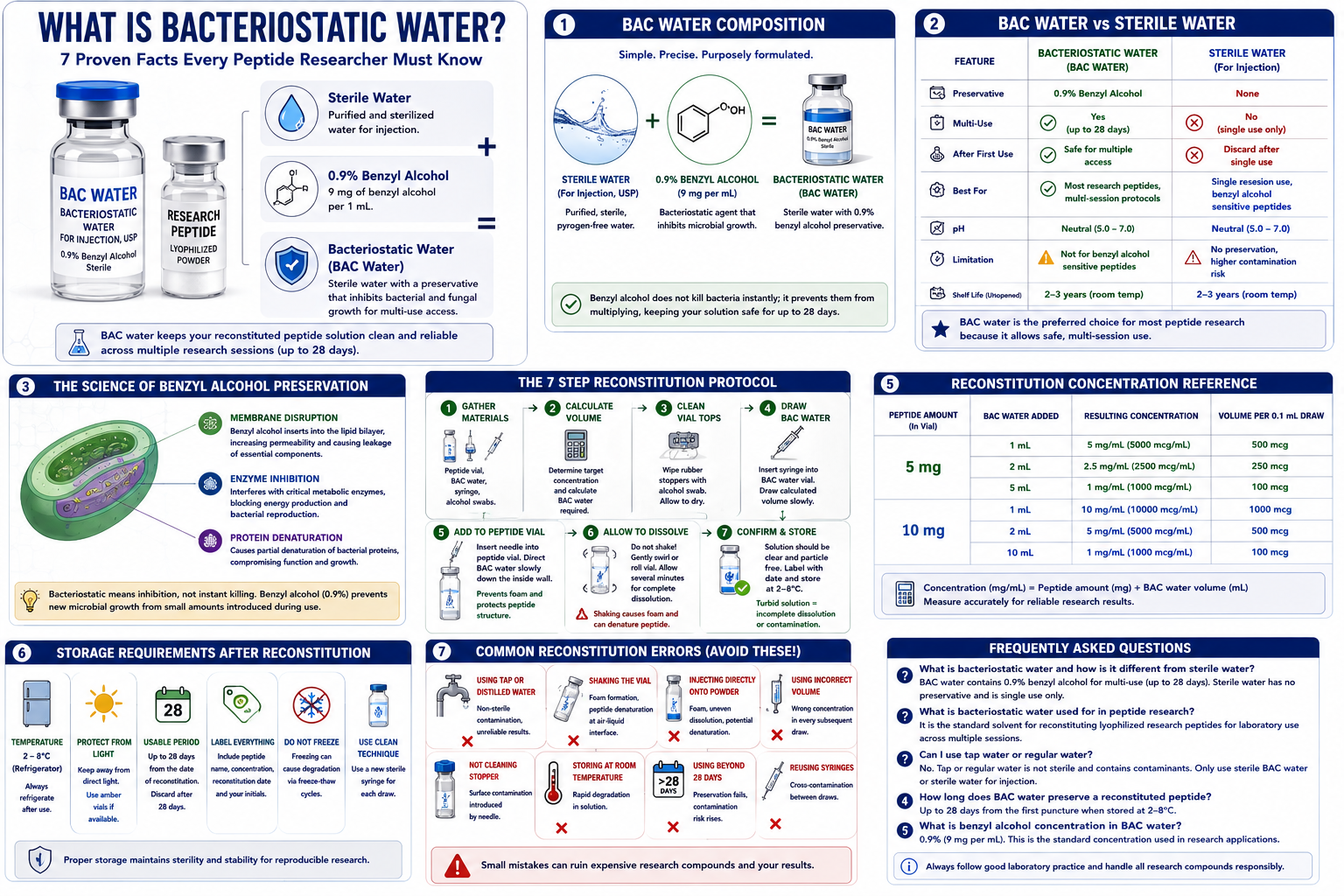
Bacteriostatic water, commonly abbreviated as BAC water, is sterile water that contains 0.9% benzyl alcohol as a bacteriostatic preservative. The United States Pharmacopeia defines bacteriostatic water for injection USP as water that has been sterilized and contains one or more suitable bacteriostatic agents. The most common formulation, and the one used in virtually all research applications, uses benzyl alcohol at a concentration of 0.9%, equal to 9 mg per mL, as the preservative agent.
In everyday terms, what is bacteriostatic water is sterile water with one critically important addition: a small amount of benzyl alcohol that prevents bacteria from growing in the solution after the vial has been opened.
The benzyl alcohol does one job. It inhibits the growth of most bacteria and fungi. Bacteriostatic means it holds microbial growth in check rather than killing on contact. The practical consequence is that a vial can be entered more than once over a period of weeks without the solution immediately becoming a culture medium, which is exactly what multi-session research handling requires. Plain sterile water has no preservative, so once its seal is broken it is effectively single use.
What is bacteriostatic water doing in practice? It is solving the contamination problem that arises from the fundamental reality of peptide research. A researcher reconstitutes a vial of lyophilized peptide on day one. They draw a small amount for their first experimental session. They need to return to that vial on day three, day seven, day fourteen. Every time a needle enters a vial, there is a small but real risk of introducing microorganisms. Without a preservative in the solvent, even a small contamination in an early draw can result in a growing microbial culture that renders the entire vial unusable.
Bacteriostatic water prevents this. The benzyl alcohol maintains an environment in which bacteria cannot proliferate across the multi-session use that research protocols require.
What is bacteriostatic water solving specifically in the context of research peptides?
Research peptides are supplied as lyophilized powder for a reason. They are far more stable as dry powder than in solution. Once you add liquid, the clock starts ticking on degradation. Using bacteriostatic water does not stop degradation entirely, but it prevents the additional variable of bacterial contamination from confounding your results.
As covered in our guide on [lyophilization], research peptides are freeze-dried precisely because peptides in liquid solution are inherently unstable. Water promotes hydrolysis, oxidation, and deamidation of peptide bonds. The lyophilized powder form dramatically extends storage stability.
But at some point the powder must become a solution. That is when bacteriostatic water becomes essential.
Three specific problems arise when the wrong solvent is used for peptide reconstitution:
Problem 1: Bacterial Contamination
Without a bacteriostatic preservative, any microorganism introduced during needle puncture can multiply rapidly in the liquid environment. Contaminated peptide solutions produce unreliable research results and cannot be used safely in any research context.
Problem 2: Compound Degradation
Some solvents interact chemically with peptide structures, accelerating the hydrolysis and oxidation processes that degrade the compound. The benzyl alcohol in bacteriostatic water does not interact with peptide bonds and is chemically compatible with the vast majority of research peptide structures.
Problem 3: pH Instability
Most research peptides have optimal stability within specific pH ranges. Bacteriostatic water maintains a neutral pH that is appropriate for the majority of peptide compounds. Some alternative solvents can shift pH in ways that accelerate degradation.
Bacteriostatic water differs from sterile water as its benzyl alcohol component allows a single vial to be accessed multiple times over a 28 day period without compromising sterility, while sterile water must be discarded after a single use. This multi-access capability makes bacteriostatic water the preferred reconstitution solvent in peptide research settings where small aliquots are drawn across several laboratory sessions.
What is bacteriostatic water preservative mechanism at the molecular level?
Benzyl alcohol is an aromatic alcohol with the molecular formula C7H8O. At the 0.9% concentration used in bacteriostatic water, it functions through several mechanisms to inhibit microbial growth.
Membrane Disruption
Benzyl alcohol disrupts the integrity of bacterial cell membranes by intercalating into the lipid bilayer. This disruption increases membrane permeability, allowing essential cellular components to leak out and preventing normal membrane function. The result is inhibition of bacterial growth and reproduction.
Enzyme Inhibition
Benzyl alcohol interferes with enzyme systems critical to bacterial metabolism. By disrupting key metabolic processes, it prevents bacteria from generating the energy and molecular building blocks needed for reproduction.
Protein Denaturation
At the concentrations used in bacteriostatic water, benzyl alcohol can cause partial denaturation of bacterial proteins, further compromising cellular function without affecting the more stable peptide structures of the research compound being reconstituted.
Importantly, what is bacteriostatic water mechanism is inhibitory rather than lethal. Benzyl alcohol at 0.9% does not kill bacteria already present in significant numbers. It prevents new bacterial growth from the small inoculum that might enter through needle puncture. This is why the starting conditions of reconstitution matter: the water must be sterile, the vial environment must be clean, and needle technique must minimize contamination risk.
What is bacteriostatic water compared to the other solvents that might be considered for peptide reconstitution?
Reconstitution Solvent Comparison Table
| Solvent | Preservative | Multi-Use? | pH | Best For | Limitations |
|---|---|---|---|---|---|
| Bacteriostatic water (BAC water) | 0.9% benzyl alcohol | ✅ Up to 28 days | Neutral 5.0 to 7.0 | Most research peptides, multi-session research | Not suitable for benzyl alcohol sensitive peptides |
| Sterile water for injection | None | ❌ Single use only | Neutral | Single session use, benzyl alcohol sensitive peptides | No preservation, single use |
| Bacteriostatic saline (0.9% NaCl) | 0.9% benzyl alcohol | ✅ Up to 28 days | Neutral | Peptides requiring isotonic conditions | Added sodium chloride may affect some assays |
| Acetic acid solution (0.1% to 1%) | None | ❌ Limited | Acidic 3.0 to 4.0 | Hydrophobic or acidic peptides that resist dissolution | Acidic pH, no preservation, may affect pH sensitive assays |
| DMSO | None | ❌ Limited | Variable | Highly insoluble peptides as small percentage | Not suitable as primary reconstitution solvent, cytotoxic |
| Tap water or distilled water | None | ❌ Never | Variable | Nothing | Never use, non-sterile, contains contaminants |
Researchers use bacteriostatic water for injection to dissolve or dilute peptides because it preserves the integrity of peptide solutions. The antimicrobial properties extend the shelf life of reconstituted peptides, reduce the risk of false experimental results from contamination, and make multi-session research protocols practical.
The most common alternative to bacteriostatic water is sterile water for injection. Sterile water is appropriate when only a single draw will be taken from the reconstituted vial, or when the specific peptide being reconstituted has known sensitivity to benzyl alcohol. For the vast majority of research peptides and research protocols, bacteriostatic water is the correct choice because multi-session access is the norm rather than the exception.
Bacteriostatic saline adds sodium chloride at 0.9% concentration alongside the benzyl alcohol preservative. This creates an isotonic solution appropriate for certain research contexts, but the added sodium chloride can interfere with some laboratory assays. Unless isotonic conditions are specifically required, plain bacteriostatic water is preferred.
Acetic acid solutions are occasionally used for peptides with poor water solubility or those that require an acidic environment for dissolution. The acidic pH can improve dissolution for certain hydrophobic peptide sequences. However, acetic acid provides no preservation, and the acidic environment may accelerate degradation of some peptide bonds over time.
What is bacteriostatic water used for, step by step?
Correct reconstitution technique is as important as correct solvent selection. Poor technique can introduce contamination, denature the peptide, or produce an inaccurate concentration regardless of how appropriate the solvent is.
The 7 Step Reconstitution Protocol
| Step | Action | Why It Matters |
|---|---|---|
| 1. Gather materials | Peptide vial, BAC water vial, appropriate syringe, alcohol swabs | Preparation prevents errors and contamination |
| 2. Calculate volume needed | Determine target concentration and calculate BAC water volume required | Accurate concentration is essential for reliable research |
| 3. Clean both vial tops | Wipe rubber stoppers with alcohol swab, allow to dry | Removes surface contaminants before needle entry |
| 4. Draw BAC water | Insert syringe into BAC water vial, draw calculated volume | Slow careful draw prevents air bubbles |
| 5. Add BAC water to peptide vial | Insert needle into peptide vial, direct BAC water slowly down the inside wall | Wall injection prevents foam and preserves peptide structure |
| 6. Allow to dissolve | Do not shake. Gently swirl or roll vial, allow several minutes | Shaking causes foam and mechanical stress that denatures peptide |
| 7. Confirm dissolution and store | Confirm solution is clear, label vial with date, store at 2 to 8 degrees C | Turbid solution indicates incomplete dissolution or contamination |
Step 5 deserves particular emphasis.
The technique of directing the bacteriostatic water down the inner wall of the vial rather than directly onto the peptide powder is one of the most important and most overlooked aspects of proper reconstitution. Directing liquid forcefully onto the powder can cause foaming, which introduces air into the solution. Air bubbles create interfaces between liquid and gas phases that can cause peptide denaturation at the bubble surface, degrading compound quality before the first draw is even taken.
Directing the water slowly down the wall allows it to dissolve the powder gently from below, minimizing agitation and preserving the molecular integrity of the peptide.
What is bacteriostatic water volume to add for a specific target concentration?
This is one of the most practical questions in peptide reconstitution, and one that many guides handle imprecisely. The calculation depends entirely on the amount of peptide in the vial and the concentration you want to achieve.
Reconstitution Concentration Reference Table
| Peptide Vial Amount | BAC Water Added | Resulting Concentration | Volume per 0.1 mL Draw |
|---|---|---|---|
| 5 mg | 1 mL | 5 mg per mL (5000 mcg per mL) | 500 mcg |
| 5 mg | 2 mL | 2.5 mg per mL (2500 mcg per mL) | 250 mcg |
| 5 mg | 5 mL | 1 mg per mL (1000 mcg per mL) | 100 mcg |
| 10 mg | 1 mL | 10 mg per mL (10000 mcg per mL) | 1000 mcg |
| 10 mg | 2 mL | 5 mg per mL (5000 mcg per mL) | 500 mcg |
| 10 mg | 10 mL | 1 mg per mL (1000 mcg per mL) | 100 mcg |
The formula is straightforward:
Concentration (mg per mL) = Peptide amount (mg) divided by BAC water volume added (mL)
Choose your BAC water volume based on the concentration you need for your research protocol. More BAC water creates a more dilute solution. Less BAC water creates a more concentrated solution.
For research requiring precise concentration control, use a calibrated syringe and measure BAC water volume carefully. Errors in volume measurement directly translate to errors in the concentration of every subsequent draw from the reconstituted vial.
What is bacteriostatic water doing to peptide shelf life after reconstitution?
Reconstituted peptide solutions should always be stored at temperatures between 2 and 8 degrees Celsius to ensure their effectiveness and prevent degradation over time. It is recommended that they be used within 14 to 28 days of preparation.
Once a peptide is reconstituted in bacteriostatic water, several storage principles apply:
Reconstituted Peptide Storage Guidelines
| Parameter | Requirement | Why |
|---|---|---|
| Temperature | 2 to 8 degrees C (standard refrigeration) | Slows peptide degradation in solution |
| Light exposure | Minimize, store away from light | UV and visible light can degrade peptide bonds |
| Usable period | Up to 28 days from reconstitution | Benzyl alcohol maintains sterility for this period |
| Freeze after reconstitution | Not recommended for most peptides | Freeze thaw cycles introduce additional degradation |
| Labeling | Date of reconstitution, concentration, peptide name | Required for accurate research documentation |
| Container | Original sealed vial with rubber stopper | Maintains sterile environment between draws |
The 28 day usable period of a reconstituted peptide in bacteriostatic water reflects the preservative capacity of the benzyl alcohol. Beyond this period, bacterial growth inhibition becomes less reliable. Any reconstituted solution that appears cloudy, discolored, or shows visible particulate matter should not be used regardless of the time elapsed since reconstitution.
Understanding [peptide purity] extends beyond the vial contents themselves to include the reconstituted solution. A compound that arrives with 99% purity can be compromised by poor reconstitution technique or inadequate storage conditions. The COA documents compound quality at time of testing, as described in our guide on [how to read a peptide certificate of analysis]. Maintaining that quality through reconstitution and storage is the researcher’s responsibility.
What is bacteriostatic water protocol most commonly violated in research settings?
Common Reconstitution Errors Reference Table
| Error | Consequence | Prevention |
|---|---|---|
| Using tap or distilled water | Non-sterile contamination, unreliable results | Always use sterile bacteriostatic water for injection USP |
| Shaking the vial vigorously | Foam formation, peptide denaturation at air-liquid interface | Roll or swirl gently, never shake |
| Injecting water directly onto powder | Foam, uneven dissolution, potential denaturation | Direct water down the inner vial wall |
| Using incorrect volume of BAC water | Wrong concentration in every subsequent draw | Calculate and measure volume carefully before reconstitution |
| Not cleaning vial stopper | Surface contamination introduced by needle | Always swab with alcohol and allow to dry before puncture |
| Storing reconstituted peptide at room temperature | Rapid degradation in solution | Refrigerate at 2 to 8 degrees C immediately after reconstitution |
| Using beyond 28 days | Benzyl alcohol preservation fails, contamination risk rises | Label with date, discard after 28 days |
| Reusing syringes | Cross-contamination between draws | Use fresh sterile syringe for each draw |
You just spent a significant amount on a research peptide. You add regular sterile water instead of bacteriostatic water and congratulate yourself on saving a few dollars. Within 48 hours, bacteria are growing in your reconstituted peptide. Your research compound is contaminated. Your experiment is ruined. This happens more often than anyone likes to admit. Bacteriostatic water is the most overlooked and least expensive component of any peptide research setup, and skipping it is the fastest way to waste everything else.
The cost of bacteriostatic water is minimal relative to the cost of research peptide compounds. The decision to use proper reconstitution solvent is not an area where cost optimization makes sense.
What is bacteriostatic water is sterile water containing 0.9% benzyl alcohol as a preservative. Sterile water contains no preservative. What is bacteriostatic water doing differently is allowing multi-session access to a reconstituted vial over up to 28 days without contamination risk. Sterile water must be discarded after a single use because it provides no protection against bacterial growth after the vial is opened.
What is bacteriostatic water composed of is water that has been purified and sterilized, with 0.9% benzyl alcohol added as a bacteriostatic preservative. Some formulations also contain sodium chloride, making them bacteriostatic saline rather than plain bacteriostatic water.
What is bacteriostatic water used for is reconstituting lyophilized research peptides from dry powder form into liquid solution for laboratory use. It is the standard reconstitution solvent because it prevents bacterial contamination across the multiple draws that research protocols typically require from a single reconstituted vial.
What is bacteriostatic water able to maintain is sterile conditions for up to 28 days after a vial is first punctured, when stored at 2 to 8 degrees Celsius. After 28 days the preservative capacity of the benzyl alcohol becomes less reliable and the reconstituted solution should be discarded.
No. What is bacteriostatic water providing that tap water and regular distilled water cannot is sterility and bacteriostatic preservation. Tap water contains microorganisms and chemical contaminants that will immediately compromise any research peptide solution. Only sterile bacteriostatic water or sterile water for injection should be used for research peptide reconstitution.
What is bacteriostatic water storage requirement for unopened vials is room temperature away from direct light and heat. Once a vial of BAC water has been accessed, it should be stored at 2 to 8 degrees Celsius and used within 28 days.
What is bacteriostatic water benzyl alcohol content is 0.9% weight per volume, equal to 9 mg per mL. This concentration is sufficient to inhibit bacterial growth in multi-use vials while remaining chemically compatible with the peptide compounds being reconstituted. More detail on bacteriostatic water standards is available through the National Library of Medicine.
Key Takeaways
Continue Learning
This post is part of a growing educational library on research peptide science and quality practice. Related reading:
Subscribe for updates as this educational library continues to grow, evidence based peptide research guidance explained clearly and practically.
This content is for educational and informational purposes only. It does not constitute medical advice, diagnosis, or treatment recommendations. Research peptides are for laboratory use only and are not approved for human consumption or therapeutic use. Always consult a qualified healthcare professional before making any decisions related to your health.
10-vial kits • Capsule packs as listed • Research use only
© 2026 Pepkitshop. All rights reserved.
Vial product prices are per kit of 10 vials. Quantity 1 = 10 vials. Capsule products retain the pack size stated on their listing.
All products are supplied strictly for laboratory research. They are not intended for human or veterinary use, consumption, diagnosis, or treatment.
WhatsApp us

