Vial products: price per kit of 10 vials. Quantity 1 = 10 vials. Capsule products are priced per capsule pack as listed. Dismiss
By Pepkitshop | Peptide Coach and Educator
Updated July 2026 | Educational Content, Not Medical Advice
What is nitric oxide and why has this simple molecule become one of the most studied signaling compounds in vascular biology?
Few molecules in the human body are as small, as fleeting, and as biologically consequential as nitric oxide. It exists for only seconds at a time. It is a gas at room temperature. It was once considered purely an environmental pollutant. Yet the discovery of its role as an endogenous signaling molecule in the cardiovascular system was considered so significant that it earned three scientists the Nobel Prize in Physiology or Medicine in 1998.
Understanding what is nitric oxide means understanding the biological foundation of vascular tone, endothelial function, blood flow regulation, and a range of repair and signaling processes that appear throughout the research literature across multiple disciplines including peptide science.
This guide explains what is nitric oxide completely, from its synthesis in endothelial cells through its five primary biological roles, the consequences of reduced nitric oxide availability, and what the latest 2026 research shows about its therapeutic relevance.
If you are new here, start with our guide on [what a peptide actually is] and our post on [how peptides work in the body] before continuing. Nitric oxide functions as a gaseous signaling molecule within biological systems, and understanding cellular signaling first makes its mechanisms significantly clearer.
What is nitric oxide in plain biological terms?
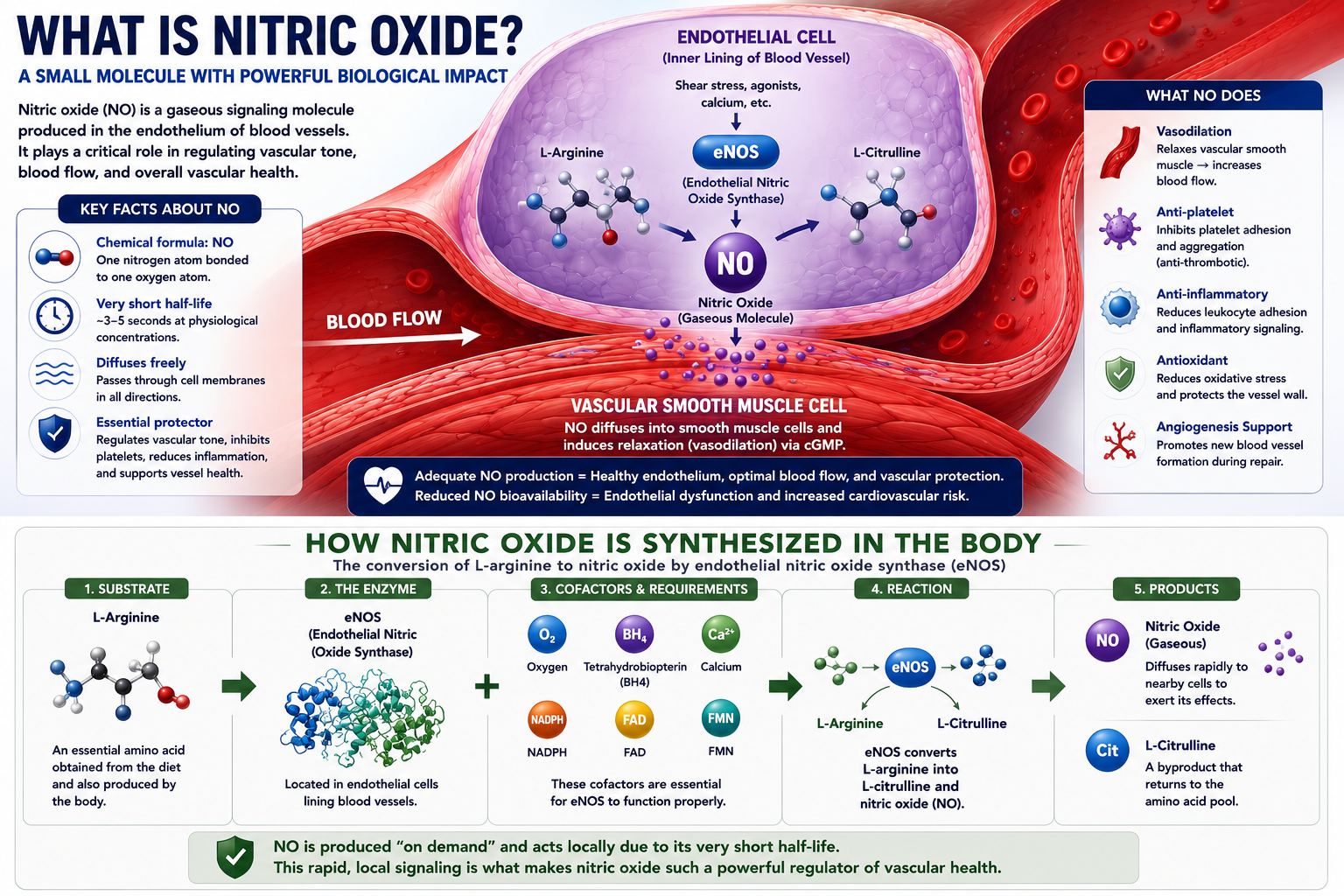
Nitric oxide is a soluble gas continuously synthesized from the amino acid L-arginine in endothelial cells by the constitutive calcium-calmodulin-dependent enzyme nitric oxide synthase. This substance has a wide range of biological properties that maintain vascular homeostasis, including modulation of vascular dilator tone, regulation of local cell growth, and protection of the vessel from injurious consequences of platelets and cells circulating in blood, playing in this way a crucial role in the normal endothelial function.
In everyday terms, what is nitric oxide is a gaseous signaling molecule produced within the cells lining your blood vessels that acts as one of the primary regulators of how those vessels dilate, contract, and protect themselves from damage.
The chemical formula is simply NO, one nitrogen atom bonded to one oxygen atom. It is a free radical, meaning it has an unpaired electron, which makes it highly reactive and accounts for its very short biological half-life. In the concentration range of 10 to 50 nanomolar, NO has a half-life of about three to five seconds.
What is nitric oxide in terms of its broader significance? Nitric oxide is a strong vasodilatory and anti-inflammatory signaling molecule that plays diverse roles in maintaining vascular homeostasis. Nitric oxide produced by endothelial cells is a critical regulator of this balance, such that endothelial dysfunction is defined as a reduced capacity for nitric oxide production and decreased nitric oxide sensitivity.
That last point is significant. The clinical definition of endothelial dysfunction, a precursor condition to cardiovascular disease, is literally defined in terms of reduced nitric oxide capacity. Understanding what is nitric oxide is therefore understanding one of the central pillars of vascular health biology.
What is nitric oxide in its historical scientific context?
The story of nitric oxide as a biological signaling molecule is one of the most surprising discoveries in modern physiology.
In 1980, pharmacologist Robert Furchgott conducted a series of experiments that would change the field. In their seminal experiment, Furchgott and Zawadzki found that strips of rabbit aorta with intact endothelium relaxed in response to acetylcholine but constricted in response to the same agonist when the endothelium had been rubbed off. The substance responsible for acetylcholine-stimulated relaxation was initially called endothelium-derived relaxant factor, but was subsequently found to be nitric oxide.
The identity of this endothelium-derived relaxing factor remained unknown for several years. Its potential endogenous production as an endothelium-derived relaxing factor was first proposed independently by Robert Furchgott and Louis Ignarro in 1986 and confirmed in subsequent studies. It was thus the first gaseous molecule accepted to be a signaling mediator in the organism.
This was a genuinely revolutionary finding. The prevailing understanding of signaling molecules at the time focused on proteins, peptides, and classical neurotransmitters. The idea that a simple diatomic gas, produced in one cell and capable of diffusing directly through cell membranes to act on neighboring cells, could serve as a biological signal was entirely new.
Robert Furchgott, Louis Ignarro, and Ferid Murad were awarded the Nobel Prize in Physiology or Medicine in 1998 specifically for their discoveries concerning nitric oxide as a signaling molecule in the cardiovascular system. Since then, nitric oxide research has expanded to encompass immunology, neuroscience, tissue repair, and the mechanisms underlying multiple aspects of peptide biology.
What is nitric oxide produced from biologically?
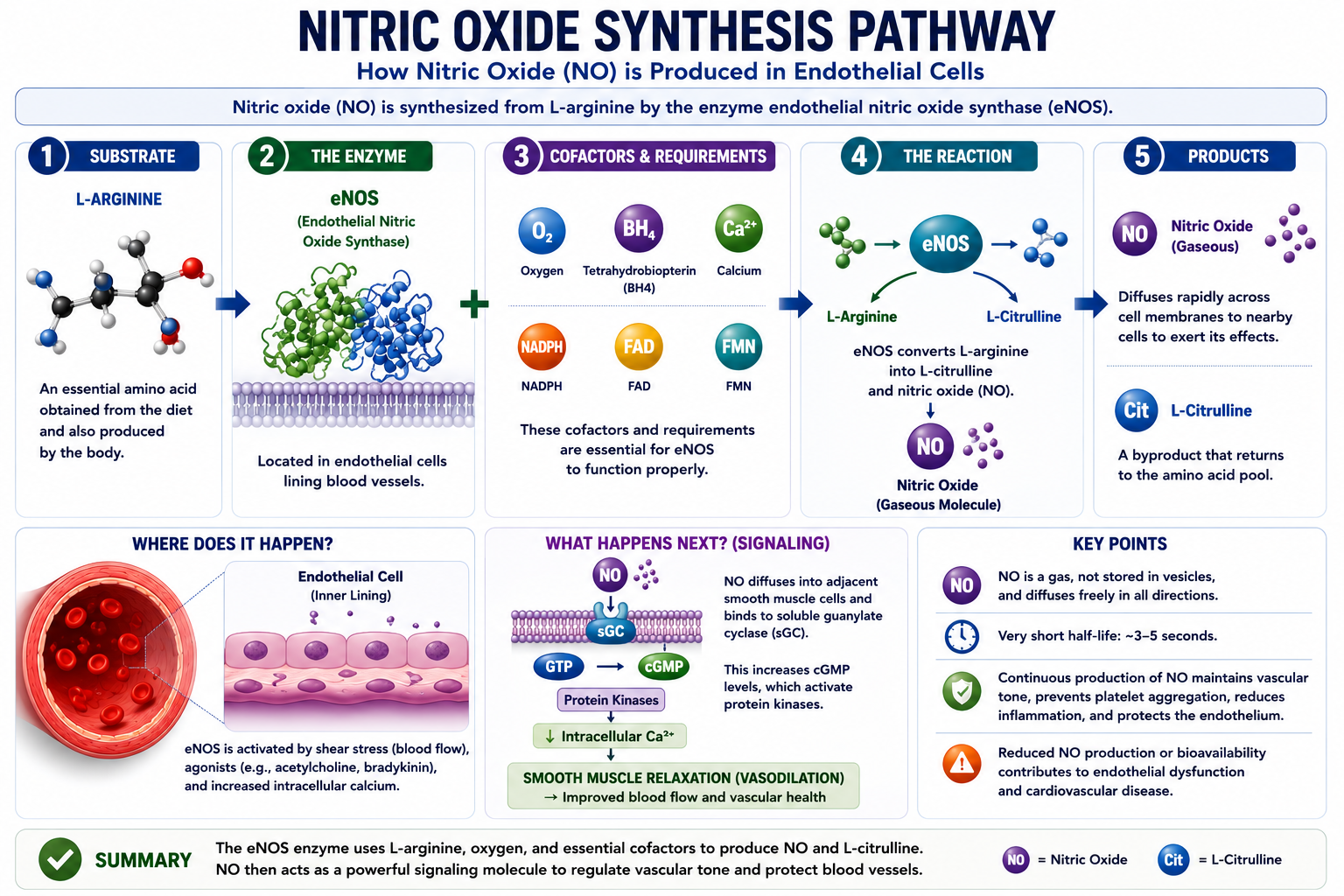
A functional eNOS oxidizes its substrate L-arginine to L-citrulline and nitric oxide. This normal function of eNOS requires dimerization of the enzyme, the presence of the substrate L-arginine, and the essential cofactor tetrahydrobiopterin, one of the most potent naturally occurring reducing agents.
The synthesis pathway is straightforward to describe. The enzyme nitric oxide synthase converts the amino acid L-arginine into two products: L-citrulline and nitric oxide. This reaction requires molecular oxygen, the cofactor tetrahydrobiopterin (BH4), and several other molecular partners.
Once produced, nitric oxide diffuses freely through cell membranes in all directions due to its small size and gaseous nature. It does not require a specific transport mechanism or receptor to cross cellular boundaries. This diffusion property is what allows nitric oxide produced in endothelial cells to act directly on adjacent smooth muscle cells, platelets in the bloodstream, and other neighboring cells simultaneously.
NO released from the endothelium as a gas or attached to transport molecules activates soluble guanylyl cyclase in smooth muscle after binding to its heme group, resulting in increased cyclic GMP. Cyclic GMP activates GMP-dependent kinases that decrease intracellular calcium concentration in smooth muscle, producing relaxation.
This cyclic GMP pathway is the primary mechanism through which nitric oxide produces vascular smooth muscle relaxation and therefore blood vessel dilation. Understanding this pathway, receptor activation leading to second messenger production leading to cellular response, reflects the same fundamental signaling architecture described in our post on [how peptides work in the body], applied here to a gaseous rather than peptide signaling molecule.
What is nitric oxide synthesis controlled by at the enzymatic level?
Three distinct nitric oxide synthase (NOS) enzymes exist in the body, each with different locations, regulation, and functional roles. Understanding this distinction clarifies why what is nitric oxide in one biological context differs from what is nitric oxide in another.
The 3 Nitric Oxide Synthase Enzymes Comparison Table
| Enzyme | Abbreviation | Primary Location | Regulation | Primary Role |
|---|---|---|---|---|
| Endothelial NOS | eNOS | Blood vessel endothelial cells | Calcium-calmodulin dependent, constitutive | Vascular tone, blood flow regulation, anti-platelet, anti-inflammatory |
| Neuronal NOS | nNOS | Neurons, skeletal muscle | Calcium-calmodulin dependent, constitutive | Neural signaling, neurotransmission, memory |
| Inducible NOS | iNOS | Immune cells, macrophages | Calcium independent, induced by inflammation | Immune defense, pathogen destruction |
eNOS: The Vascular Regulator
Nitric oxide is an important protective molecule in the vasculature, and endothelial NOS is responsible for most of the vascular nitric oxide produced. eNOS is the enzyme most relevant to vascular health and to the biological mechanisms that appear in peptide research. It is constitutively expressed in endothelial cells, meaning it is always present and active in response to appropriate stimuli such as blood flow induced shear stress and specific receptor activation.
nNOS: The Neural Communicator
Neuronal NOS produces nitric oxide in neurons where it serves as an atypical neurotransmitter. Unlike classical neurotransmitters that are packaged in vesicles and released at synapses, nitric oxide diffuses freely from the neuron that produces it, potentially affecting multiple neighboring cells simultaneously. nNOS-derived nitric oxide plays roles in synaptic plasticity, learning, and memory formation.
iNOS: The Immune Defender
Inducible NOS is not expressed constitutively. It is switched on in immune cells, particularly macrophages, in response to inflammatory signals such as cytokines and bacterial components. When activated, iNOS produces much larger amounts of nitric oxide than eNOS or nNOS, sustained over longer periods. At these higher concentrations, nitric oxide becomes directly toxic to bacteria, parasites, and other pathogens, serving as part of the innate immune defense.
What is nitric oxide doing across its major biological functions?
Nitric oxide regulates vascular tone, inhibits platelet activity and leukocyte adhesion to the endothelium, modulates proliferation and apoptosis of vascular cells, influences the intracellular redox environment, and alters cellular respiration.
The 5 Primary Biological Roles of Nitric Oxide
| Role | Mechanism | Biological Consequence |
|---|---|---|
| Vasodilation | Activates sGC in smooth muscle, increases cGMP, reduces intracellular calcium | Blood vessel relaxation, reduced vascular resistance, improved blood flow |
| Anti-platelet | Inhibits platelet adhesion, aggregation, and activation | Prevents inappropriate blood clot formation, anti-thrombotic protection |
| Anti-inflammatory | Suppresses NFkB activation, reduces leukocyte adhesion to vessel wall | Reduced vascular inflammation, protection against atherosclerosis |
| Antioxidant | Upregulates superoxide dismutase, scavenges reactive oxygen species | Protection against oxidative damage in vessel wall |
| Angiogenesis modulation | Regulates VEGF signaling and endothelial cell survival | Contributes to new blood vessel formation in repair contexts |
Role 1: Vasodilation
This is the most well known function of what is nitric oxide. When endothelial cells produce nitric oxide in response to increased blood flow, receptor activation, or other stimuli, the gas diffuses into adjacent smooth muscle cells and triggers the cGMP cascade described above. Smooth muscle relaxation causes the vessel to widen, reducing resistance to blood flow and improving perfusion of downstream tissues.
Role 2: Anti-platelet Protection
Platelets circulating in the bloodstream continuously encounter the endothelial surface. Endothelial nitric oxide helps maintain platelets in an inactive state, preventing them from adhering to the vessel wall and aggregating into clots under normal conditions. This anti-platelet function is part of what keeps blood flowing freely through healthy vessels.
Role 3: Anti-inflammatory Signaling
NO stabilizes the expression of IkBa. IkBa inhibits the activation of NFkB, which is a critical factor in the activation and adherence to the endothelium of reactive oxygen species-producing leukocytes. In this way, nitric oxide suppresses one of the primary pathways through which inflammation promotes leukocyte adhesion to vessel walls, a key early step in atherosclerotic plaque formation.
Role 4: Antioxidant Activity
NO can upregulate heme-oxygenase expression, and this enzyme reduces superoxide formation and increases superoxide scavenging. NO upregulates extracellular superoxide dismutase expression, and this enzyme catalyzes the reduction of superoxide to hydrogen peroxide. These antioxidant mechanisms protect the endothelium and surrounding tissue from oxidative damage.
Role 5: Angiogenesis Modulation
Nitric oxide plays a regulatory role in [angiogenesis], the formation of new blood vessels. It modulates VEGF signaling, supports endothelial cell survival during the sprouting and migration phases of vessel formation, and regulates vascular tone in newly forming capillaries. This connection between nitric oxide and angiogenesis is one of the reasons both molecules appear frequently in the same tissue repair research literature.
What is nitric oxide insufficiency in clinical terms?
Endothelial dysfunction is defined as a reduced capacity for nitric oxide production and decreased nitric oxide sensitivity. This ultimately results in an imbalance in vascular homeostasis leading to a prothrombotic, proinflammatory, and less compliant blood vessel wall.
Endothelial dysfunction represents the transition from healthy vascular biology to pathological vascular biology. When the endothelium loses its capacity to produce adequate nitric oxide or when the vascular smooth muscle becomes less sensitive to its effects, the multiple protective functions described above are progressively lost.
Healthy Endothelium vs Endothelial Dysfunction Comparison Table
| Parameter | Healthy Endothelium | Endothelial Dysfunction |
|---|---|---|
| Nitric oxide production | Adequate, responsive to flow and stimuli | Reduced, impaired eNOS function |
| Vascular tone | Appropriate vasodilation capacity | Impaired vasodilation, increased resistance |
| Platelet activity | Inhibited, anti-thrombotic | Less inhibited, pro-thrombotic tendency |
| Inflammation | Suppressed, leukocyte adhesion limited | Increased, leukocyte adhesion promoted |
| Oxidative stress | Managed by antioxidant mechanisms | Elevated reactive oxygen species, NO degradation |
| Atherosclerosis risk | Low | Elevated |
Cardiovascular risk factors such as hypertension, hypercholesterolemia, diabetes mellitus, or chronic smoking stimulate the production of reactive oxygen species in the vascular wall. These reactive oxygen species and the superoxide they generate combine with nitric oxide to form peroxynitrite, reducing nitric oxide bioavailability.
This oxidative degradation mechanism explains why cardiovascular risk factors impair nitric oxide function. Reactive oxygen species produced by these conditions react with nitric oxide before it can act on smooth muscle, effectively scavenging the molecule and reducing its bioavailability. The result is a progressive loss of the protective functions that nitric oxide normally provides.
Central to endothelial dysfunction is nitric oxide, whose decreased synthesis, enhanced degradation or impaired signalling shifts vascular tone toward vasoconstriction, inflammation and thrombosis.
What is nitric oxide contribution to new blood vessel formation?
The relationship between nitric oxide and [angiogenesis] is one of the most active areas of vascular biology research. Nitric oxide does not simply regulate existing vessel tone. It participates actively in the formation of new vessels during repair and growth.
Several mechanisms connect what is nitric oxide to the angiogenic process:
VEGF Signaling Modulation
VEGF, the primary driver of angiogenesis discussed in our angiogenesis post, signals partly through nitric oxide. When VEGF binds its receptor VEGFR2 on endothelial cells, one of the downstream consequences is activation of eNOS and increased nitric oxide production. The nitric oxide produced then contributes to the vasodilation, increased vascular permeability, and endothelial cell migration that characterize early angiogenesis.
Endothelial Cell Survival
Nitric oxide supports the survival of endothelial cells during the sprouting and migration phases of new vessel formation. Loss of nitric oxide signaling during angiogenesis increases endothelial cell apoptosis and impairs the formation of stable new vessel networks.
Vascular Permeability
Early in the angiogenic process, existing vessels need to become more permeable to allow plasma proteins to leak out and form a provisional extracellular matrix scaffold for migrating cells. Nitric oxide contributes to this controlled increase in vascular permeability.
Repair Context
In tissue repair settings, adequate nitric oxide availability supports the angiogenic response by maintaining the health and responsiveness of endothelial cells at the wound site. Reduced nitric oxide availability in aged or metabolically compromised tissue is one factor that contributes to impaired angiogenesis and slower healing.
What is nitric oxide research showing in the most current published literature?
A 2026 spotlight commentary published in the British Journal of Clinical Pharmacology synthesized the current state of nitric oxide research with a focus on translational impact. The commentary identified three recurring mechanisms that diminish nitric oxide bioactivity in clinical populations: oxidative degradation leading to peroxynitrite formation, impaired eNOS activity, and inflammatory signaling driving eNOS uncoupling. The commentary noted that over the past decade, a series of human studies and randomized trials have clarified where nitric oxide modulating strategies offer clinical relevance and where therapeutic optimism should be tempered.
Several specific findings from the current research landscape are worth noting:
eNOS Uncoupling Is a Central Mechanism
When the eNOS enzyme lacks adequate cofactors, particularly tetrahydrobiopterin, it can become uncoupled, producing superoxide rather than nitric oxide. This paradoxical situation, where the enzyme designed to produce a protective molecule instead produces a damaging one, is now recognized as a central mechanism in multiple cardiovascular pathologies.
Inflammation and Nitric Oxide Interact Bidirectionally
Recent research has clarified that the relationship between inflammation and nitric oxide is bidirectional. Inflammation reduces nitric oxide bioavailability through multiple mechanisms. Reduced nitric oxide in turn allows greater inflammatory signaling. This creates a reinforcing cycle that is now understood to be a key driver of progressive endothelial dysfunction.
Nitric Oxide Pathway Appears in Peptide Research
The nitric oxide pathway, specifically eNOS activation and nitric oxide-mediated vasodilation, appears as a mechanism in multiple areas of peptide research documented through the National Library of Medicine and peer reviewed research databases. Understanding what is nitric oxide at a mechanistic level is therefore directly relevant to interpreting research literature across multiple peptide categories.
What is nitric oxide in plain language is a gaseous signaling molecule produced in blood vessel walls that causes vessels to relax and widen, prevents blood clots from forming unnecessarily, reduces vascular inflammation, and supports the formation of new blood vessels during repair.
What is nitric oxide produced from is the amino acid L-arginine. The enzyme nitric oxide synthase, particularly the endothelial form called eNOS, converts L-arginine to L-citrulline and nitric oxide in a reaction that requires oxygen and the cofactor tetrahydrobiopterin.
What is nitric oxide half life in biological systems is very short, approximately 3 to 5 seconds at physiological concentrations. This extremely short lifespan means nitric oxide acts locally and continuously rather than accumulating or traveling significant distances through the body.
Endothelial dysfunction is the clinical term for impaired endothelial cell function, defined as a reduced capacity for nitric oxide production and reduced sensitivity to its effects. It is considered a precursor condition to atherosclerosis and cardiovascular disease. What is nitric oxide insufficiency is therefore directly synonymous with endothelial dysfunction.
What is nitric oxide doing in angiogenesis is serving as a downstream mediator of VEGF signaling, supporting endothelial cell survival during vessel sprouting, contributing to the controlled vascular permeability needed in early angiogenesis, and regulating tone in newly forming capillaries.
Nitric oxide synthase is the enzyme family that produces nitric oxide. Three types exist because different biological contexts require different production profiles. eNOS in blood vessels produces low-level continuous nitric oxide for vascular regulation. nNOS in neurons produces nitric oxide for neural signaling. iNOS in immune cells produces high-level nitric oxide for pathogen destruction when inflammation is triggered.
What is nitric oxide appearing in peptide research is as a downstream signaling mediator. Several peptide compounds studied in tissue repair and vascular research contexts have been found to interact with the eNOS pathway, modulating nitric oxide production and therefore influencing vascular tone and angiogenic capacity at research sites.
Continue Learning
This post is part of a growing educational library on peptide science and vascular biology. Related reading:
Subscribe for updates as this educational library continues to grow, evidence based science explained clearly without hype.
This content is for educational and informational purposes only. It does not constitute medical advice, diagnosis, or treatment recommendations. Always consult a qualified healthcare professional before making any decisions related to your health.
10-vial kits • Capsule packs as listed • Research use only
© 2026 Pepkitshop. All rights reserved.
Vial product prices are per kit of 10 vials. Quantity 1 = 10 vials. Capsule products retain the pack size stated on their listing.
All products are supplied strictly for laboratory research. They are not intended for human or veterinary use, consumption, diagnosis, or treatment.
WhatsApp us

