Vial products: price per kit of 10 vials. Quantity 1 = 10 vials. Capsule products are priced per capsule pack as listed. Dismiss
By Pepkitshop | Peptide Research Education
Updated July 2026 | Educational Content, Not Medical Advice
What should researchers look for when evaluating peptide quality and how do you distinguish a genuinely high quality research compound from one that only appears high quality on the surface?
The research peptide market in 2026 is more crowded than at any previous point. New suppliers enter regularly. Documentation standards vary enormously. Marketing language has become increasingly sophisticated. And the consequences of sourcing low quality compounds are not merely financial. They are scientific. Research conducted with unreliable compounds produces unreliable results, and unreliable results waste time, resources, and potentially affect the conclusions drawn from months or years of work.
What should researchers look for when evaluating peptide quality is therefore not a simple checklist question. It requires understanding what quality actually means at each stage of peptide manufacturing, what documentation genuinely verifies versus what only appears to verify, and what the most current 2026 regulatory and analytical standards require.
This guide provides that complete framework. By the end you will have a structured, evidence-based approach to evaluating any research peptide compound before you use it in your work.
What should researchers look for when evaluating peptide quality has become more urgent in 2026 than at any previous time in the research peptide field.
Evaluating a research peptide supplier involves reviewing the quality systems, testing practices, documentation standards, and transparency provided by the company. In 2026, buyers should look for several key indicators of quality, including independent third party testing, batch specific COAs, peptide identity verification, purity analysis, and transparent documentation practices.
Several developments in 2026 specifically have sharpened the importance of rigorous quality evaluation:
Researchers comparing peptide vendors in 2026 are paying closer attention to documentation, lot level testing, and transparency. The most important factors are batch specific COAs, transparent analytical methods, traceable laboratory information, clear research use only restrictions, and avoidance of any human use or medical claims.
The June 2026 implementation of the EMA guideline EMA/CHMP/CVMP/QWP/367182/2025 introduced new European standards for research grade peptide quality documentation that are now influencing evaluation expectations globally. This technical guideline establishes a 99% or higher purity benchmark as a non-negotiable requirement for data reproducibility, verified through concurrent HPLC and mass spectrometry analysis. It distinguishes between clinical grade pharmaceuticals and research grade chemicals intended for laboratory use.
Federal enforcement activity in the United States in 2025 and 2026 has also clarified the risk landscape. Cases where compounds were found to contain entirely different substances than labeled demonstrated that supplier reputation and marketing language are insufficient substitutes for verifiable analytical documentation.
What should researchers look for when evaluating peptide quality in this environment is a structured, evidence-based framework that does not rely on trust alone.
What should researchers look for when evaluating peptide quality can be organized into seven core standards. Meeting all seven provides strong assurance of compound quality. Failing any one of the seven introduces a specific type of quality uncertainty that affects research reliability.
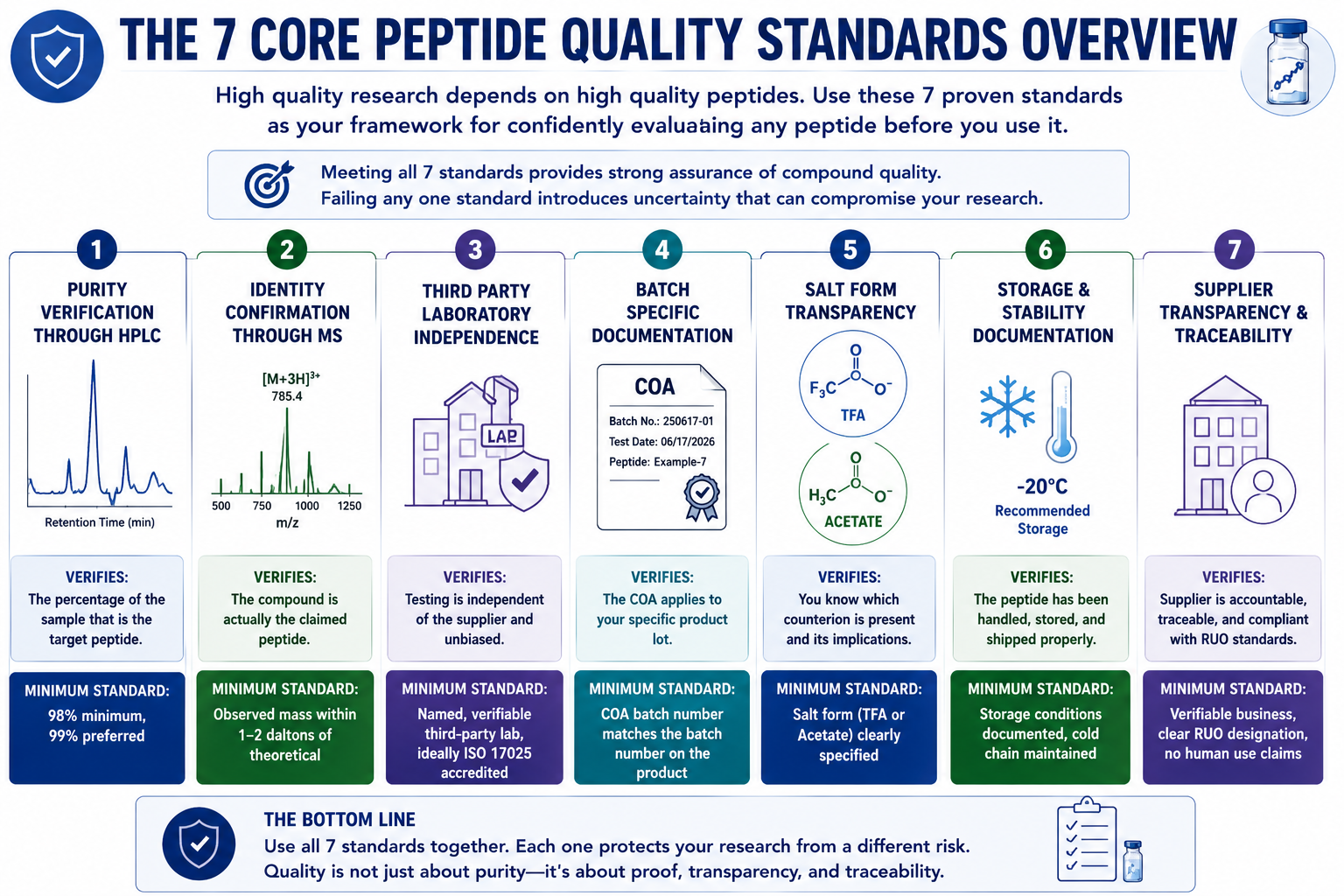
The 7 Core Peptide Quality Standards Overview
| Standard | What It Verifies | Minimum Requirement |
|---|---|---|
| 1. HPLC Purity | Percentage of sample that is the target peptide | 98% minimum, 99% preferred |
| 2. Mass Spectrometry Identity | Compound is actually the claimed peptide | Observed mass within 1 to 2 daltons of theoretical |
| 3. Third Party Laboratory | Testing is independent of the supplier | Named, verifiable, ideally ISO 17025 accredited |
| 4. Batch Specific Documentation | COA applies to your specific product lot | Batch number on COA matches batch number on product |
| 5. Salt Form Transparency | You know what counterion is present and its implications | TFA or acetate clearly specified |
| 6. Storage and Stability | Compound has been handled appropriately | Storage conditions documented, cold chain maintained |
| 7. Supplier Transparency | Supplier is accountable and traceable | Verifiable business identity, clear research use only designation |
Each standard addresses a specific failure mode that has been documented in the research peptide supply chain. Together they form a complete quality assurance framework that what should researchers look for when evaluating peptide quality requires.
What should researchers look for when evaluating peptide quality begins with purity.
Verify that the research peptide supplier provides both HPLC and mass spectrometry data for every product, and that purity is consistently at or above 99 percent.
As covered in depth in our guide on [peptide purity], HPLC is the primary method for measuring what percentage of a peptide sample is the intended compound versus impurities and synthesis byproducts. What should researchers look for when evaluating peptide quality at this standard includes:
HPLC Quality Standard Evaluation Table
| Element | Acceptable | Not Acceptable |
|---|---|---|
| Purity percentage | 98% or higher for research grade, 99% or higher preferred | Below 98% |
| UV wavelength stated | 214 nm or 220 nm specified | No wavelength stated |
| Chromatogram included | Yes, shows dominant single peak | Absent, no visual verification possible |
| Testing method described | Column type, mobile phase, conditions stated | Method not described |
| Integration data | Peak areas shown for all detected peaks | Only final percentage shown |
HPLC shows retention and relative peak area. Identity usually needs mass confirmation or another structural method. Purity matters, but method quality, identity data, content, storage, and documentation also matter. A number without context is incomplete.
A purity percentage without accompanying methodological detail and a chromatogram provides limited assurance. Any laboratory can report any number. What should researchers look for when evaluating peptide quality is the underlying data that makes the number verifiable.
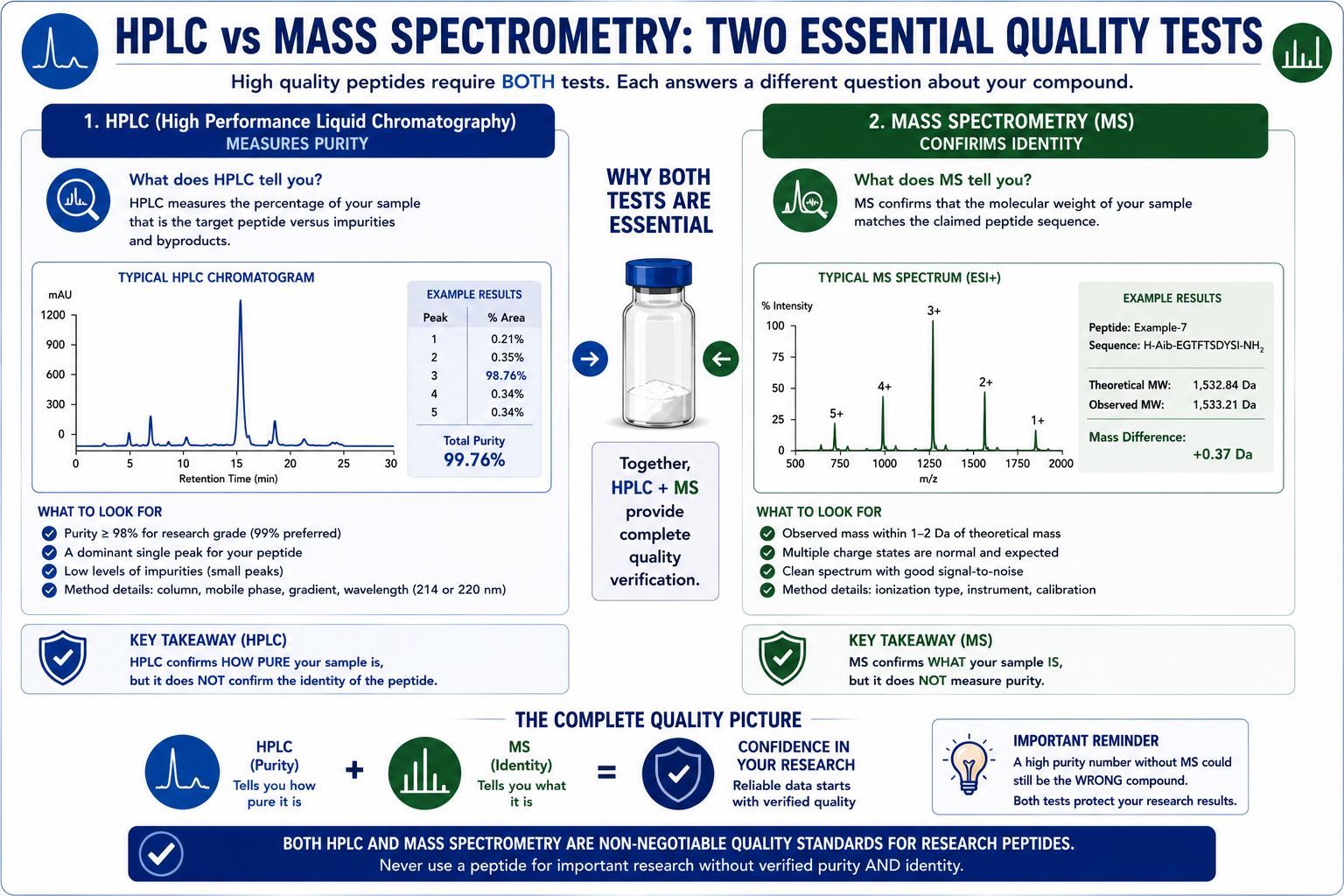
What should researchers look for when evaluating peptide quality at the identity level requires mass spectrometry data alongside HPLC.
Establish a 99% or higher purity benchmark as a non-negotiable requirement for data reproducibility, verified through concurrent HPLC and mass spectrometry analysis.
The word concurrent in this guidance is important. HPLC and mass spectrometry must both be performed on the same batch. A COA showing HPLC data from one batch and mass spectrometry data from a different batch, or no mass spectrometry data at all, does not verify the identity of the compound you received.
What should researchers look for when evaluating peptide quality in the mass spectrometry section of a COA:
Mass Spectrometry Identity Standard Evaluation Table
| Element | Acceptable | Not Acceptable |
|---|---|---|
| MS data present | Yes, for this specific batch | Absent entirely |
| Theoretical molecular weight stated | Yes, calculated from sequence | Not stated |
| Observed molecular weight stated | Yes, measured result | Not stated |
| Mass difference | Within 1 to 2 daltons | Greater than 2 to 3 daltons |
| Multiple charge states shown | Acceptable and expected for larger peptides | Not required but adds confidence |
The mass spectrometry standard is the most commonly missing element in research peptide documentation. A significant proportion of COAs in circulation include HPLC purity data but lack any mass spectrometry identity confirmation. This means the compound could be pure but still be the wrong compound entirely.
What should researchers look for when evaluating peptide quality at the laboratory level is independence.
Green flags include lot specific documentation, transparent testing methods, HPLC and mass confirmation, consistent lot coding, clear storage guidance, accessible technical support, research use only compliance, realistic explanations of analytical limitations, and documentation that matches product labels.
The testing laboratory that issues a COA must be independent of the supplier for the document to provide meaningful quality assurance. A supplier testing its own product and issuing its own COA has a direct financial interest in the results. This conflict of interest does not mean in-house results are necessarily wrong, but it means they cannot be independently verified.
Laboratory Independence Standard Evaluation Table
| Laboratory Type | Independence | Verification Method | Quality Assurance Level |
|---|---|---|---|
| ISO 17025 accredited third party | ✅ Full | Search national accreditation body database | Highest |
| Non-accredited third party | ✅ Independent | Verify lab exists and can be contacted | Moderate |
| Supplier in-house laboratory | ❌ None | Cannot be independently verified | Lower |
| Laboratory not named | ❌ Unknown | No verification possible | None |
What should researchers look for when evaluating peptide quality at this standard is a named laboratory that can be independently verified through a web search, ideally holds ISO 17025 accreditation from a recognized national accreditation body, and can confirm on request that it issued the specific COA in question.
What should researchers look for when evaluating peptide quality at the documentation level is batch specificity.
A COA is only meaningful if it applies to the specific batch of product you received. This sounds obvious. In practice, it is one of the most commonly violated standards in the research peptide supply chain.
Three specific batch documentation problems occur regularly:
Generic COAs are documents that list the compound name and a purity value but contain no batch or lot number. These documents could have been created at any time and cannot be verified as applying to any specific production run.
Recycled COAs are batch specific documents that are reused across multiple production runs. The batch number on the document does not match the batch number on the product received, meaning the testing data does not apply to what you have.
Outdated COAs are legitimate documents from a real batch, but the batch in question was produced so long ago that the stability of the documentation is questionable. As covered in our guide on [how to read a peptide COA], testing dates more than 24 months old warrant careful consideration.
Batch Documentation Standard Evaluation Table
| Check | Pass | Fail |
|---|---|---|
| Batch number present on COA | Yes, specific lot number shown | Absent or generic |
| Batch number matches product | Yes, identical to number on vial or packaging | Different from product batch number |
| Testing date present | Yes, specific date shown | Absent or only year shown |
| Testing date recency | Within 24 months | More than 24 months ago |
| COA is compound specific | Yes, specific sequence and molecular weight shown | Generic, could apply to any product |
What should researchers look for when evaluating peptide quality regarding salt form is clear specification.
As covered in our guide on [acetate vs TFA salt forms], the counterion associated with a research peptide affects the actual peptide content per gram of lyophilized powder, the compatibility of the compound with cell based research, and the quality of mass spectrometry data.
What should researchers look for when evaluating peptide quality at this standard:
The salt form should be explicitly stated in the product specification and on the COA. TFA salt and acetate salt are not equivalent for all research applications. A supplier that does not specify salt form is withholding information that affects research design decisions.
For cell based research and animal studies, acetate form should be specified. For general laboratory research, TFA form is acceptable if explicitly stated. The absence of any salt form specification is a yellow flag that the supplier may not be providing complete documentation.
What should researchers look for when evaluating peptide quality at the storage level is documented handling.
A compound that meets all analytical quality standards at time of testing can still arrive in degraded condition if it was stored or shipped improperly. What should researchers look for when evaluating peptide quality includes evidence that the supplier maintains appropriate conditions from synthesis through delivery.
Storage and Stability Documentation Standard
| Element | What to Look For | Red Flag |
|---|---|---|
| Storage conditions on COA | Recommended temperature and conditions stated | No storage guidance provided |
| Shipping conditions | Cold chain maintained for temperature sensitive compounds | Shipped without temperature protection in warm conditions |
| Shelf life information | Expected stability at recommended storage temperature | No stability information provided |
| Reconstitution guidance | Recommended solvent and concentration range | No reconstitution information |
| Appearance on arrival | Matches expected lyophilized powder description | Unexpected color, texture, or visible contamination |
Confirm that batch specific COAs are publicly accessible and that the documentation includes full methodology details. Determine where the peptides are manufactured, with a preference for domestic production under consistent quality control conditions.
What should researchers look for when evaluating peptide quality at the supplier level is verifiable accountability.
This standard addresses the business entity itself rather than the compound documentation. In a market where enforcement action has demonstrated that some suppliers provide falsified documentation or mislabeled compounds, verifiable supplier identity is a prerequisite for trusting any documentation they provide.g
Supplier Transparency Standard Evaluation Table
| Element | Acceptable | Not Acceptable |
|---|---|---|
| Business identity | Verifiable legal entity, physical address | Anonymous, no traceable business identity |
| Research use only compliance | Clear RUO designation, no human use claims | Human use claims or dosing guidance provided |
| Contact responsiveness | Technical questions answered accurately | No technical support, evasive responses |
| Documentation consistency | COA batch numbers match products consistently | Inconsistencies between documentation and product |
| Regulatory compliance | Compliant with jurisdiction specific RUO regulations | Claims or practices that violate RUO framework |
| Track record | No enforcement history, consistent quality reports | Prior enforcement actions, pattern of complaints |
Additional considerations include endotoxin testing, sterility testing where appropriate, supplier responsiveness, product traceability, and the availability of detailed analytical reports. A supplier evaluation checklist helps create a consistent process for comparing suppliers and identifying those that align with established quality expectations.
At Pepkitshop, every one of these transparency standards is met as a baseline. Our documentation is batch specific, our testing is third party, and our research use only designation is clearly maintained across all products and communications.
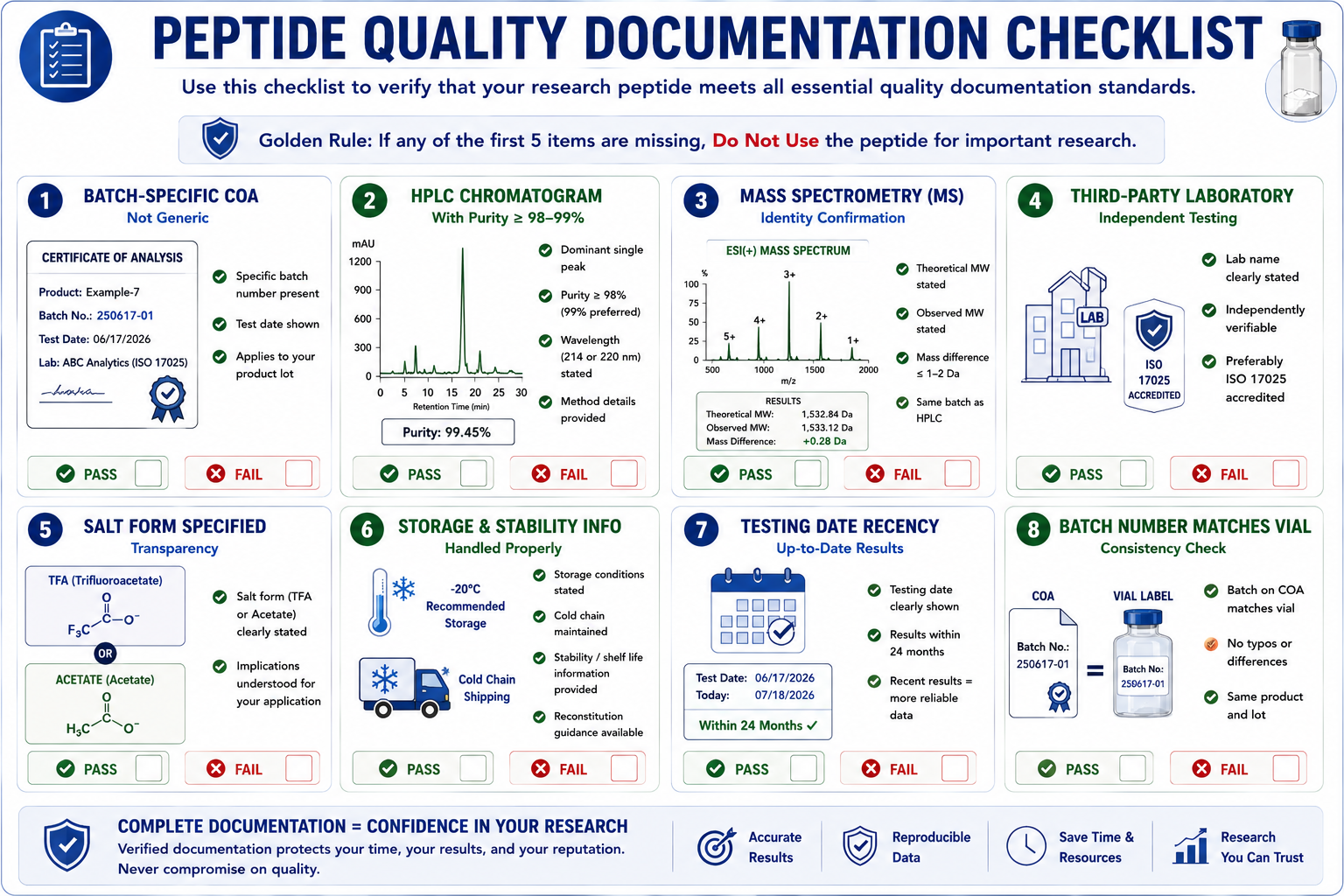
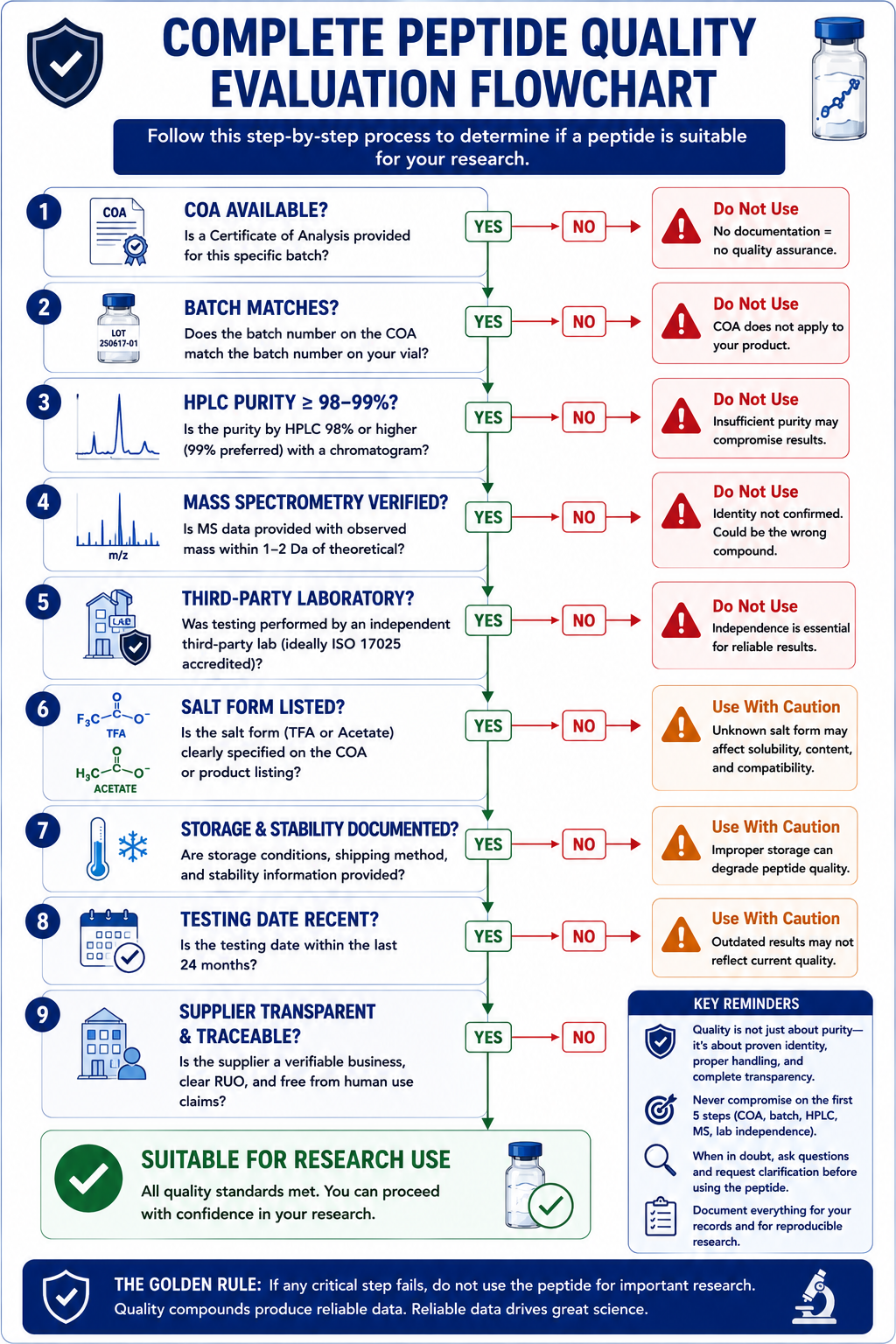
What should researchers look for when evaluating peptide quality in a single reference checklist:
Complete Peptide Quality Evaluation Checklist
| Category | Check | Pass or Fail |
|---|---|---|
| Purity | HPLC purity 98% or higher | Pass / Fail |
| Purity | UV wavelength stated (214 or 220 nm) | Pass / Fail |
| Purity | Chromatogram included | Pass / Fail |
| Identity | Mass spectrometry data present | Pass / Fail |
| Identity | Observed mass within 2 daltons of theoretical | Pass / Fail |
| Laboratory | Testing laboratory named | Pass / Fail |
| Laboratory | Laboratory independently verifiable | Pass / Fail |
| Laboratory | Third party, not in-house | Pass / Fail |
| Batch | Lot number present on COA | Pass / Fail |
| Batch | Lot number matches product received | Pass / Fail |
| Batch | Testing date within 24 months | Pass / Fail |
| Salt form | Salt form explicitly specified | Pass / Fail |
| Storage | Storage conditions documented | Pass / Fail |
| Storage | Compound arrived under appropriate conditions | Pass / Fail |
| Supplier | Verifiable business identity | Pass / Fail |
| Supplier | Research use only designation clear | Pass / Fail |
| Supplier | No human use claims made | Pass / Fail |
A compound that passes all 17 checks provides the strongest available assurance of quality in the research peptide market. A compound that fails any of the first five checks, covering purity and identity, should not be used for reproducible research regardless of other factors.
What should researchers look for when evaluating peptide quality as the most important first check is whether HPLC purity data and mass spectrometry identity data are both present, both batch specific, and both from an independently verifiable third party laboratory. These three elements together form the non-negotiable core of quality documentation.
What should researchers look for when evaluating peptide quality in terms of purity is a minimum of 98% by HPLC, with 99% or higher now established as the preferred standard by both the June 2026 EMA guideline and the leading suppliers in the research peptide market. Below 95% is not suitable for reproducible research.
What should researchers look for when evaluating peptide quality documentation includes batch specific lot numbers, concurrent HPLC and MS data, named third party laboratory with verifiable accreditation, testing date within 24 months, and salt form specification. Any of these missing from documentation represents an incomplete quality record. More detail is available in our guide on [how to read a peptide COA].
What should researchers look for when evaluating peptide quality at the laboratory level requires independence. In-house testing by the supplier cannot be independently verified and represents a conflict of interest. Third party testing from a named, verifiable laboratory is the required standard for credible quality documentation.
The June 2026 EMA guideline EMA/CHMP/CVMP/QWP/367182/2025 established 99% or higher purity verified by concurrent HPLC and mass spectrometry as a non-negotiable benchmark for research grade peptide quality. This represents a formal regulatory codification of standards that leading suppliers had already adopted, and it is now influencing quality expectations globally beyond the European market.
What should researchers look for when evaluating peptide quality includes supplier technical responsiveness. A legitimate supplier with genuine quality documentation can explain their testing methodology, confirm their laboratory credentials, and answer specific questions about their COA. Evasive or non-technical responses to documentation questions are a meaningful red flag. More detail on evaluating supplier documentation is available through the National Library of Medicine and peer reviewed research databases..
This post is part of a growing educational library on research peptide quality and handling. Related reading:
Subscribe for updates as this educational library continues to grow, evidence based peptide research guidance explained clearly and practically.
This content is for educational and informational purposes only. It does not constitute medical advice, diagnosis, or treatment recommendations. Research peptides are for laboratory use only and are not approved for human consumption or therapeutic use. Always consult a qualified healthcare professional before making any decisions related to your health.
10-vial kits • Capsule packs as listed • Research use only
© 2026 Pepkitshop. All rights reserved.
Vial product prices are per kit of 10 vials. Quantity 1 = 10 vials. Capsule products retain the pack size stated on their listing.
All products are supplied strictly for laboratory research. They are not intended for human or veterinary use, consumption, diagnosis, or treatment.
WhatsApp us

