
No products in the cart.

Vial products: price per kit of 10 vials. Quantity 1 = 10 vials. Capsule products are priced per capsule pack as listed. Dismiss
By Pepkitshop | Peptide Coach & Educator
Updated July 2026 | Educational Content Not Medical Advice
What is peptide synthesis and why does understanding it matter for anyone serious about peptide science?
Every research peptide that exists in a laboratory vial was built from scratch using a precise chemical process. Understanding what is peptide synthesis gives you a fundamental insight into why peptides behave the way they do, why purity matters so much, and how small differences in the manufacturing process produce significant differences in compound quality.
This guide explains what is peptide synthesis in plain English from the basic chemistry to the step-by-step manufacturing process without oversimplifying the science or making it inaccessible to non-chemists.
If you are new here, start with our foundational guide on [what a peptide actually is] before continuing. Understanding peptide structure first makes the synthesis process much easier to follow.
What is peptide synthesis in the simplest possible terms?
It is the process of chemically building a peptide a short chain of amino acids in a laboratory setting, one amino acid at a time, in a precise and controlled sequence.
In nature, your body synthesizes peptides using ribosomes molecular machines that read genetic instructions and assemble amino acids in the correct order. What is peptide synthesis in a laboratory context is essentially a chemical replication of that same assembly process but performed outside the body using chemical reagents rather than biological machinery.
The goal of peptide synthesis is to produce a specific sequence of amino acids in the exact order required to create the target compound. A single error in sequence one amino acid in the wrong position produces a different compound with potentially different biological properties.
What is peptide synthesis without precision? It is an impure, unreliable product. Precision at every step of the synthesis process is what determines whether the final compound meets research-grade standards. This is why understanding synthesis connects directly to understanding [peptide purity] the two topics are inseparable.
Understanding what is peptide synthesis today requires knowing where it came from.
For much of the early 20th century, chemists could study naturally occurring peptides but had no reliable method to produce them artificially. The chemistry involved was complex amino acids have multiple reactive sites, and building a specific sequence without unwanted side reactions was enormously challenging.
The field changed permanently in 1963 when Dr. Robert Bruce Merrifield published a landmark paper describing a new approach he called solid-phase peptide synthesis. Merrifield’s insight was to anchor the growing peptide chain to a solid resin bead during assembly allowing excess reagents and byproducts to be washed away easily at each step rather than requiring complex separation procedures.
The impact was immediate and profound. What had taken weeks or months of laborious chemistry could now be accomplished in days. Merrifield was awarded the Nobel Prize in Chemistry in 1984 specifically for this contribution.
What is peptide synthesis in modern laboratories is a direct continuation of Merrifield’s original innovation refined, automated, and scaled, but built on the same foundational principle of solid-phase assembly.
What is peptide synthesis achieved through? There are two primary methods and understanding the difference between them matters for understanding compound quality.
Solution Phase vs Solid Phase Synthesis Comparison Table
| — | Solution Phase Synthesis | Solid Phase Synthesis (SPPS) |
|---|---|---|
| Where peptide is built | In liquid solution | Anchored to solid resin bead |
| Purification between steps | Complex requires separation | Simple wash away excess reagents |
| Scalability | Limited complex at scale | High easily scaled and automated |
| Suitable for long peptides | ❌ Difficult | ✅ Yes |
| Current industry use | Rare largely replaced | ✅ Dominant method worldwide |
| Automation possible | Limited | ✅ Fully automated systems exist |
| Purity control | More difficult | More controllable |
Solution phase synthesis the older method assembles peptides in liquid. While it still has limited applications, it has been largely replaced by solid phase methods for research peptide production due to the purification challenges involved.
Solid Phase Peptide Synthesis SPPS is now the dominant method worldwide. It is used in both research laboratories and pharmaceutical manufacturing, and is the method behind virtually every research peptide produced today.
What is peptide synthesis using the solid phase method and what makes it so effective?
SPPS is a method used to create peptides by assembling amino acids in a stepwise fashion on a solid support, such as a resin. This process allows peptides to be synthesized in a controlled, efficient, and scalable manner. SPPS simplifies the purification process, as the peptide remains attached to the solid phase throughout synthesis, making it easier to remove byproducts and non-functional peptides.
The key innovation is the solid support typically small polymer resin beads. The first amino acid in the target sequence is chemically anchored to the resin. Each subsequent amino acid is then added one at a time in a repeating cycle of chemical reactions. Throughout the entire process, the growing peptide chain stays attached to the resin, which makes washing away unwanted byproducts straightforward.
Think of it like building a LEGO structure on a base plate. The base plate (resin) keeps everything anchored and stable while you add pieces (amino acids) one at a time. When you are done, you detach the finished structure from the base plate and clean it up.
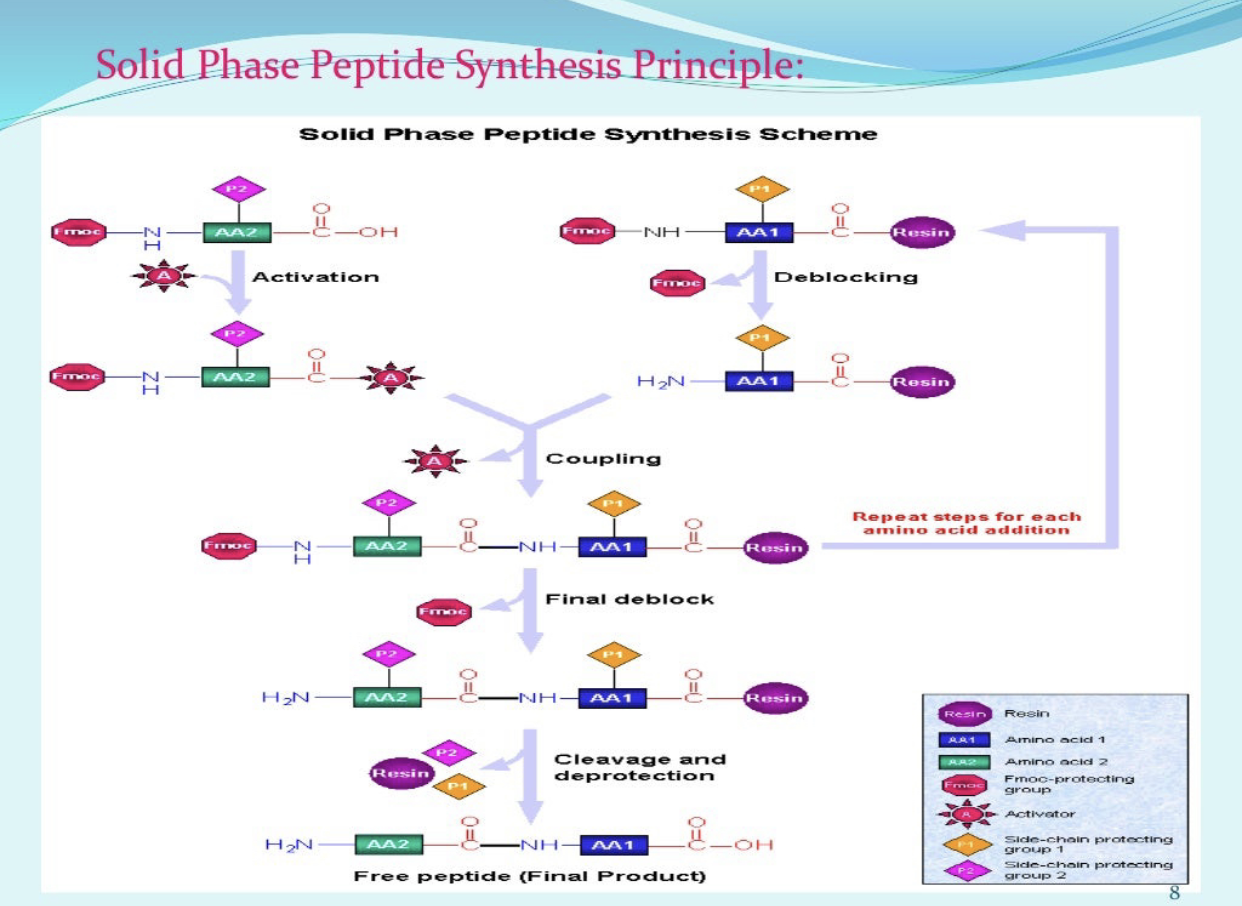
When the full sequence has been assembled, the completed peptide is chemically cleaved from the resin, purified, and processed into its final form.
What is peptide synthesis at its most efficient? It is this combination of stepwise precision, anchored assembly, and simple purification that makes SPPS the foundation of modern peptide production.
What is peptide synthesis broken down into its actual steps?
The general process for synthesizing peptides on a resin starts by attaching the first amino acid, the C-terminal residue, to the resin. To prevent polymerization of the amino acid, the alpha amino group and the reactive side chains are protected with a temporary protecting group.
Once the amino acid is attached to the resin, the resin is filtered and washed to remove byproducts and excess reagents. Next, the N-alpha protecting group is removed in a deprotection process and the resin is again washed to remove byproducts and excess reagents. Then the next amino acid is coupled to the attached amino acid.
Here is the complete 7-step cycle explained plainly:
Step 1: Resin Preparation
The solid support resin is prepared and loaded into the synthesis vessel. The resin provides the anchor point for the entire synthesis. Different resin types are used depending on the desired final form of the peptide.
Step 2: First Amino Acid Attachment
The first amino acid in the target sequence always attached at the C-terminus end is chemically bonded to the resin. Protecting groups are added to prevent unwanted reactions at this stage.
Step 3: Deprotection
The temporary protecting group on the attached amino acid is chemically removed a process called deprotection. This exposes a reactive site ready to bond with the next amino acid.
Step 4: Washing
The resin is thoroughly washed with solvents to remove all deprotection reagents and byproducts. This washing step is critical incomplete washing leaves residues that compromise purity.
Step 5 : Coupling
The next amino acid in the sequence also carrying its own protecting groups is introduced and chemically bonded to the exposed reactive site of the previous amino acid. This forms the peptide bond that links the two amino acids together.
Step 6: Repeat
Steps 3 through 5 are repeated for every subsequent amino acid in the target sequence. A 15 amino acid peptide requires 15 complete deprotection-wash-coupling cycles. Each cycle must achieve high efficiency even small errors compound across multiple cycles.
Step 7: Cleavage and Global Deprotection
Once the full sequence is assembled, the completed peptide is chemically cleaved from the resin. All remaining protecting groups are simultaneously removed. The peptide is now free in solution and ready for purification and processing.
What is peptide synthesis chemistry built on? Two main protecting group strategies Fmoc and Boc define the two primary SPPS approaches used today.
Fmoc vs Boc SPPS Comparison Table
| Fmoc-SPPS | Boc-SPPS | |
|---|---|---|
| Protecting group | 9-Fluorenylmethyloxycarbonyl | tert-Butyloxycarbonyl |
| Deprotection reagent | Mild base (piperidine) | Strong acid (TFA, HF) |
| Safety profile | Milder conditions | Requires hazardous reagents |
| Equipment needed | Standard laboratory | Specialized HF equipment |
| Industry preference | ✅ Dominant method today | Limited specialist applications |
| Suitable for most peptides | ✅ Yes | Specific applications only |
| Automation compatibility | ✅ Excellent | Limited |
Fmoc-SPPS uses a protecting group called 9-Fluorenylmethyloxycarbonyl abbreviated Fmoc. It is removed using mild base conditions, making it safer to work with and compatible with automated synthesizer equipment. Fmoc-SPPS is the primary method used in modern peptide synthesis laboratories, with the capability for automated synthesis with high precision for repetitive tasks. It is the dominant method in both research and pharmaceutical manufacturing today.
Boc-SPPS uses a protecting group called tert-Butyloxycarbonyl abbreviated Boc. It requires strong acid conditions including hydrofluoric acid (HF) for final deprotection a hazardous reagent requiring specialized equipment and safety infrastructure. While Boc-SPPS was the original method developed by Merrifield, it has been largely replaced by Fmoc chemistry in modern laboratories.
Understanding these two approaches matters for researchers evaluating synthesis documentation knowing which chemistry was used tells you something about the manufacturing conditions and quality controls in place.
What is peptide synthesis quality and how does it connect to the final purity of the compound?
Every cycle in the SPPS process has a coupling efficiency a percentage of molecules that successfully formed the correct peptide bond. In a well-optimized synthesis, coupling efficiency might reach 99% or higher per cycle.
But inefficiency compounds rapidly across cycles.
If coupling efficiency is 99% per step for a 15 amino acid peptide that is 15 cycles. The cumulative yield of full-length, correct sequence peptide is 0.99 to the power of 15 approximately 86%. The remaining 14% consists of deletion sequences, truncated chains, and other synthesis byproducts.
This is precisely why purification after synthesis is essential and why the HPLC and mass spectrometry testing described in our guide on [peptide purity] exists. The synthesis process inherently generates impurities. Quality synthesis minimizes them. Quality testing verifies them.
A peptide manufacturer claiming 99% purity from a poorly optimized synthesis is making a claim that the testing should either confirm or contradict. This is why independent third-party testing matters and why understanding what is peptide synthesis helps you ask better questions about the compounds you are researching.
More information on published synthesis research and purity standards is available through the National Library of Medicine and the peer-reviewed research database.
What is peptide synthesis beyond the assembly process itself?
Once cleaved from the resin, the raw peptide requires several additional steps before it is research-ready:
HPLC Purification
The cleaved peptide mixture is run through preparative HPLC a larger-scale version of the analytical HPLC used for purity testing. This separates the target peptide from synthesis byproducts, deletion sequences, and other impurities. The purified fraction is collected.
Analytical Testing
The purified peptide is tested using analytical HPLC and mass spectrometry to verify purity and confirm molecular identity. This produces the data that appears on a Certificate of Analysis.
Lyophilization
The purified peptide in solution is freeze-dried a process called lyophilization to produce the stable white powder form in which research peptides are typically supplied. This removes water and creates a stable form that can be stored at low temperatures without significant degradation.
Quality Release
The final product is reviewed against quality specifications before release. For research-grade peptides this typically means verifying purity of 98% or higher and confirming identity by mass spectrometry.
Understanding this complete journey from amino acid assembly through purification, testing, and lyophilization gives a complete picture of what a research peptide actually is before it reaches a laboratory.
| Stage | Purpose | Output |
|---|---|---|
| Resin cleavage | Release completed peptide from solid support | Raw peptide in solution |
| Global deprotection | Remove all protecting groups | Fully deprotected peptide |
| Preparative HPLC | Separate target from impurities | Purified peptide fraction |
| Analytical HPLC | Measure purity percentage | Purity data for COA |
| Mass spectrometry | Confirm molecular identity | Identity data for COA |
| Lyophilization | Remove water create stable powder | Freeze-dried peptide |
| Quality release | Verify against specifications | Research-ready compound |
What is peptide synthesis at its most basic it is the process of chemically building a peptide one amino acid at a time in a laboratory, using a solid resin as an anchor, in a precise sequence that matches the target compound.
What is peptide synthesis used for spans a wide range from producing compounds for basic scientific research to manufacturing peptide-based pharmaceuticals. Understanding what is peptide synthesis is essential for anyone evaluating research compounds seriously.
Solid phase peptide synthesis SPPS is the dominant method for building peptides in laboratories. It assembles amino acids sequentially on a solid resin support, allowing easy washing between steps and producing high-purity compounds when optimized correctly.
Because every coupling cycle has an efficiency rate and inefficiency compounds across multiple cycles. A 15-step synthesis at 99% coupling efficiency still produces approximately 14% impurities from deletion sequences and incomplete reactions. This is why purification after synthesis is essential.
Both are SPPS methods using different protecting groups. Fmoc uses mild base conditions and is the dominant modern method. Boc requires hazardous strong acid reagents and specialized equipment. Most research peptides today are produced using Fmoc-SPPS.
After synthesis the peptide is cleaved from the resin, purified by preparative HPLC, tested for purity and identity, then lyophilized into a freeze-dried powder for stable storage and supply.
What is peptide synthesis quality measured by primarily by the purity percentage achieved after purification, confirmed by HPLC analysis and mass spectrometry identity testing. These results are documented on a Certificate of Analysis. Our full guide on [research use only] explains the regulatory context surrounding this documentation.
Continue Learning
This post is part of a growing educational library on peptide science. Related reading:
[What Is a Peptide?] — The foundational guide to what peptides are and how they work as biological signals[What Is Peptide Purity?] — How HPLC testing verifies synthesis quality and what a Certificate of Analysis tells you[What Does Research Use Only Mean?] — The regulatory framework surrounding research peptides explained clearlyWhat Is Lyophilization? — Coming next: why peptides are freeze-dried and how it affects stabilityThis content is for educational and informational purposes only. It does not constitute medical advice, diagnosis, or treatment recommendations. Always consult a qualified healthcare professional before making any decisions related to your health.
10-vial kits • Capsule packs as listed • Research use only
© 2026 Pepkitshop. All rights reserved.
Vial product prices are per kit of 10 vials. Quantity 1 = 10 vials. Capsule products retain the pack size stated on their listing.
All products are supplied strictly for laboratory research. They are not intended for human or veterinary use, consumption, diagnosis, or treatment.
WhatsApp us
 Optimized by Seraphinite Accelerator
