
No products in the cart.

Vial products: price per kit of 10 vials. Quantity 1 = 10 vials. Capsule products are priced per capsule pack as listed. Dismiss
By Pepkitshop | Peptide Research Education
Updated July 2026 | Educational Content, Not Medical Advice
How to verify a peptide certificate of analysis from a third party laboratory is one of the most important practical skills any researcher working with research compounds needs to develop in 2026.
This is not a theoretical concern. Testing laboratory credentials require verification through independent searches, as some vendors create fictitious laboratory names or falsify accreditation claims. In 2025 and 2026, multiple enforcement actions and community investigations documented cases where suppliers provided COAs from laboratories that did not exist, had fabricated accreditation credentials, or had been created by the supplier itself under a different business name to create the appearance of third party testing.
Understanding how to verify a peptide certificate of analysis from a third party laboratory means understanding the specific steps that distinguish a genuinely independent, accredited laboratory from one that only appears to be. This guide covers every step of that verification process, from identifying the laboratory through checking accreditation databases, contacting the laboratory directly, detecting photoshopped or fabricated documents, and understanding what additional testing elements like endotoxin results add to the complete quality picture.
If you have not yet read our guide on [how to read a peptide COA], start there first. That guide covers how to evaluate the content of a COA. This guide covers how to verify that the document itself is authentic and the laboratory that issued it is real.
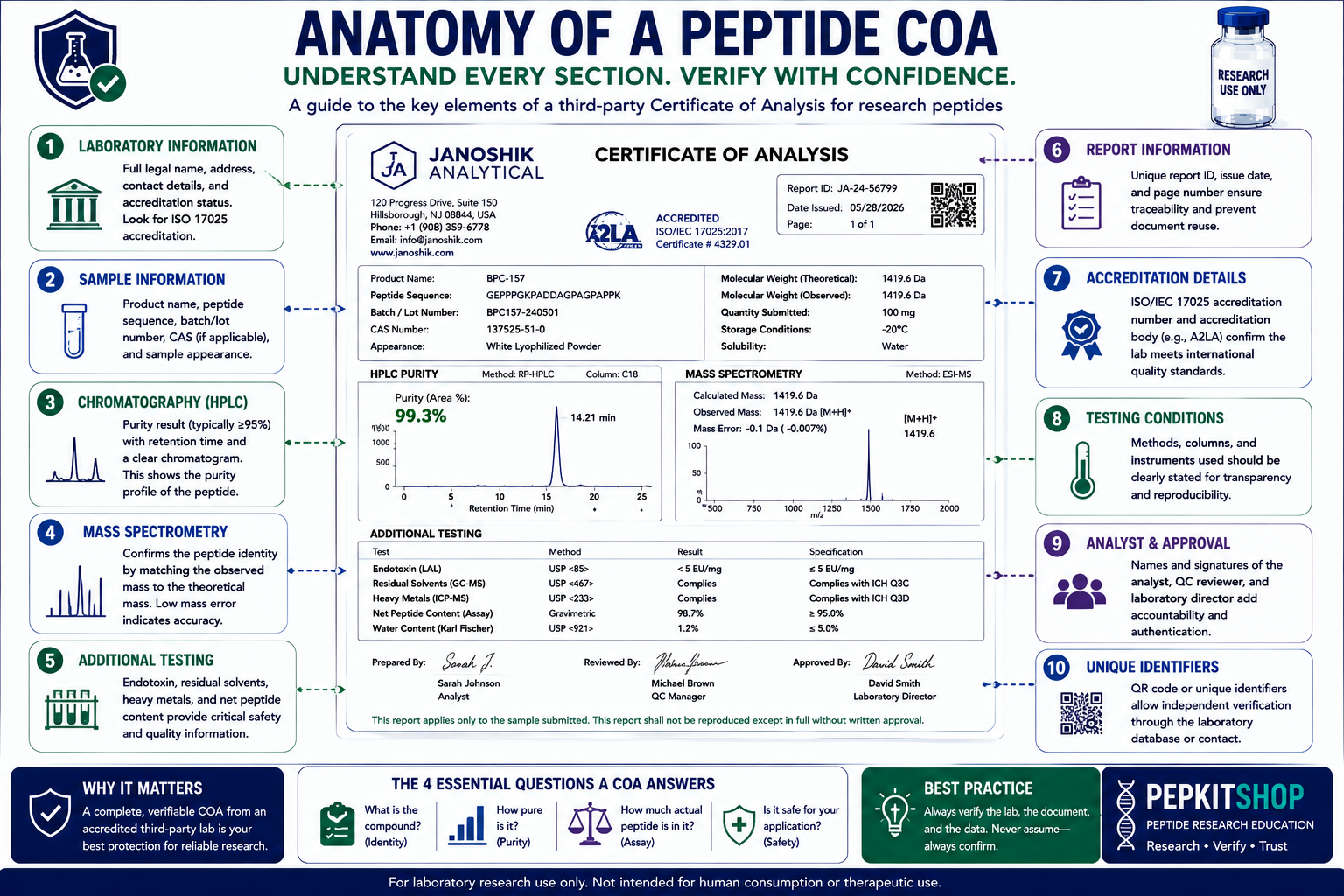
How to verify a peptide certificate of analysis from a third party laboratory matters more in 2026 than at any previous point in the research peptide market.
Independent testing has repeatedly flagged grey-market products that failed identity or purity expectations, including batches sold as popular compounds that received failing grades. Third-party testing works precisely because it sometimes catches products that the seller’s own marketing would never admit to. When a vendor points to recent, independent, lot-specific results that anyone can read, that is the strongest signal available.
A COA from a laboratory you cannot independently verifyovia A2LA, ILAC, or a direct call to the lab using contact details you found yourself, not from the document, is not a third-party COA in any meaningful sense.
This second point is the foundation of how to verify a peptide certificate of analysis from a third party laboratory. The contact details you use to verify the laboratory must come from your own independent search, not from the COA document itself. A supplier who has fabricated a laboratory can equally fabricate a phone number and email address on the COA that routes back to themselves. Independently finding and contacting the laboratory using information from your own search is what makes verification meaningful.
Vendors have been known to fabricate COAs. If COA references a third party lab, independently contact the lab to verify COA authenticity. For in-house testing, request evidence of lab accreditation. Compare COA values against USP monograph standards where available.
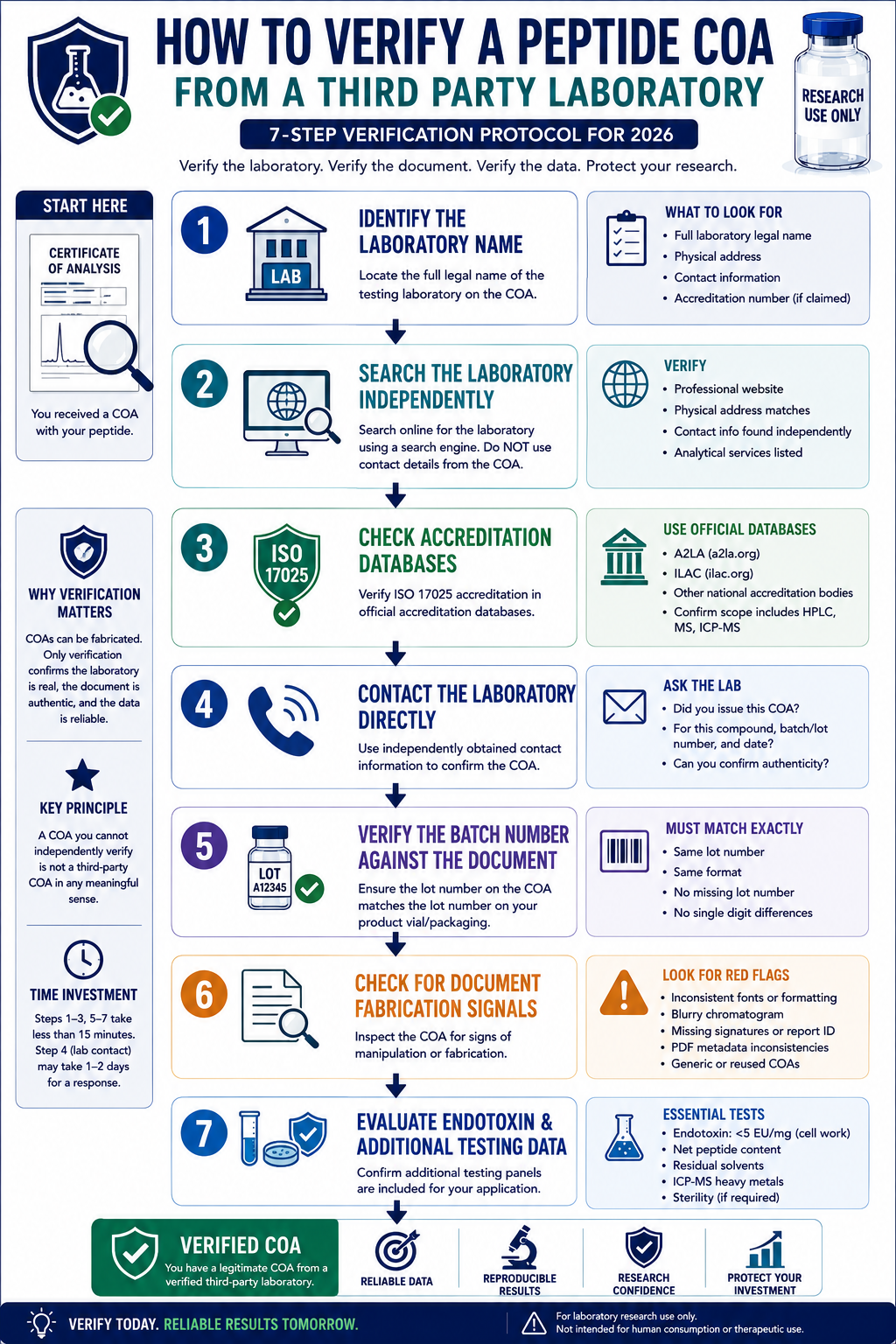
How to verify a peptide certificate of analysis from a third party laboratory follows seven specific steps. Each step addresses a different failure mode in COA documentation.
| Step | What It Checks | Time Required |
|---|---|---|
| 1. Identify laboratory name | Laboratory is named and identifiable | 1 minute |
| 2. Independent search | Laboratory has verifiable online presence | 5 minutes |
| 3. Accreditation database check | Laboratory holds ISO 17025 or equivalent | 5 to 10 minutes |
| 4. Direct laboratory contact | Laboratory confirms issuing the specific COA | 1 to 2 days |
| 5. Batch number verification | COA lot number matches product received | 1 minute |
| 6. Document fabrication check | Document shows no signs of manipulation | 5 minutes |
| 7. Additional testing evaluation | Endotoxin and other panels present where required | 5 minutes |
The full protocol takes less than 15 minutes for steps 1 through 3, 5, 6, and 7. Step 4 requires contacting the laboratory and waiting for a response, which for serious research applications is worth the additional time.
For routine purchases from established suppliers with long track records of verified documentation, steps 1, 3, and 5 alone provide meaningful baseline verification. For first purchases from any supplier, or for critical research applications, all seven steps should be completed.
How to verify a peptide certificate of analysis from a third party laboratory begins with finding the laboratory name.
A complete COA clearly identifies the testing laboratory by its full legal business name. This information should appear on the COA header, in a laboratory certification block, or in the report footer.
Testing by an unnamed lab is a major red flag. Third-party testing should identify the laboratory that conducted the analysis. Unnamed third-party lab language without a specific accredited laboratory identified is not verifiable and does not meet the standard for independent verification.
What you are looking for at this step:
The full legal name of the testing laboratory, not a generic description like “independent laboratory” or “certified testing facility.” A physical address for the laboratory location. Contact information such as a phone number and email address, noting that you will verify these independently in step 4 rather than using them directly from the document. An accreditation certificate number or accreditation body reference if ISO 17025 accreditation is claimed.
If a COA does not name the testing laboratory, the document provides no verifiable quality assurance regardless of what numbers it contains. This is a disqualifying finding and no further verification steps are necessary.
How to verify a peptide certificate of analysis from a third party laboratory at the search level requires finding the laboratory through your own independent research.
Take the laboratory name identified in step 1 and search for it using a standard web search engine. What you are looking for:
A dedicated laboratory website with a professional presence consistent with an analytical testing business. Physical address that matches the address on the COA and can be located on mapping services. Contact information, including phone number and email, that you will use independently in step 4 rather than the information provided on the COA. Evidence of the laboratory’s analytical capabilities, such as service listings for HPLC, mass spectrometry, or ICP-MS testing. Client testimonials, published reports, or community references that confirm the laboratory serves clients in the research or pharmaceutical space.
Red flag: a COA created by the manufacturer themselves which introduces a conflict of interest. Green flag: a COA from an accredited, independent third-party laboratory, dated within the last 6 to 12 months.
If your independent search cannot locate the laboratory at all, or if the laboratory appears to have been registered very recently with no established presence, this is a strong signal that the laboratory may not be legitimate. Do not proceed with using the compound for critical research without additional verification.
How to verify a peptide certificate of analysis from a third party laboratory at the accreditation level requires searching publicly maintained databases.
ISO 17025 accreditation is the international standard for testing and calibration laboratories. An ISO 17025 accredited laboratory has been assessed by an independent accreditation body and found to meet specific requirements for technical competence, management systems, and method validation. Accreditation must be maintained through periodic surveillance assessments and renewals.
A COA from a laboratory you cannot independently verify via A2LA, ILAC, or a direct call to the lab is not a third-party COA in any meaningful sense.
| Database | Coverage | URL | How to Search |
|---|---|---|---|
| A2LA (American Association for Laboratory Accreditation) | United States | a2la.org | Search by laboratory name or accreditation number |
| ILAC (International Laboratory Accreditation Cooperation) | International | ilac.org | Links to member accreditation bodies worldwide |
| UKAS (United Kingdom Accreditation Service) | United Kingdom | ukas.com | Search accredited laboratory directory |
| DAkkS (Deutsche Akkreditierungsstelle) | Germany | dakks.de | Search accredited bodies database |
| COFRAC (Comité Français d’Accréditation) | France | cofrac.fr | Search accredited laboratory directory |
To verify accreditation for a laboratory claiming ISO 17025 status, visit the A2LA accreditation database or the appropriate database for the laboratory’s country, search for the laboratory by name, and confirm that its accreditation is current and covers the specific testing methods relevant to peptide analysis, specifically HPLC, mass spectrometry, and ICP-MS.
If the laboratory claims ISO 17025 accreditation but cannot be found in the relevant accreditation database, or if its accreditation has lapsed, the accreditation claim is false. This is a disqualifying finding.
If the laboratory does not claim ISO 17025 accreditation, it may still be a legitimate analytical laboratory, but its testing results carry less formal assurance. In this case, step 4, direct contact, becomes more important for establishing confidence in the documentation.
How to verify a peptide certificate of analysis from a third party laboratory most definitively requires contacting the laboratory directly.
This step is the most robust verification available and the hardest for a supplier to circumvent through document fabrication. A laboratory that actually performed the testing can confirm, when contacted through independently obtained contact information, that it issued the specific COA in question.
The contact information you use must come from your independent search in step 2, not from the COA document. This distinction is critical. A supplier who has fabricated a COA with a fictional laboratory can also include a phone number that routes to themselves or to a confederate. Using contact information you found independently eliminates this risk.
What to say when contacting the laboratory:
Provide the laboratory with the compound name, batch or lot number, and testing date from the COA. Ask the laboratory to confirm whether it issued a Certificate of Analysis matching those details. Ask whether it can share any identifying information from its records that confirms the document’s authenticity.
A legitimate laboratory will be able to confirm that it issued the document and will not be surprised by the request. Verification requests are routine in pharmaceutical and research supply chains. A laboratory that becomes evasive, claims no knowledge of the COA, or provides inconsistent information is a signal that the document’s authenticity is questionable.
Third-party testing refers to quality analysis performed by external, accredited laboratories with no financial stake in product sales. This provides objective data that eliminates conflicts of interest in quality reporting.
How to verify a peptide certificate of analysis from a third party laboratory requires matching the document to your specific product.
This step takes less than one minute and eliminates one of the most common forms of COA fraud in the research peptide market: providing legitimate documentation from a real batch while shipping product from a different, untested batch.
The batch or lot number on the COA must match exactly the batch or lot number printed on your product vial or packaging. Even a single digit difference indicates the COA does not apply to what you received.
Start by matching lot numbers, checking for full chromatograms, and confirming a named laboratory. Then verify third-party task IDs directly with the lab when possible. Generic PDFs reused across multiple products or missing method data are major warning signs.
If your product arrived without a lot number on the vial or packaging, this itself is a documentation failure. Legitimate research grade compounds are labeled with batch identifiers that allow their documentation to be traced. Product received without lot number identification cannot be matched to any COA regardless of what the supplier provides.
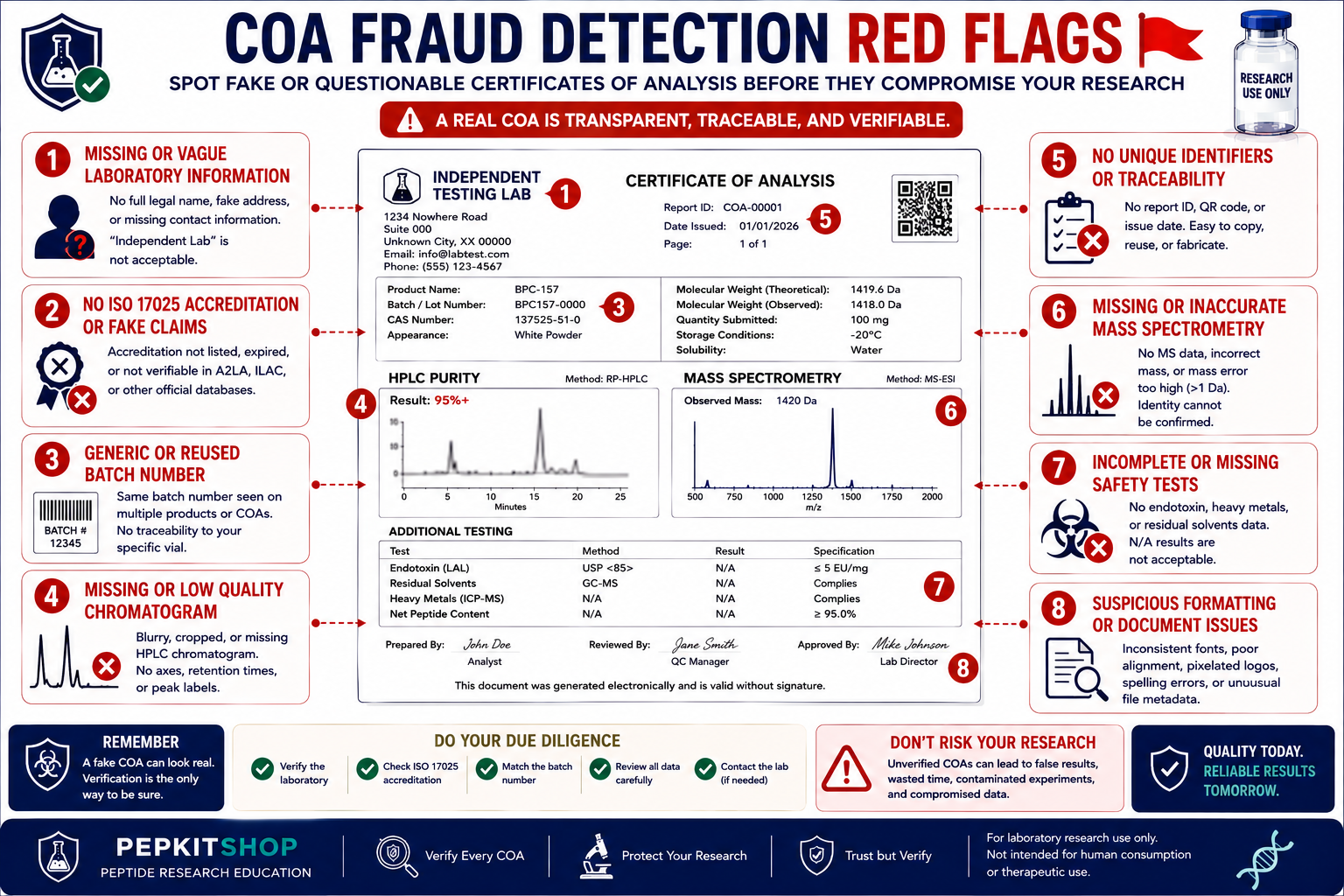
How to verify a peptide certificate of analysis from a third party laboratory includes checking the document itself for signs of manipulation.
With basic image editing skills, anyone can fabricate a COA. The unique key verification system is the protection against this: if the COA does not verify, it does not matter how legitimate the document looks.
Visual inspection of a COA cannot definitively confirm its authenticity, but certain signals suggest document manipulation:
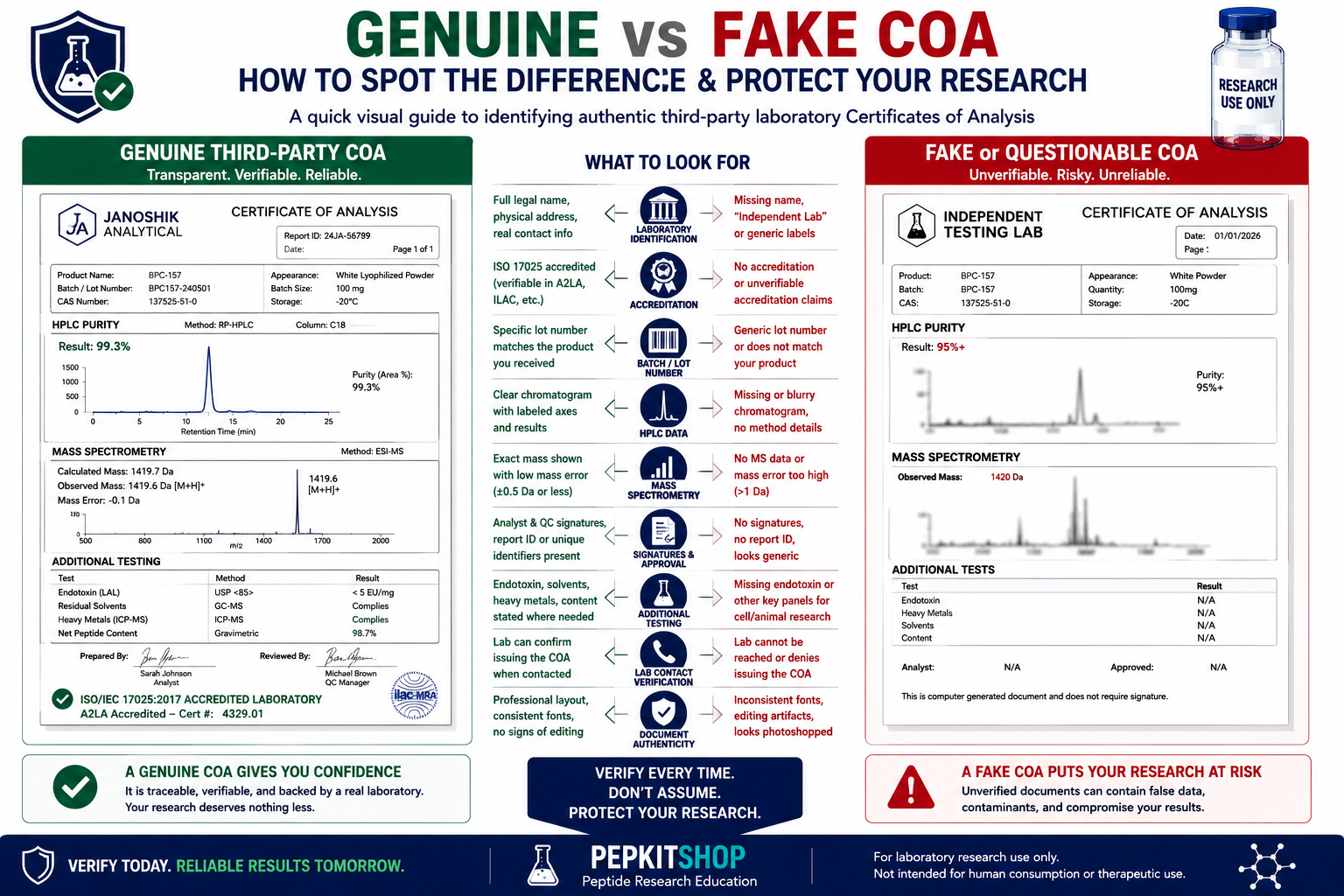
| Signal | Legitimate COA | Potentially Fabricated COA |
|---|---|---|
| Font consistency | Uniform throughout document | Mixed fonts or sizes within same section |
| Data alignment | Consistent table alignment and spacing | Misaligned data within tables |
| Logo quality | Clean, high resolution laboratory logo | Pixelated or low resolution logo suggesting screenshot or paste |
| Chromatogram quality | Clear, properly labeled axes and peaks | Blurry chromatogram suggesting image insertion |
| Metadata | PDF metadata shows laboratory as author | PDF metadata shows unrelated software or author |
| Digital signature | Laboratory digital signature present where applicable | Absent where claimed |
| Unique identifiers | Report number, analyst signature, QC approval | Generic document with no unique identifiers |
To check PDF metadata on a computer, open the PDF, go to File, then Properties or Document Properties. The metadata will show when the document was created, what software created it, and who the author is listed as. A COA created by laboratory analysis software from the testing laboratory’s systems will show that laboratory’s information. A COA created in Microsoft Word or consumer PDF software and attributed to a different author raises questions about document authenticity.
A ±0.1% tolerance on a 3,000 Da peptide allows a ±3 Da variance, which is wide enough to mask truncated sequences or incorrect amino acid substitutions. Similarly, HPLC purity above 95% sounds acceptable, but a chromatogram showing significant secondary peaks or an elevated baseline tells a different story than the single number alone.
How to verify a peptide certificate of analysis from a third party laboratory is complete only when additional testing panels are evaluated for applications that require them.
A credible COA answers four questions: What is the compound? confirmed by mass spectrometry. How pure is it? confirmed by HPLC. How much actual peptide is in the powder? confirmed by net peptide content. And is it safe for cell based work? confirmed by endotoxin and contaminant testing. A COA that cannot answer all four is incomplete. The most common gap in commercial RUO COAs is the absence of endotoxin testing, which matters for cell based research even when HPLC and mass spectrometry results look perfect.
| Test | What It Measures | Required For | Acceptable Result |
|---|---|---|---|
| Endotoxin (LAL assay) | Bacterial endotoxin contamination in EU per mg | Any cell based assay, immune cell work, inflammation research | Below 5 EU per mg |
| Net peptide content | Actual peptide mass versus total powder weight | Quantitative dose-response research | Stated as percentage of labeled weight |
| Residual solvents | TFA, acetonitrile, DMF, DMSO levels | Any sensitive biological assay | Below ICH Q3C limits |
| ICP-MS heavy metals | Lead, arsenic, cadmium, mercury | Cell based assays, animal studies | Below detectable limits |
| Sterility | Microbial contamination | Any aseptic research application | No growth |
Quality peptide COAs report HPLC purity of 95% or higher, accurate mass spectrometry confirmation, endotoxin levels below 5 EU per mg, and bacterial counts under 100 CFU per gram. Third party laboratories like Janoshik Analytical or Colmaric Analyticals typically generate these reports within 7 to 14 days of production.
Endotoxin testing is the most commonly omitted additional panel and the one with the most direct impact on cell based research validity. Endotoxins are bacterial cell wall components that trigger powerful immune responses at very low concentrations. A peptide with perfect HPLC purity and confirmed mass spectrometry identity can still produce confounded results in cell culture or animal studies if it carries endotoxin contamination. For any research involving cell lines, immune cells, or inflammation pathways, endotoxin documentation is not optional.
How to verify a peptide certificate of analysis from a third party laboratory is informed by knowing which laboratories have established credibility in the research peptide community.
Independent, accredited third-party laboratories exist specifically to provide independent checking, and reputable analytical labs in this space such as Janoshik Analytical publish testing that buyers and communities can scrutinize.
Third-party laboratories like Janoshik Analytical or Colmaric Analyticals typically generate these reports within 7 to 14 days of production.
| Laboratory | Known For | Community Recognition |
|---|---|---|
| Janoshik Analytical | HPLC and mass spectrometry peptide testing, public result database | Widely referenced in research peptide community, results publicly searchable |
| Colmaric Analyticals | Peptide purity and identity testing | Established reputation in US research peptide community |
| MZ Biolabs | Comprehensive peptide analytical testing | Used by multiple established suppliers |
| Eurofins | Large international accredited laboratory network | ISO 17025 accredited, pharmaceutical and research testing |
| SGS | Global accredited testing and inspection organization | ISO 17025 accredited, broad analytical capabilities |
Janoshik Analytical deserves particular mention because of its public result database. Unlike most testing laboratories whose results are private client documents, Janoshik publishes its analytical results in a publicly searchable database. This means any researcher can search for results from a specific compound or supplier and see what independent testing has found, without needing to request documents from the supplier at all. This public transparency model represents one of the most robust quality verification tools available in the 2026 research peptide market.
At Pepkitshop, our compounds are tested through established third party laboratories with verifiable accreditation. We believe that knowing how to verify a peptide certificate of analysis from a third party laboratory empowers researchers to hold any supplier accountable, including us.
How to verify a peptide certificate of analysis from a third party laboratory in a single reference checklist:
| Step | Check | Pass or Fail |
|---|---|---|
| 1. Laboratory identification | Full legal laboratory name present on COA | Pass / Fail |
| 2. Independent search | Laboratory found through independent web search | Pass / Fail |
| 2. Independent search | Physical address independently confirmed | Pass / Fail |
| 3. Accreditation check | Laboratory found in A2LA, ILAC, or equivalent database | Pass / Fail |
| 3. Accreditation check | Accreditation is current, not lapsed | Pass / Fail |
| 3. Accreditation check | Accreditation covers HPLC and MS testing methods | Pass / Fail |
| 4. Direct contact | Laboratory contacted using independently obtained information | Pass / Fail |
| 4. Direct contact | Laboratory confirms issuing COA for stated batch | Pass / Fail |
| 5. Batch verification | Lot number on COA matches lot number on product | Pass / Fail |
| 5. Batch verification | Product arrived with identifiable lot number | Pass / Fail |
| 6. Document check | Font and formatting consistent throughout | Pass / Fail |
| 6. Document check | Chromatogram present and clearly labeled | Pass / Fail |
| 6. Document check | PDF metadata consistent with laboratory origin | Pass / Fail |
| 7. Additional testing | Endotoxin data present for cell based applications | Pass / Fail |
| 7. Additional testing | Net peptide content stated | Pass / Fail |
| 7. Additional testing | ICP-MS heavy metal panel present where required | Pass / Fail |
How to verify a peptide certificate of analysis from a third party laboratory begins with finding the laboratory name on the COA and then searching for it independently to confirm it exists. Do not use contact information from the COA document itself for verification. Find the laboratory through your own search and use that independently obtained information to make contact.
ISO 17025 is the international standard for testing and calibration laboratory competence. A laboratory with current ISO 17025 accreditation has been independently assessed and found to meet specific technical and management requirements. How to verify a peptide certificate of analysis from a third party laboratory using ISO 17025 databases means searching A2LA, ILAC, or the relevant national accreditation body to confirm current accreditation status and scope.
If a laboratory does not claim ISO 17025 accreditation, how to verify a peptide certificate of analysis from a third party laboratory requires placing greater weight on direct contact confirmation in step 4. An unaccredited laboratory may still be legitimate and competent, but without formal accreditation there is no independent assessment of its methods and systems. Direct confirmation of COA issuance is essential in this case.
Yes. With basic image editing skills anyone can fabricate a COA. The unique key verification system is the protection against this. If the COA does not verify, it does not matter how legitimate the document looks. How to verify a peptide certificate of analysis from a third party laboratory through accreditation database checks and direct laboratory contact is specifically designed to catch fabricated documents that would otherwise appear legitimate.
Janoshik Analytical is an independent testing laboratory that has established a public database of peptide testing results that anyone can search. How to verify a peptide certificate of analysis from a third party laboratory using Janoshik involves searching their public database for results from the supplier or compound in question. Published results from Janoshik are available to the research community regardless of whether the supplier chooses to share them. More detail on laboratory accreditation verification is available through the National Library of Medicine.
Endotoxin levels should be reported as below 5 EU per mg for any peptide intended for use in cell based assays or any biological research application. Endotoxin contamination at higher levels triggers immune responses in cell cultures that confound experimental results even when HPLC purity and mass spectrometry identity are both acceptable.
How to verify a peptide certificate of analysis from a third party laboratory for a new supplier purchase requires completing all seven steps in the full protocol. This includes accreditation database verification, direct laboratory contact, and batch number matching. For a first purchase from any supplier, the full verification protocol is warranted regardless of how professional the supplier appears. As covered in our guide on [what makes a research peptide supplier trustworthy], supplier appearance is not a reliable proxy for documentation authenticity.
This post is part of a growing educational library on research peptide quality verification. Related reading:
10-vial kits • Capsule packs as listed • Research use only
© 2026 Pepkitshop. All rights reserved.
Vial product prices are per kit of 10 vials. Quantity 1 = 10 vials. Capsule products retain the pack size stated on their listing.
All products are supplied strictly for laboratory research. They are not intended for human or veterinary use, consumption, diagnosis, or treatment.
WhatsApp us
 Optimized by Seraphinite Accelerator
