
No products in the cart.

Vial products: price per kit of 10 vials. Quantity 1 = 10 vials. Capsule products are priced per capsule pack as listed. Dismiss
By Pepkitshop | Peptide Research Education
Updated August 2026 | Educational Content, Not Medical Advice
Australia has emerged as a significant hub for peptide research, with world-class institutions contributing to scientific discovery across therapeutic, diagnostic, and biotechnological applications. The ARC Centre for Innovations in Peptide and Protein Science (CIPPS), a collaboration between the University of Queensland, University of Sydney, Australian National University, and Monash University, represents one of the most concentrated efforts in peptide science anywhere in the world.
This guide provides an overview of peptide research in Australia as of 2026, including key institutions, regulatory frameworks, and the distinction between approved therapeutic peptides and research-use-only compounds.
Australia has invested significantly in peptide science over the past decade. The ARC Centre for Innovations in Peptide and Protein Science (CIPPS) is the most visible example, bringing together researchers from four of Australia’s leading universities.
Key Australian Peptide Research Facts:
Australian scientists are at the forefront of venom-derived peptide research, with native species providing a unique library of bioactive compounds that could lead to new treatments for pain, cardiovascular disease, and autoimmune disorders.
Australian Research Institutions Advancing Peptide Science
Several Australian institutions are leading peptide research efforts:
UQ researchers are investigating venom peptides from Australian native species, including cone snails, spiders, and snakes. Their work focuses on understanding how these peptides interact with ion channels and receptors.
Sydney researchers are focused on peptide therapeutics, developing novel peptide-based treatments for chronic conditions. Their work includes peptide drug delivery systems and peptide engineering.
ANU scientists are studying peptide-protein interactions and developing peptide-based diagnostics. Their research includes computational peptide design and structural biology.
Monash researchers are exploring peptide-based materials and nanostructures, with applications in drug delivery and tissue engineering.
Australia’s national science agency conducts peptide research across multiple divisions, including peptide chemistry, analytical methods, and biotechnology applications.

Australia’s regulatory framework for peptides is governed by the Therapeutic Goods Administration (TGA), which operates under the Therapeutic Goods Act 1989.
The TGA regulates therapeutic goods, including peptides that are intended for human use. Peptides that are not listed on the Australian Register of Therapeutic Goods (ARTG) cannot be supplied for therapeutic use in Australia.
Key points about the TGA framework:
The TGA has explicitly stated that products labelled “for research use only” or similar disclaimers do not circumvent the requirement for therapeutic goods to be included in the ARTG before supply.
Several peptide-based therapeutics are approved for use in Australia through the TGA’s ARTG pathway.
| Peptide | Indication | Category |
|---|---|---|
| Insulin | Diabetes management | Therapeutic peptide |
| GLP-1 receptor agonists (Ozempic, Trulicity, etc.) | Type 2 diabetes, weight management | Therapeutic peptide |
| Glucagon | Severe hypoglycemia | Therapeutic peptide |
| Calcitonin | Osteoporosis, Paget’s disease | Therapeutic peptide |
| Desmopressin | Diabetes insipidus, bleeding disorders | Therapeutic peptide |
| Oxytocin | Labor induction, postpartum hemorrhage | Therapeutic peptide |
These peptides have undergone the full TGA regulatory pathway, including clinical trials and safety assessments. They are available by prescription only.
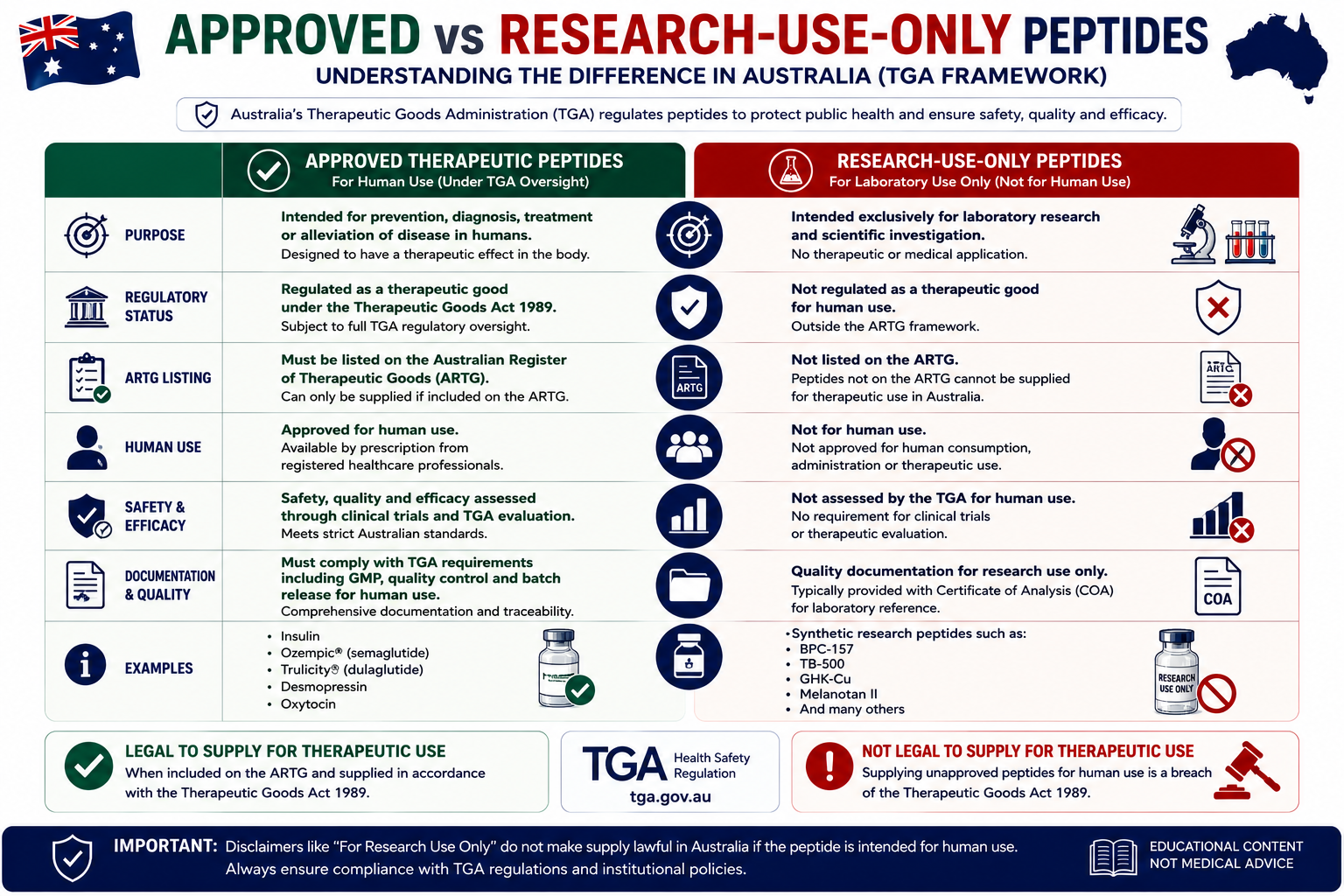
Research peptides sold in Australia for laboratory study sit outside the ARTG framework. They are not approved for human use and are not intended for therapeutic application.
Recent TGA enforcement actions have targeted suppliers of unapproved peptide products, with infringement notices, fines, and product seizures. The TGA has stated that it will continue to prioritize this area.
For researchers working in Australian institutions, sourcing research peptides requires understanding these boundaries and ensuring compliance with institutional and federal regulations.
More detail on regulatory frameworks is available through the TGA official website.
Australian peptide research stands out in several areas:
Australia’s unique biodiversity provides access to venom peptides from native species not found elsewhere. This gives Australian researchers a distinctive advantage in this research area.
CIPPS represents a collaborative research model that brings together multiple universities, researchers, and disciplines. This approach accelerates peptide discovery and development.
Australia’s TGA framework provides clear regulatory guidance for therapeutic peptides, which supports the development of approved peptide therapeutics.
Australian researchers collaborate extensively with international institutions, including US, UK, and European partners, facilitating global knowledge sharing.
Several trends will shape the future of peptide research in Australia:
| Area | Potential Impact |
|---|---|
| Venom-derived therapeutics | New pain treatments, cardiovascular therapies, autoimmune treatments |
| Peptide drug delivery | Improved targeting, reduced side effects |
| Peptide diagnostics | New diagnostic tools for infectious and chronic diseases |
| Peptide materials | Biodegradable materials for medical devices and tissue engineering |
| Peptide-based vaccines | New approaches to immunization and immune modulation |
The TGA’s 2026 enforcement priorities indicate that Australia will continue to maintain a clear distinction between approved therapeutic peptides and research-use-only compounds. Researchers should stay informed about regulatory updates.
Continued investment in peptide research through institutions like CIPPS and CSIRO positions Australia as a significant contributor to global peptide science.
Peptide research in Australia is focused on venom-derived peptide discovery, therapeutic peptide development, peptide engineering, peptide diagnostics, and peptide-based materials. The ARC Centre for Innovations in Peptide and Protein Science (CIPPS) coordinates research across multiple Australian universities.
The TGA regulates therapeutic peptides through the Australian Register of Therapeutic Goods (ARTG). Peptides intended for human use must be listed on the ARTG before supply. The TGA has designated unapproved peptides as an enforcement priority in 2026.
Approved therapeutic peptides in Australia include insulin, GLP-1 receptor agonists (Ozempic, Trulicity), glucagon, calcitonin, desmopressin, and oxytocin. These peptides have undergone TGA assessment and are available by prescription.
Research peptides sold exclusively for laboratory use are not approved for human use and are not intended for therapeutic application. The TGA enforces the distinction between approved therapeutic peptides and research-use-only compounds.
The ARC Centre for Innovations in Peptide and Protein Science (CIPPS) is a collaboration between the University of Queensland, University of Sydney, Australian National University, and Monash University. It represents one of the most concentrated peptide research efforts in the world.
Detailed information about TGA peptide regulations is available through the TGA official website. Additional scientific research on peptide science can be found through the National Library of Medicine.
This post is part of a growing educational library on peptide research and science. Related reading:
Subscribe for updates as this educational library continues to grow, evidence based peptide research guidance explained clearly and practically.
This content is for educational and informational purposes only. It does not constitute medical advice, diagnosis, or treatment recommendations. Research peptides are for laboratory use only and are not approved for human consumption or therapeutic use. Always consult a qualified healthcare professional before making any decisions related to your health.
10-vial kits • Capsule packs as listed • Research use only
© 2026 Pepkitshop. All rights reserved.
Vial product prices are per kit of 10 vials. Quantity 1 = 10 vials. Capsule products retain the pack size stated on their listing.
All products are supplied strictly for laboratory research. They are not intended for human or veterinary use, consumption, diagnosis, or treatment.
WhatsApp us
 Optimized by Seraphinite Accelerator
