
No products in the cart.

Vial products: price per kit of 10 vials. Quantity 1 = 10 vials. Capsule products are priced per capsule pack as listed. Dismiss
By Pepkitshop | Peptide Research Education
Updated July 2026 | Educational Content, Not Medical Advice
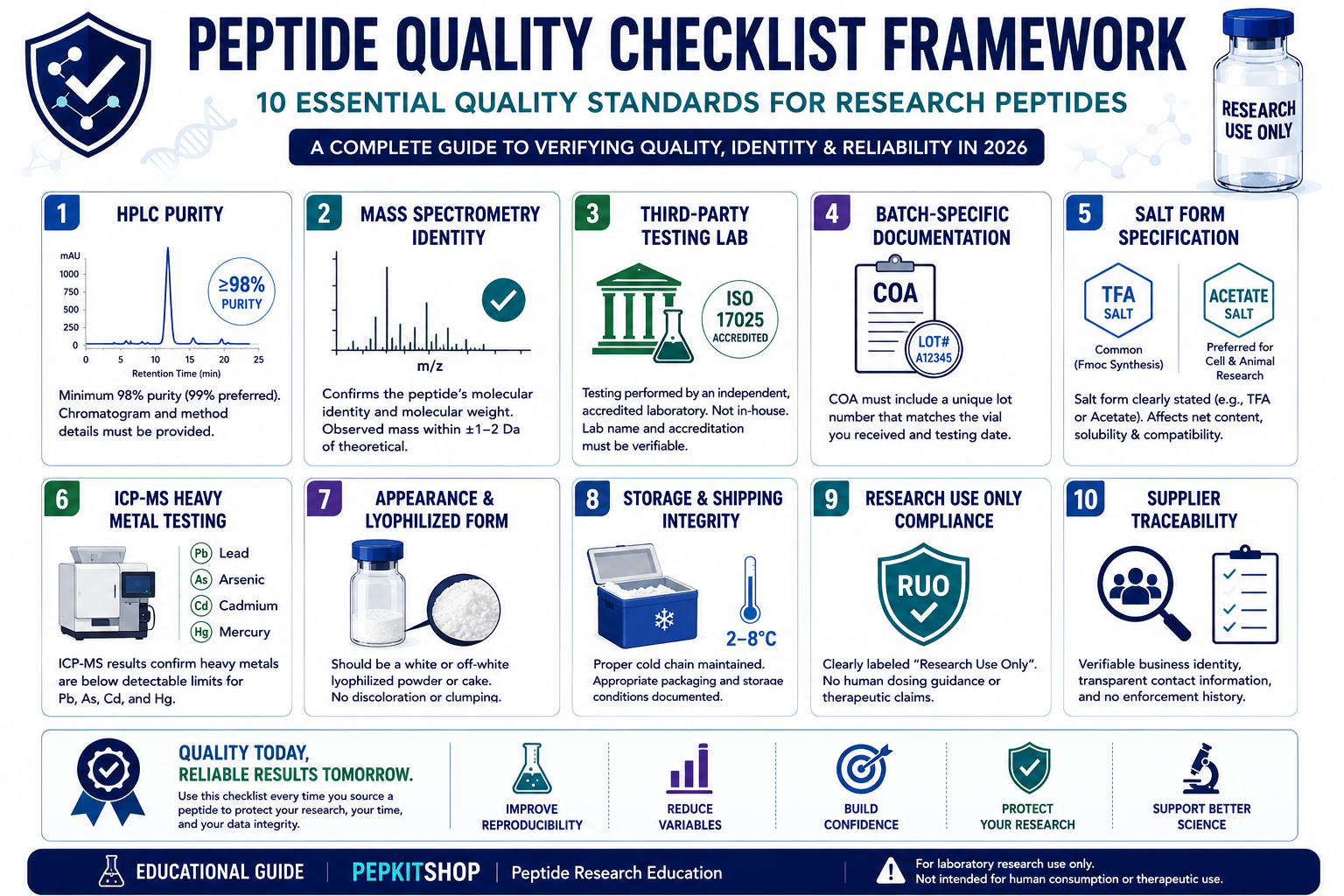
How do you know if a research peptide is genuinely high quality and what specific standards should you check before using any compound in your research?
The research peptide market contains a wide spectrum of quality. Some suppliers provide compounds with verified 99% purity, documented identity confirmation, and complete third party testing. Others provide compounds with questionable documentation, unverified purity, and no independent quality assurance. The difference between the two affects the reliability of your research.
This peptide quality checklist provides the complete framework for evaluating any research peptide compound before you use it. Ten specific, verifiable standards drawn from the 2026 regulatory and analytical landscape. A printable checklist you can apply to any compound from any supplier.
If you are not yet familiar with how to evaluate a peptide COA, read our guide on [how to read a peptide COA] first. This checklist builds directly on that foundation.
What is a peptide quality checklist and why is it essential for researchers in 2026?
A quality checklist for research peptides is not a bureaucratic exercise. It is the primary defense against wasted time, ruined experiments, and unreliable data. Every researcher sourcing compounds for in vitro or animal studies should have a structured evaluation process that includes purity verification, identity confirmation, independent testing documentation, and supplier assessment.
The consequences of using an unverified peptide are not theoretical. Even small peptide impurities of 2 to 5% can alter biological response in tissue assays. Without verification, you cannot distinguish between the peptide’s actual activity and the activity of contaminants.
The June 2026 EMA guideline and March 2025 FDA guidance have both raised documentation expectations for research grade peptides. This means the standards that were considered sufficient in 2023 or 2024 are no longer adequate for serious research in 2026.
A peptide quality checklist provides structured, objective evaluation. It prevents the common error of assuming quality based on professional website appearance or supplier reputation alone. It ensures that every compound is evaluated against the same standards before use.
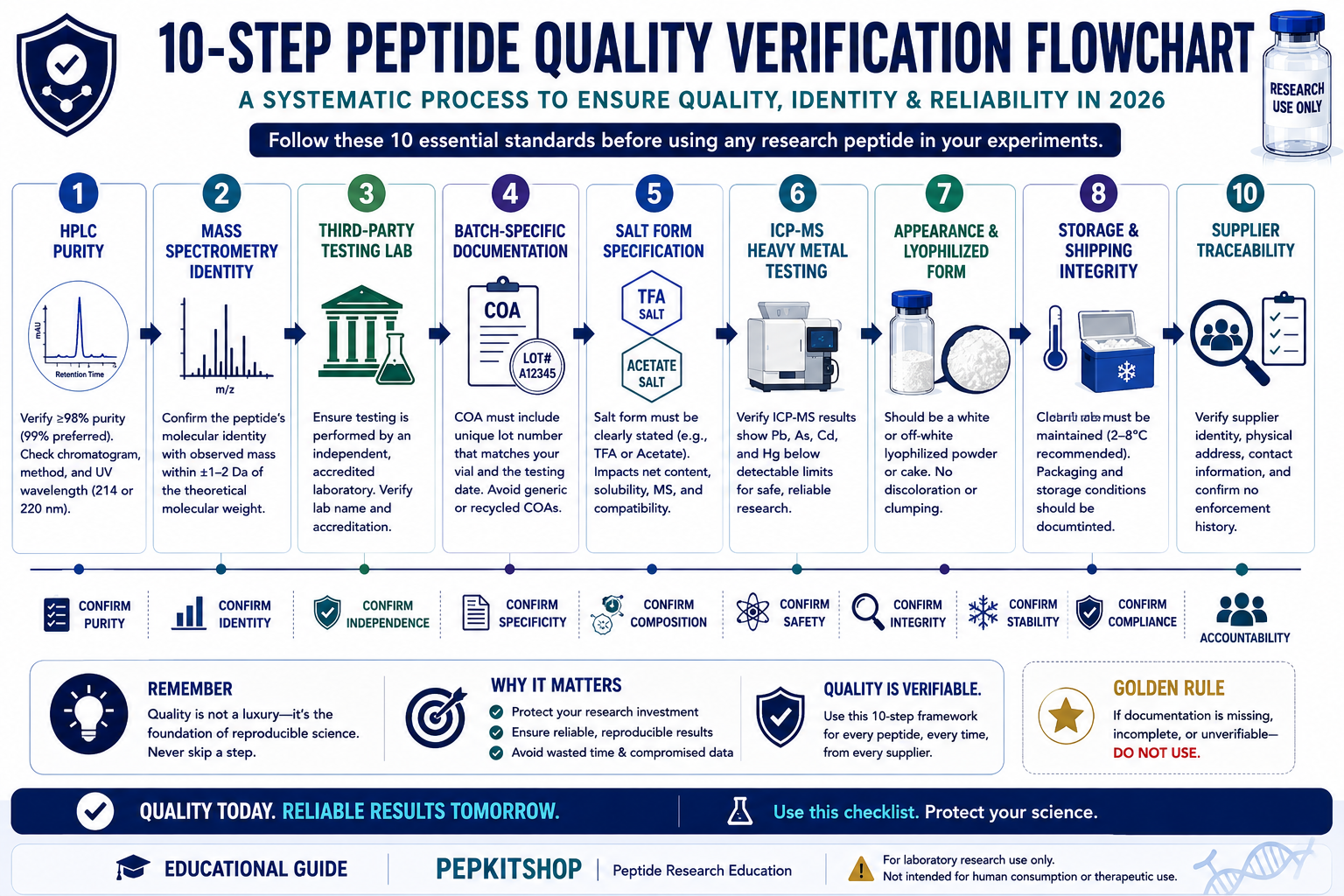
What is a peptide quality checklist organized into for practical use?
The ten standards below are ordered roughly by importance. The first five standards are non-negotiable for any research application. The last five are essential for serious research but may be weighted differently depending on the specific application.
The 10 Essential Peptide Quality Standards Overview
| # | Standard | What It Verifies | Non-Negotiable? |
|---|---|---|---|
| 1 | HPLC Purity | Percentage of sample that is the target peptide | ✅ Yes |
| 2 | Mass Spectrometry Identity | Compound is actually the claimed peptide | ✅ Yes |
| 3 | Third Party Testing Laboratory | Testing is independent of the supplier | ✅ Yes |
| 4 | Batch Specific Documentation | COA applies to your specific product lot | ✅ Yes |
| 5 | Salt Form Specification | Counterion is known and appropriate | ✅ Yes |
| 6 | ICP-MS Heavy Metal Testing | Compound is free from toxic heavy metal contamination | ⚠️ Strongly Recommended |
| 7 | Appearance and Lyophilized Form | Physical condition matches expectations | ⚠️ Strongly Recommended |
| 8 | Storage and Shipping Integrity | Compound handling preserved quality | ⚠️ Recommended |
| 9 | Research Use Only Compliance | Supplier operates within legal framework | ✅ Yes |
| 10 | Supplier Traceability | Supplier is verifiable and accountable | ✅ Yes |
What is a peptide quality checklist starting point for evaluating any compound?
HPLC purity is the most basic quality metric for any peptide compound. As covered in our guide on [peptide purity], HPLC measures the percentage of the sample that is the target peptide versus impurities and synthesis byproducts.
For research use, the minimum acceptable purity is 98%. In 2026, serious suppliers publish to 99% HPLC purity as standard. Anything below 98% is not research grade.
HPLC Purity Quality Standard
| Check | Requirement | Verification |
|---|---|---|
| Purity percentage | 98% or higher minimum, 99% preferred | Find on COA, confirm level |
| UV wavelength | 214 nm or 220 nm stated | Check COA for wavelength specification |
| Chromatogram | Included, shows dominant single peak | Visually inspect for one main peak |
| Method description | Column type, mobile phase stated | Check COA for methodology details |
Key Consideration: HPLC purity alone is not sufficient for complete quality verification. A compound can be pure but still be the wrong compound. This is why Standard 2 (mass spectrometry identity) is equally essential.
What is a peptide quality checklist second most critical standard?
Mass spectrometry confirms that the compound in the vial is actually the peptide claimed, not a structurally different compound.
HPLC shows retention and relative peak area. Identity usually needs mass confirmation or another structural method. A purity number without identity context is incomplete.
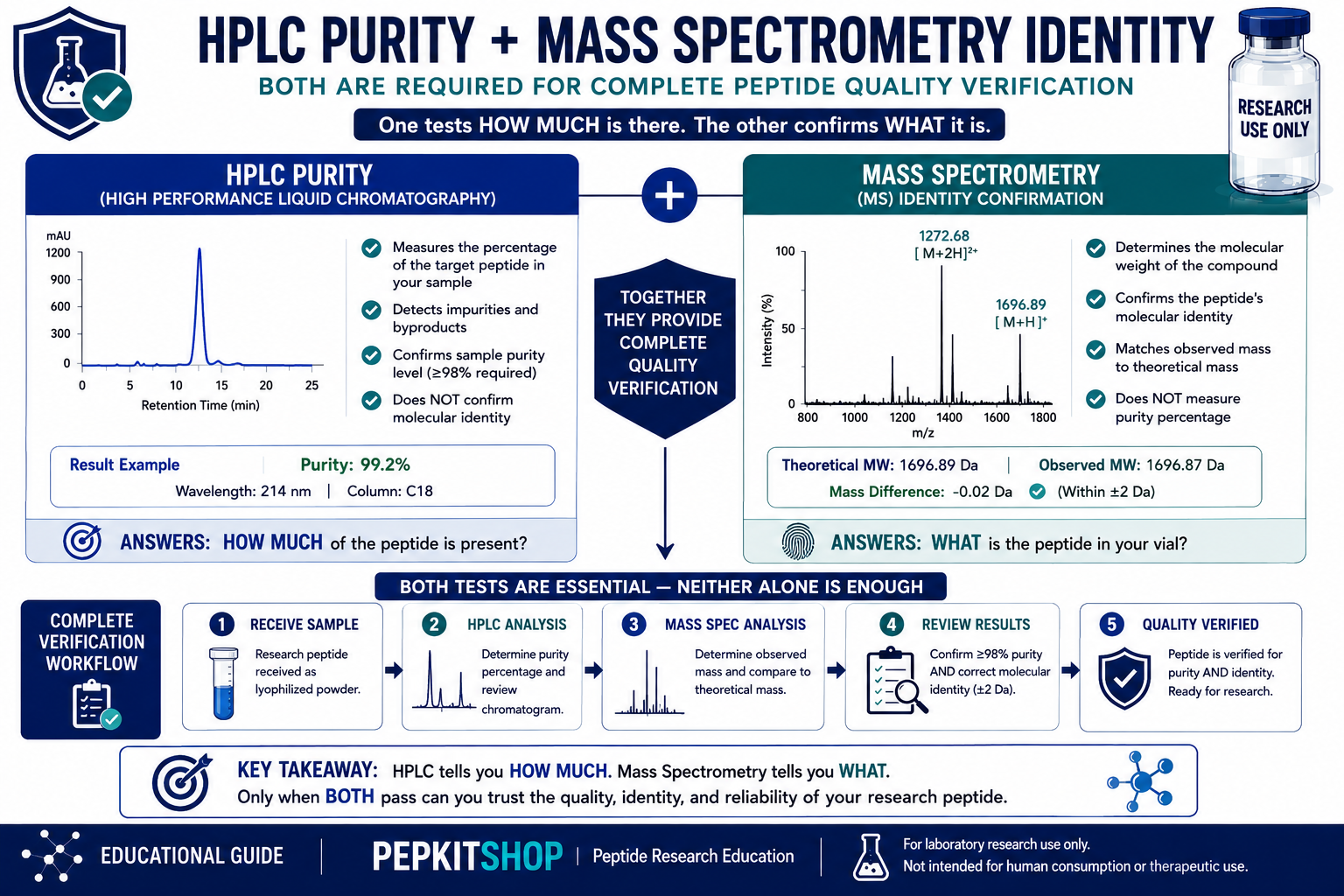
Mass Spectrometry Identity Standard
| Check | Requirement | Verification |
|---|---|---|
| MS data present | Yes, for this specific batch | Confirm MS data on COA |
| Theoretical MW stated | Calculated from sequence | Check COA for theoretical value |
| Observed MW stated | Actual measured mass | Check COA for observed value |
| Mass difference | Within 1 to 2 daltons of theoretical | Calculate difference |
Key Consideration: A COA with HPLC data but no mass spectrometry data has verified purity but has not confirmed identity. This is a significant quality gap that should be addressed before use.
What is a peptide quality checklist independence requirement?
The testing laboratory must be independent of the supplier for the COA to provide meaningful quality assurance. In-house testing cannot be independently verified.
Third Party Laboratory Standard
| Check | Requirement | Verification |
|---|---|---|
| Laboratory named | Clear identification on COA | Find lab name on COA |
| Laboratory verifiable | Can be found via web search | Search independently |
| Laboratory address | Physical location stated | Confirm existence |
| Accreditation | ISO 17025 or equivalent preferred | Check accreditation body database |
| Not in-house | Not owned by supplier | Verify independence |
Key Consideration: A COA without a named testing laboratory provides no independent verification. A COA with a named laboratory that cannot be independently verified is equally problematic.
What is a peptide quality checklist lot verification requirement?
A COA is only meaningful if it applies to the specific batch of product you received. Generic COAs and recycled COAs provide no meaningful quality assurance.
Batch Specific Documentation Standard
| Check | Requirement | Verification |
|---|---|---|
| Lot number on COA | Present, specific | Find batch number on COA |
| Lot number matches product | Identical to vial or packaging | Compare COA and vial numbers |
| Testing date | Present, specific date | Check date on COA |
| Testing recency | Within 24 months | Calculate time since testing |
Key Consideration: A COA that appears complete but has a batch number that does not match your product is documentation of a different compound entirely. This is one of the most common and most dangerous quality gaps.
What is a peptide quality checklist counterion transparency requirement?
As covered in our guide on acetate vs TFA salt forms, the counterion associated with the peptide affects actual peptide content by weight, compatibility with cell-based research, and mass spectrometry performance.
Salt Form Specification Standard
| Check | Requirement | Verification |
|---|---|---|
| Salt form specified | Clear identification on COA | Check for TFA or acetate designation |
| Counterion understood | Researcher knows implications | Review salt form implications for your application |
Key Consideration: TFA salt is the default from Fmoc synthesis. Acetate salt requires a conversion step and is preferred for cell-based and animal research. The absence of any salt form specification is a quality documentation gap.
What is a peptide quality checklist contamination verification requirement?
In 2026 a standard COA is no longer sufficient to meet modern compliance standards. To meet current standards, a COA must include: High Performance Liquid Chromatography to verify purity at 98% or higher, Mass Spectrometry to confirm molecular identity, and ICP-MS testing to verify heavy metal levels below detectable limits for lead, arsenic, cadmium, and mercury.
ICP-MS testing is the method used to detect trace heavy metal contamination that can confound cell-based and animal research results.
ICP-MS Heavy Metal Testing Standard
| Check | Requirement | Verification |
|---|---|---|
| ICP-MS data present | Yes, for this batch | Confirm ICP-MS data on COA |
| Lead (Pb) | Below detectable limits | Check specific values |
| Arsenic (As) | Below detectable limits | Check specific values |
| Cadmium (Cd) | Below detectable limits | Check specific values |
| Mercury (Hg) | Below detectable limits | Check specific values |
Key Consideration: ICP-MS testing is the quality standard that most suppliers skip. For cell-based assays and animal research, the absence of ICP-MS documentation is a significant quality gap that directly affects data reliability.
What is a peptide quality checklist physical condition requirement?
Research peptides should arrive as lyophilized powder, not pre-reconstituted solution. The physical appearance should match expectations for the specific compound and salt form.
Appearance and Form Standard
| Check | Requirement | Verification |
|---|---|---|
| Form | Lyophilized powder, not solution | Visual inspection of vial |
| Appearance | White or off-white powder or cake | Visual inspection |
| No discoloration | No unexpected color | Visual inspection |
| No clumping | Powder should be free-flowing | Visual inspection |
| Vial integrity | Vial intact, no damage | Physical inspection |
Key Consideration: A lyophilized peptide that appears discolored, clumped, or different from expectations may have been exposed to moisture, heat, or degradation.
What is a peptide quality checklist handling verification requirement?
A compound that meets all analytical standards at testing can still arrive degraded if stored or shipped improperly. Temperature control during shipping is particularly important for peptide stability.
Storage and Shipping Integrity Standard
| Check | Requirement | Verification |
|---|---|---|
| Shipping temperature | Cold packs used in warm conditions | Check packaging |
| Insulated packaging | Appropriate for transit time | Check packaging |
| Storage conditions documented | COA includes storage guidance | Check COA for storage section |
| Arrival temperature | Cool, not hot | Check upon arrival |
Key Consideration: As covered in our guide on how to store research peptides, heat is one of the four primary enemies of peptide stability. A compound that arrives warm after summer shipping may have degraded significantly.
What is a peptide quality checklist regulatory compliance requirement?
Reliable suppliers are transparent about sourcing, testing, storage, and legal status. The biggest red flags are human dosing advice, therapeutic claims, and pressure driven marketing.
A supplier providing human dosing guidance, making therapeutic or health benefit claims, or using marketing language implying personal use is operating outside the legal framework.
Research Use Only Compliance Standard
| Check | Requirement | Verification |
|---|---|---|
| RUO designation | Clear on website and packaging | Check product pages |
| No dosing guidance | No human use instructions | Check website and communications |
| No therapeutic claims | No health benefit statements | Check marketing language |
| Disclaimer language | Present on documentation | Check COA and packaging |
| Age verification | Check present if applicable | Check checkout process |
Key Consideration: A supplier willing to violate regulatory boundaries in marketing is a supplier whose quality documentation should also be viewed with skepticism.
What is a peptide quality checklist accountability requirement?
A supplier that cannot be independently identified as a real, legally registered business entity cannot be held accountable for product quality.
Supplier Traceability Standard
| Check | Requirement | Verification |
|---|---|---|
| Legal business identity | Verifiable entity | Search business registration |
| Physical address | Confirmable location | Check website and verify |
| Contact information | Working email or phone | Test contact details |
| No enforcement history | No FDA or regulatory actions | Search enforcement databases |
| Reputation | Community verified | Check independent platforms |
Key Consideration: Anonymous vendors, suppliers without verifiable business identity, and vendors with enforcement history cannot be held accountable for quality issues.
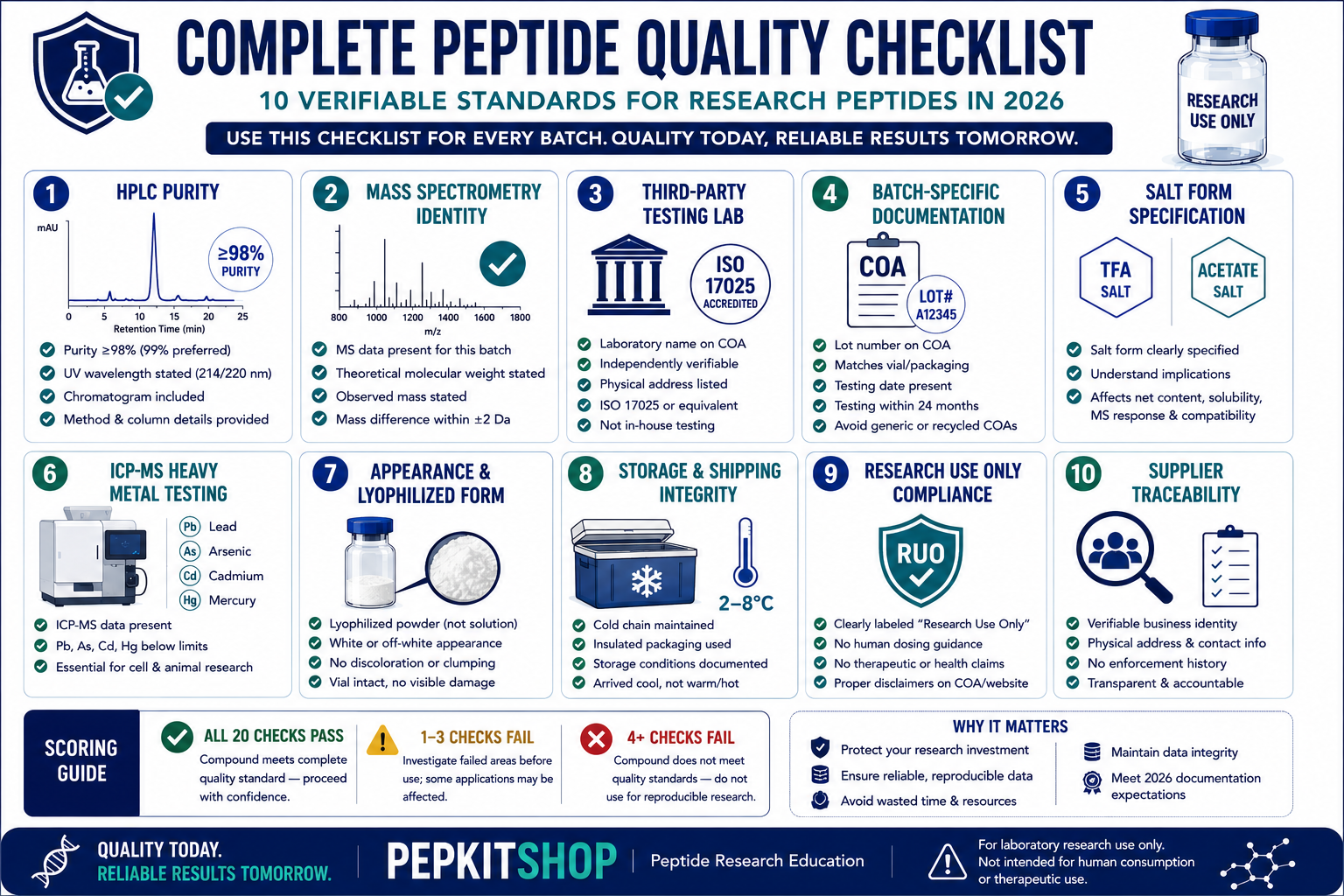
What is a peptide quality checklist in a single, printable format:
Complete Peptide Quality Checklist
| # | Standard | Check | Pass / Fail |
|---|---|---|---|
| 1 | HPLC Purity | Purity 98% or higher | ☐ Pass ☐ Fail |
| 1 | HPLC Purity | UV wavelength stated (214/220 nm) | ☐ Pass ☐ Fail |
| 1 | HPLC Purity | Chromatogram included | ☐ Pass ☐ Fail |
| 2 | MS Identity | MS data present for this batch | ☐ Pass ☐ Fail |
| 2 | MS Identity | Observed mass within 2 daltons of theoretical | ☐ Pass ☐ Fail |
| 3 | Third Party Lab | Laboratory named on COA | ☐ Pass ☐ Fail |
| 3 | Third Party Lab | Laboratory independently verifiable | ☐ Pass ☐ Fail |
| 4 | Batch Specific | Lot number present on COA | ☐ Pass ☐ Fail |
| 4 | Batch Specific | Lot number matches product | ☐ Pass ☐ Fail |
| 5 | Salt Form | Salt form explicitly specified | ☐ Pass ☐ Fail |
| 6 | ICP-MS | ICP-MS data present | ☐ Pass ☐ Fail |
| 6 | ICP-MS | Lead, arsenic, cadmium, mercury below limits | ☐ Pass ☐ Fail |
| 7 | Appearance | Lyophilized powder, not solution | ☐ Pass ☐ Fail |
| 7 | Appearance | Normal color, no clumping | ☐ Pass ☐ Fail |
| 8 | Storage/Shipping | Cold chain maintained | ☐ Pass ☐ Fail |
| 8 | Storage/Shipping | Storage conditions documented | ☐ Pass ☐ Fail |
| 9 | RUO Compliance | Clear RUO designation | ☐ Pass ☐ Fail |
| 9 | RUO Compliance | No human dosing guidance | ☐ Pass ☐ Fail |
| 10 | Supplier Traceability | Verifiable business identity | ☐ Pass ☐ Fail |
| 10 | Supplier Traceability | No enforcement history | ☐ Pass ☐ Fail |
Scoring Guide
| Result | Recommendation |
|---|---|
| All 20 checks pass | ✅ Compound meets complete quality standard — proceed with confidence |
| 1 to 3 checks fail | ⚠️ Investigate failed areas before use; some applications may be affected |
| 4 or more checks fail | ❌ Compound does not meet quality standards do not use for reproducible research |
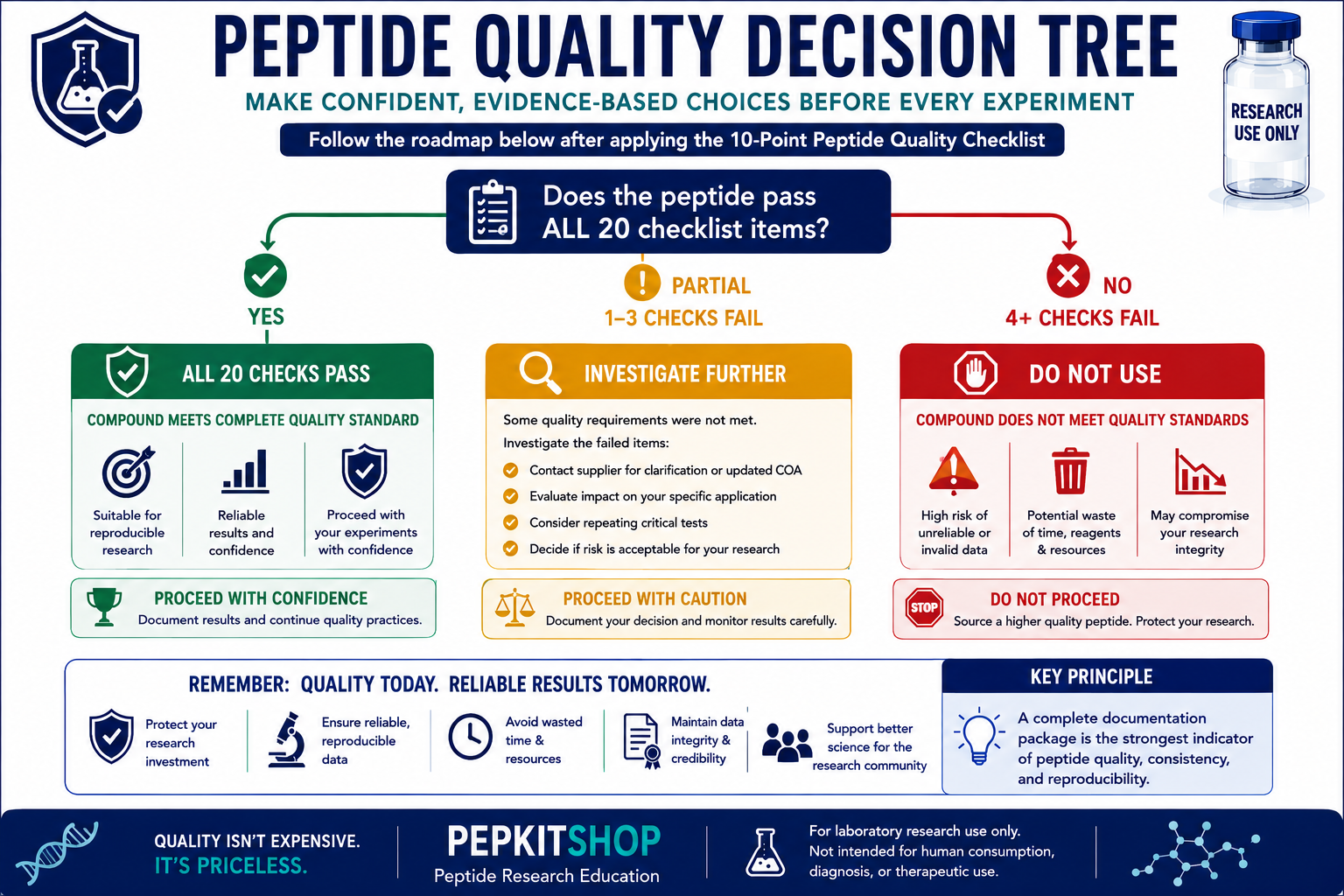
A peptide quality checklist is a structured evaluation framework that ensures every research peptide compound is verified against the same quality standards before use. It prevents the common error of assuming quality based on appearance or reputation alone. More detail on quality standards is available through the National Library of Medicine.
The most critical item is HPLC purity at 98% or higher combined with mass spectrometry identity confirmation. A compound can be pure but still be the wrong compound. Both purity and identity verification are essential.
It depends on which item fails. Failure of any of the first five standards should be considered disqualifying for serious research. Failure of standards 6 through 10 should be investigated and weighed based on the specific application.
ICP-MS stands for Inductively Coupled Plasma Mass Spectrometry. It is the analytical method used to detect trace heavy metal contamination including lead, arsenic, cadmium, and mercury. It is on the checklist because heavy metal contamination can confound cell-based and animal research results at concentrations that would not be detected by standard HPLC purity measurement.
This checklist should be applied to every compound before use, regardless of supplier or reputation. Quality can vary between batches from the same supplier. Every batch should be independently verified.
The analytical data sections are typically standardized with numbers and units that are universally understandable regardless of language. The purity percentage, molecular weight, and lot number should be identifiable. If you need help interpreting a COA, consult our guide on [how to read a peptide COA].
This post is part of a growing educational library on research peptide quality and evaluation. Related reading:
Subscribe for updates as this educational library continues to grow, evidence based peptide research guidance explained clearly and practically.
This content is for educational and informational purposes only. It does not constitute medical advice, diagnosis, or treatment recommendations. Research peptides are for laboratory use only and are not approved for human consumption or therapeutic use. Always consult a qualified healthcare professional before making any decisions related to your health.
10-vial kits • Capsule packs as listed • Research use only
© 2026 Pepkitshop. All rights reserved.
Vial product prices are per kit of 10 vials. Quantity 1 = 10 vials. Capsule products retain the pack size stated on their listing.
All products are supplied strictly for laboratory research. They are not intended for human or veterinary use, consumption, diagnosis, or treatment.
WhatsApp us
 Optimized by Seraphinite Accelerator
