
No products in the cart.

Vial products: price per kit of 10 vials. Quantity 1 = 10 vials. Capsule products are priced per capsule pack as listed. Dismiss
By Pepkitshop | Peptide Research Education
Updated August 2026 | Educational Content, Not Medical Advice
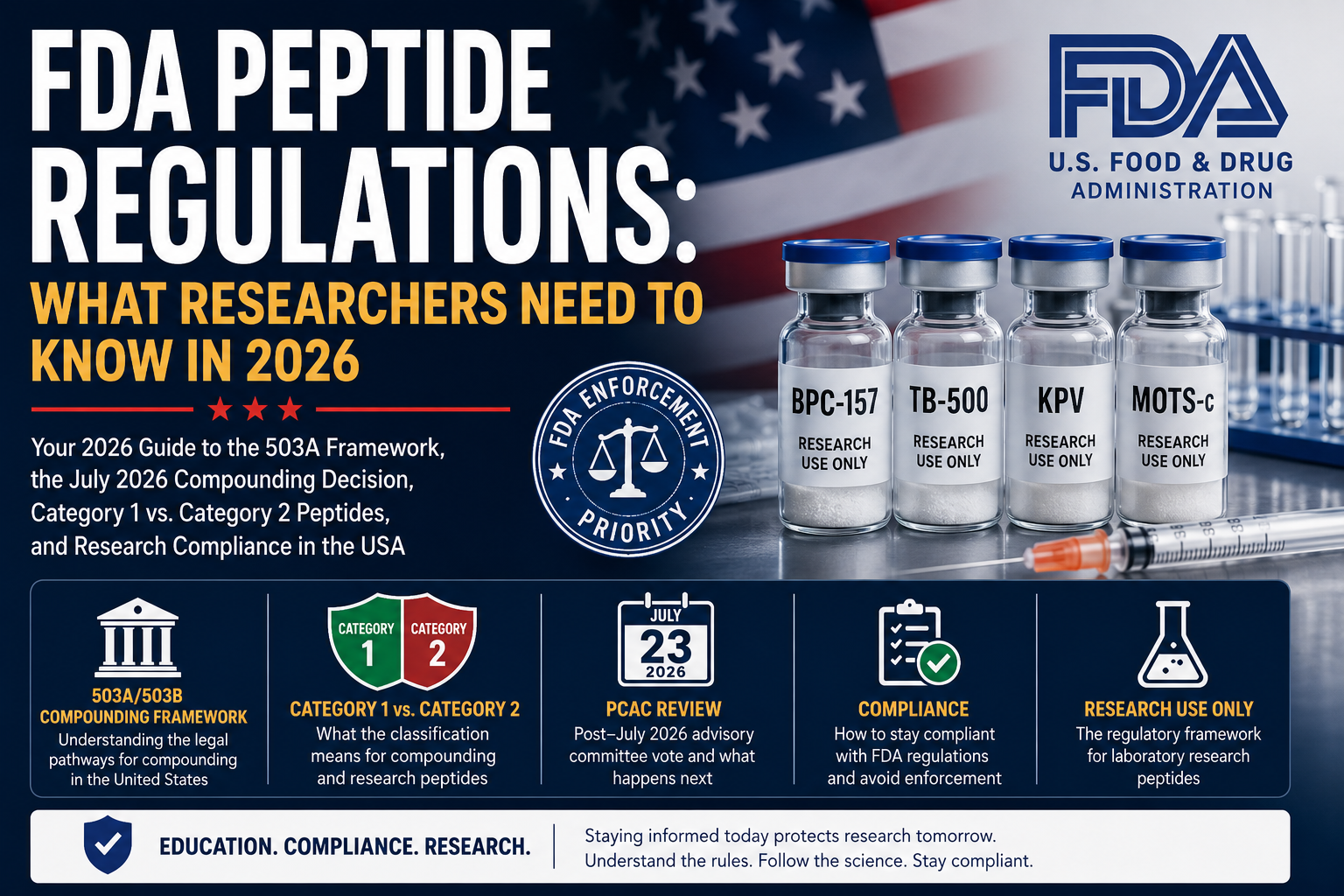
The US Food and Drug Administration (FDA) has designated unapproved peptides as an enforcement priority in 2026. On July 23, 2026, the FDA’s Pharmacy Compounding Advisory Committee (PCAC) met to consider whether seven popular research peptides should be permitted for legal compounding a decision that could reshape the peptide research landscape in the United States [citation:1][citation:2].
This guide provides a comprehensive overview of FDA peptide regulations as of 2026, including the 503A compounding framework, the Category 1 and Category 2 classification system, the July 2026 PCAC decision, what it means for research compliance, and what researchers need to know about the evolving regulatory landscape.
If you are not yet familiar with the US peptide research landscape, read our guide on [peptide research in the United States] first. This post builds directly on that foundation.
The FDA is the US regulatory authority for drugs, medical devices, and therapeutic goods. It operates under the Federal Food, Drug, and Cosmetic Act (FD&C Act) [citation:9].
| Category | Description | Examples |
|---|---|---|
| Approved drugs (NDA/ANDA) | Peptides that have completed clinical trials and received FDA approval | Insulin, GLP-1 receptor agonists, HGH |
| Compounded peptides (503A/503B) | Peptides prepared by compounding pharmacies for patient-specific prescriptions | Currently limited; subject to FDA bulks list review [citation:1] |
| Research peptides | Peptides sold for laboratory research only, not approved for human use | Various, sold under “research use only” designation [citation:5] |
| Dietary supplements | Not applicable to peptides | N/A |
The FDA has designated unapproved peptides as an enforcement priority, with warning letters issued in 2026 for selling unapproved injectable drugs despite “research use only” disclaimers [citation:9][citation:5].
Section 503A of the Food, Drug, and Cosmetic Act governs pharmacy compounding in the United States [citation:9]. This framework determines which substances can be legally prepared by compounding pharmacies for patient-specific prescriptions.
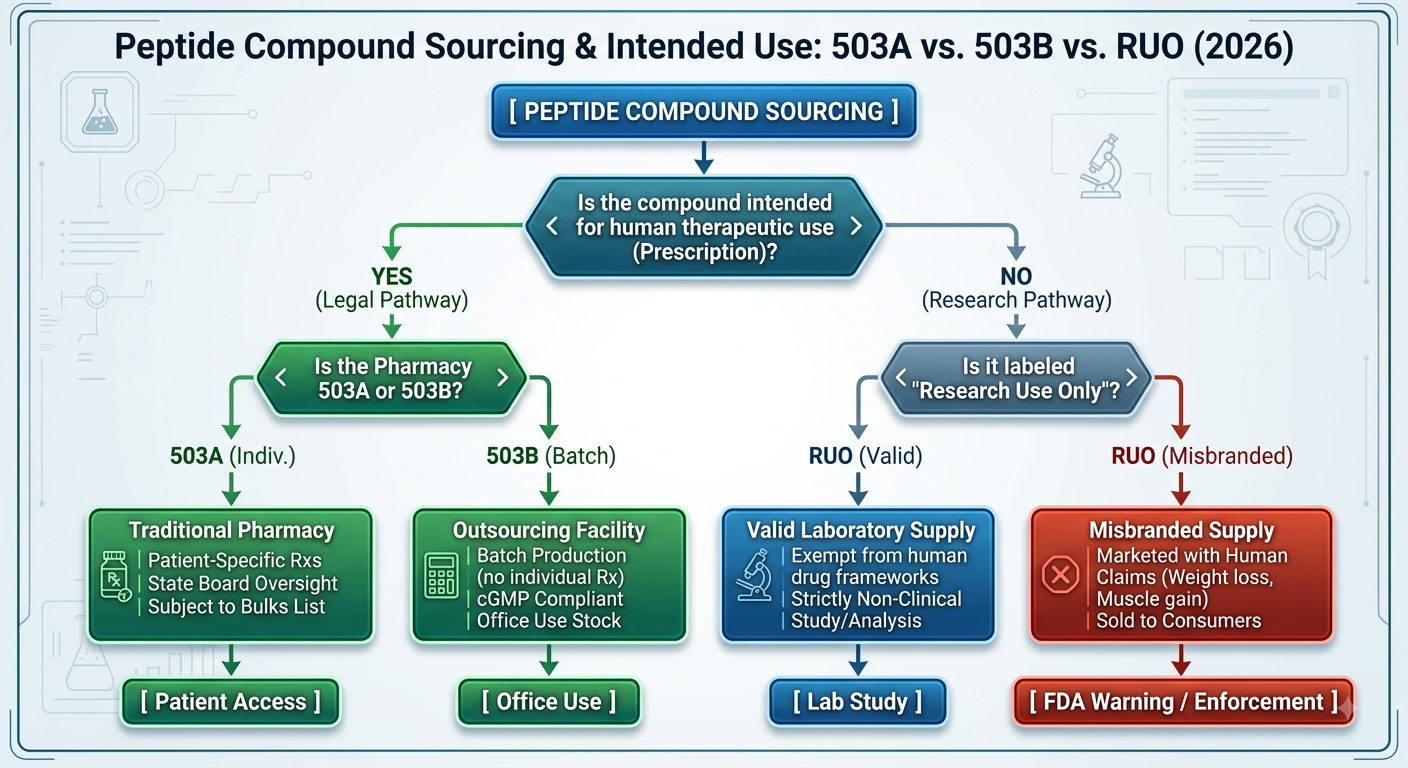
The interim Bulk Drug Substances List separates compounds into categories that determine whether they may be used in pharmacy compounding for human consumption.
The key distinction is between Category 1 and Category 2 peptides [citation:9]:
Understanding the difference between Category 1 and Category 2 peptides is essential for understanding FDA regulations.
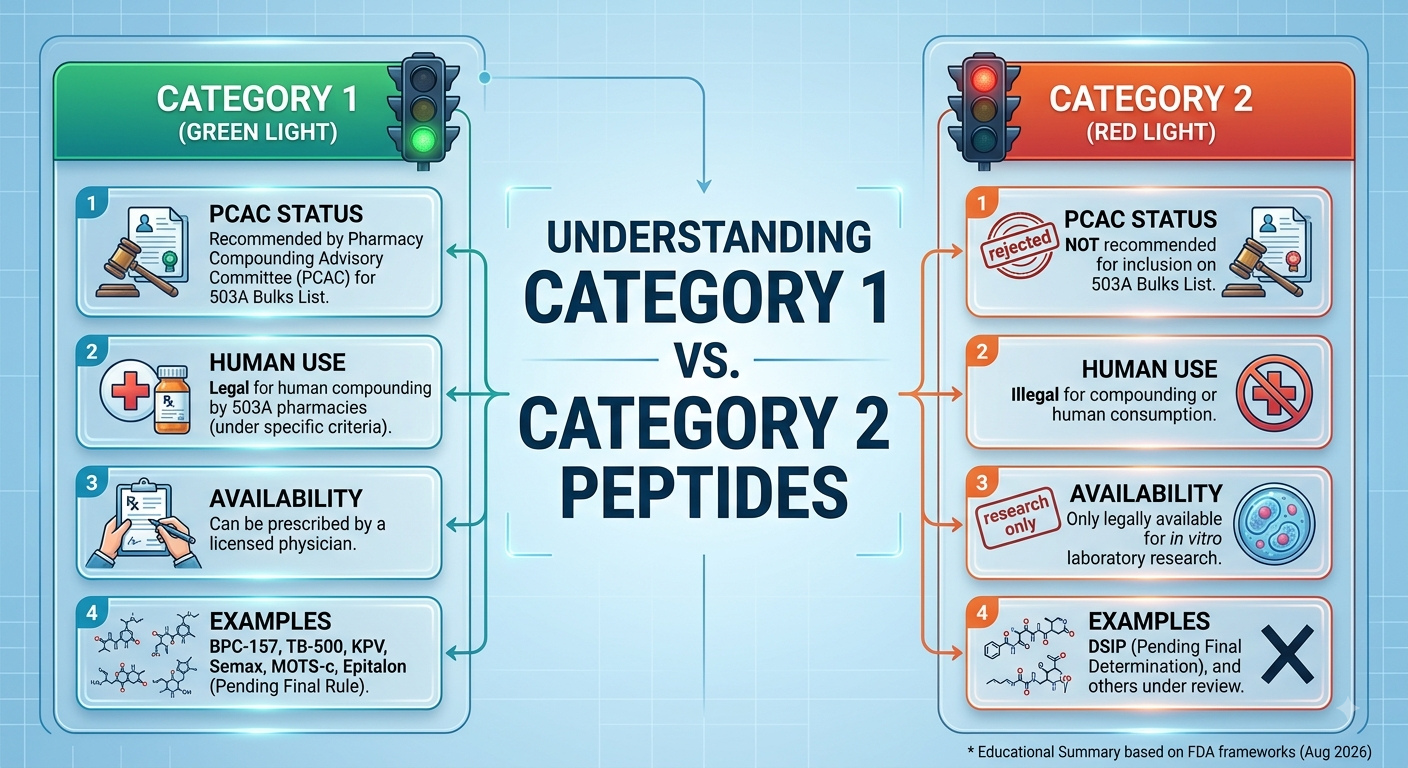
Selling a Category 2 peptide as a supplement or medication is unlawful, even if the product appears “clean” or is labeled professionally.
The most significant development in US peptide regulation in 2026 was the Pharmacy Compounding Advisory Committee meeting on July 23, 2026 [citation:1].
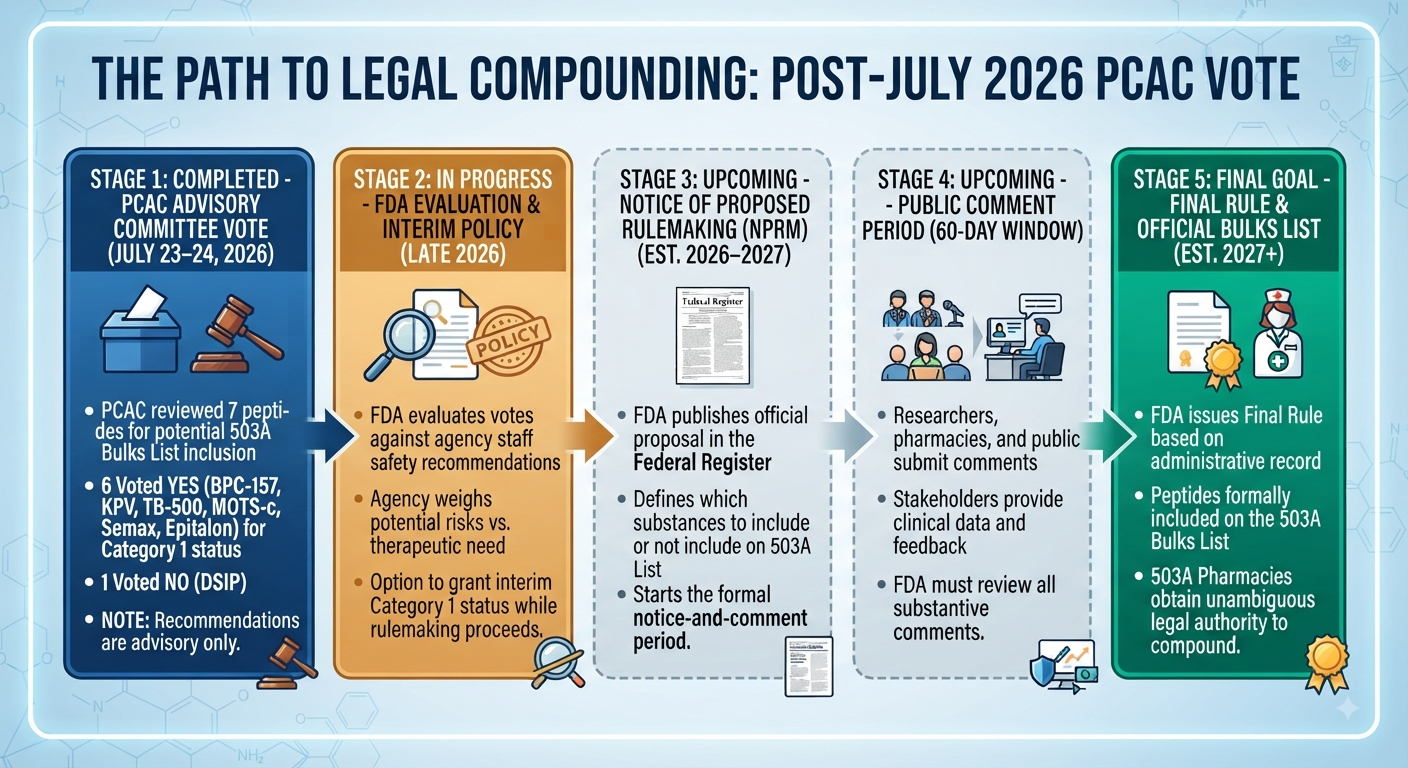
| Peptide | Committee Vote | Outcome |
|---|---|---|
| BPC-157 | ✅ Supported | Recommended for Category 1 / 503A Bulks List |
| KPV | ✅ Supported | Recommended for Category 1 / 503A Bulks List |
| TB-500 | ✅ Supported | Recommended for Category 1 / 503A Bulks List |
| MOTS-c | ✅ Supported | Recommended for Category 1 / 503A Bulks List |
| Semax | ✅ Supported | Recommended for Category 1 / 503A Bulks List |
| Epitalon | ✅ Supported | Recommended for Category 1 / 503A Bulks List |
| DSIP | ❌ Rejected | Not recommended |
Six peptides received advisory support for potential 503A Bulks List inclusion [citation:1].
None of the peptides have been added to the 503A Bulks List, and none is an FDA-approved drug. The FDA must still decide whether to accept the committee’s nonbinding recommendations and, if so, proceed through notice-and-comment rulemaking a proposed rule, a public comment period, and a final rule before compounding pharmacies could legally prepare the substances for patients. [citation:1]
Key points to understand:
FDA staff on the committee expert scientists who review products thought there was not enough evidence of safety and efficacy. They also cited some evidence of concern. They are open to approving peptides, but research has to be done first. [citation:2]
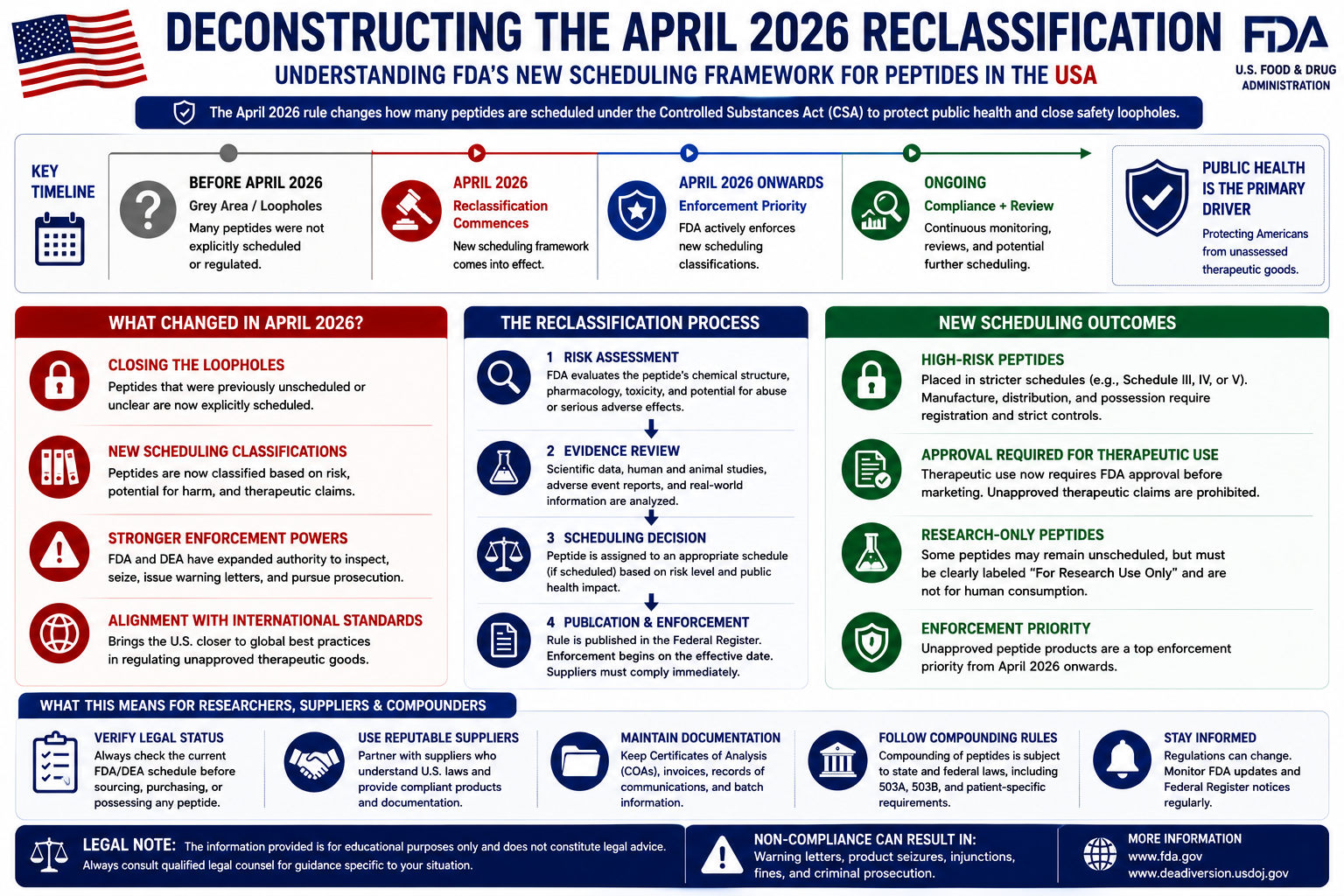
The April 2026 FDA action removed approximately a dozen peptides from Category 2, with BPC-157 the most discussed [citation:1]. However, this reclassification is often misunderstood.
| What It IS | What It IS NOT |
|---|---|
| A step in an evaluation process | FDA approval |
| A sorting of nominated substances | FDA clearance for human use |
| A potential path toward compounding eligibility | Equal footing with approved drugs |
Being part of this reclassification does not put any of these peptides on equal footing with approved drugs. They remain unapproved and investigational. The reclassification is a step in an evaluation, and different peptides may end up in different places once the review concludes. [citation:1]
April 2026: Peptides removed from Category 2
July 2026: PCAC reviews the peptides [citation:1]
Pending: FDA decides whether to accept recommendations
Pending: If accepted, FDA issues proposed rule
Pending: Public comment period
Pending: Final rule issued
Pending: Compounding pharmacies can legally compound the peptides [citation:1]
Research peptides sold in the United States for laboratory study sit outside the FDA drug approval framework. They are not approved for human use and are not intended for therapeutic application.
Research peptides exist in a regulatory gray zone. The FDA does not have the resources to pursue individual consumers. Enforcement focuses on manufacturers and sellers who make medical claims or sell adulterated products. This gray zone does not equal safety. It means no one is checking that the product is what it claims to be, is free from contamination, or is dosed accurately. [citation:5]
| Category | Approved Therapeutic Peptides | Research Peptides |
|---|---|---|
| FDA-approved? | ✅ Yes | ❌ No |
| Approved for human use? | ✅ Yes | ❌ No |
| Available by prescription? | ✅ Yes | ❌ No |
| FDA regulatory oversight? | ✅ Yes | ⚠️ Limited |
| Research use only designation? | ❌ No | ✅ Yes |
The FDA has significantly increased enforcement activity targeting unapproved peptide products.
Despite “Research Use Only” statements on product labeling, evidence from the website established that the products were intended to be drugs for human use. Statements like “influences appetite suppression, insulin sensitivity, thermogenesis, and fat-oxidation models” provided evidence of intended use as drugs. [citation:5]
| Violation | Potential Consequence |
|---|---|
| Selling unapproved drugs for human use | FDA warning letters, fines, injunctions [citation:9] |
| Making medical claims for research peptides | FDA and FTC enforcement [citation:9] |
| Misrepresenting research peptides | Product seizures, civil liability [citation:9] |
| Operating without compliance strategy | Criminal liability in severe cases [citation:9] |
| Country | Regulatory Authority | Framework Type | 2026 Status |
|---|---|---|---|
| United States | FDA | 503A compounding framework, Category 1/Category 2 classification | Compounding decision pending [citation:1] |
| Australia | TGA | ARTG listing required for therapeutic use | Enforcement priority |
| United Kingdom | MHRA | MHRA approval required for therapeutic use | Post-Brexit framework evolving |
| Canada | Health Canada | Health Canada approval required for therapeutic use | Compliance activity increasing |
The FDA regulates peptides intended for human use. Peptides that are not FDA-approved cannot be sold or marketed for therapeutic use in the US. “Research use only” disclaimers do not circumvent this requirement if the product is intended for human use [citation:5]. More detail is available through the FDA official website.
Category 1 peptides are allowed for human consumption in compounding if other requirements are met. Category 2 peptides are not allowed for human consumption and may only be sold for research purposes [citation:9].
On July 23, 2026, the FDA Pharmacy Compounding Advisory Committee recommended six peptides (BPC-157, KPV, TB-500, MOTS-c, Semax, and Epitalon) for potential 503A Bulks List inclusion. DSIP was rejected. The committee vote is non-binding and does not constitute FDA approval [citation:1]. More information is available through the FDA Compounding Advisory Committee.
FDA-approved peptides include insulin, GLP-1 receptor agonists (Ozempic, Trulicity), human growth hormone, oxytocin, and glucagon. These peptides have undergone the full FDA regulatory pathway.
The FDA has issued warning letters, including to Gram Peptides in March 2026. Products making health claims or implying human use are subject to enforcement action regardless of “research use only” labeling [citation:5][citation:9]. More detail is available through the National Library of Medicine.
Researchers should source peptides from compliant suppliers, maintain documentation, understand the distinction between approved and research peptides, and stay informed about FDA updates. The FDA’s 2026 compounding decision may change the regulatory landscape for certain peptides.
This post is part of a growing educational library on peptide research and regulatory compliance. Related reading:
Subscribe for updates as this educational library continues to grow, evidence based peptide research guidance explained clearly and practically.
This content is for educational and informational purposes only. It does not constitute medical advice, diagnosis, or treatment recommendations. Research peptides are for laboratory use only and are not approved for human consumption or therapeutic use. Always consult a qualified healthcare professional before making any decisions related to your health.
10-vial kits • Capsule packs as listed • Research use only
© 2026 Pepkitshop. All rights reserved.
Vial product prices are per kit of 10 vials. Quantity 1 = 10 vials. Capsule products retain the pack size stated on their listing.
All products are supplied strictly for laboratory research. They are not intended for human or veterinary use, consumption, diagnosis, or treatment.
WhatsApp us
 Optimized by Seraphinite Accelerator
