Vial products: price per kit of 10 vials. Quantity 1 = 10 vials. Capsule products are priced per capsule pack as listed. Dismiss
By Pepkitshop | Peptide Coach and Educator
Updated July 2026 | Educational Content, Not Medical Advice
How do peptides work in the body and what actually happens at a biological level when a peptide interacts with a living system?
This question sits at the heart of peptide science.
Understanding how do peptides work in the body moves the conversation from surface level claims to actual mechanisms. It replaces speculation with biology. And it gives anyone serious about understanding this field a foundation that makes every other topic in peptide science significantly clearer.
This guide explains how do peptides work in the body from first principles. From receptor binding and signaling cascades through the four modes of cellular communication, the types of biological systems peptides interact with, and what the latest 2026 research shows about their mechanisms of action.
If you are new here, start with our foundational guide on [what a peptide actually is] before continuing. This post builds directly on that foundation.
How do peptides work in the body at the most fundamental level?
Every peptide in biological systems is a signaling molecule. Its job is to carry a message from one location to another and trigger a specific response in the cells that receive it. The entire mechanism of how do peptides work in the body can be understood as a three step sequence: binding, transduction, and effect.
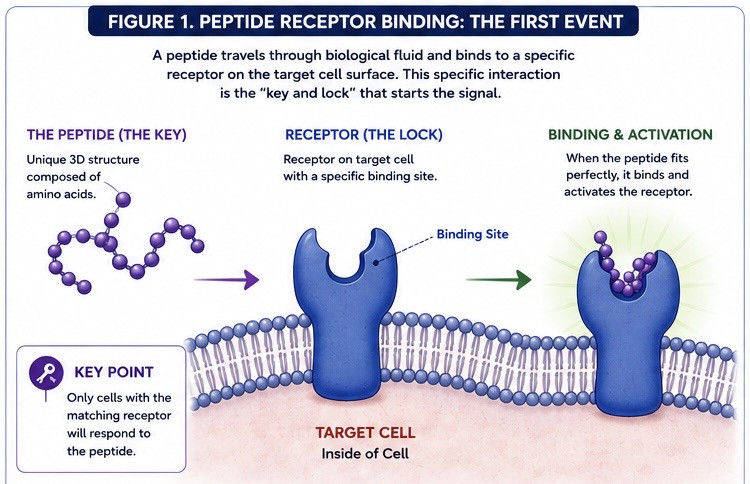
Step one is receptor binding. The peptide travels through biological fluid and encounters a receptor on the surface of a target cell. If the peptide’s structure matches the receptor, it binds. This is a highly specific interaction, the molecular equivalent of a key fitting a lock.
Step two is signal transduction. The binding event triggers a cascade of chemical reactions inside the cell. The external signal from the peptide is converted into an internal cellular response.
Step three is the downstream effect. The cellular response produces a measurable biological outcome: a hormone is released, a protein is synthesized, inflammation is modulated, or a repair process is initiated.
Understanding how do peptides work in the body means understanding each of these three steps in detail. The sections below cover each one completely.
How do peptides work in the body at the point of first contact?
Peptide hormones and growth factors initiate signaling by binding to and activating their cell surface receptors. The activated receptors interact with and modulate the activity of cell surface enzymes and adaptor proteins which entrain a series of reactions leading to metabolic and proliferative signals.
Every cell in the body is covered in receptor proteins specialized molecular structures embedded in the cell membrane that are designed to recognize and respond to specific signaling molecules. Each receptor has a binding site with a precise three dimensional shape. A peptide can only bind to a receptor whose binding site matches its own molecular structure.
This specificity is fundamental to understanding how do peptides work in the body. It is what makes peptide signaling targeted rather than generalized. A peptide that binds to a growth hormone receptor cannot simultaneously activate an immune signaling receptor. The interaction is specific to the receptor it was structurally designed to match.
This receptor ligand interaction is what gives peptides their remarkable specificity. A single amino acid substitution can dramatically alter binding affinity, half life, or functional outcome.
The consequence of this is significant. Because peptide signaling is receptor specific, the same peptide molecule can produce very different effects in different tissues depending on which receptors are present in those tissues. The biological outcome is determined not just by the peptide itself but by the receptor landscape of the target cell.
How do peptides work in the body after the binding event?
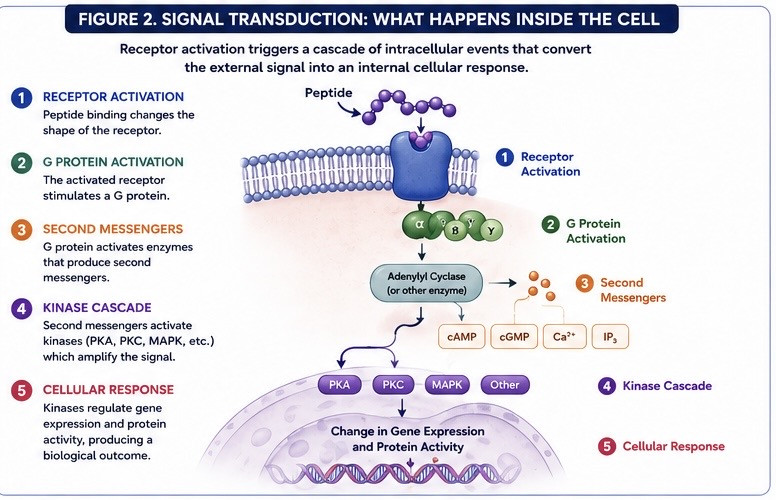
Once a peptide binds its receptor, the receptor undergoes a conformational change, a shift in its three dimensional shape. This change initiates a cascade of molecular events inside the cell called signal transduction.
Once a peptide binds its receptor, it initiates a cascade of intracellular events: second messenger production such as cAMP, cGMP, and calcium ions, kinase activation including PKA, PKC, and MAPK, gene transcription changes, and ultimately altered protein synthesis and cellular behavior.
The most common pathway involves G protein coupled receptors, abbreviated GPCRs. These are the most abundant receptor type in the human body and are involved in a wide range of peptide signaling interactions.
When a peptide binds a GPCR, the receptor activates a G protein on the inside of the cell membrane. The activated G protein then stimulates the production of second messengers, small molecules that amplify and spread the signal throughout the cell. These second messengers activate kinases, which are enzymes that modify other proteins by adding phosphate groups, turning them on or off like molecular switches.
The result is a regulated cascade where a single peptide binding event at the cell surface can trigger thousands of downstream molecular events inside the cell within seconds. This amplification is what makes peptide signaling so powerful relative to the tiny concentrations at which peptides operate in biological systems.
How do peptides work in the body at the level of observable biological effects?
The downstream effects of peptide signaling depend entirely on which cell type received the signal and which genes were activated or suppressed by the signaling cascade. The same second messenger system can produce completely different outcomes in different cell types because the downstream gene targets differ.
Some examples of downstream effects documented in research:
A peptide binding a receptor on a pituitary cell triggers the release of stored growth hormone into the bloodstream. The peptide did not itself enter the cell. It bound a surface receptor and the cell responded by releasing a hormone.
A peptide binding a receptor on a fibroblast cell activates genes involved in collagen synthesis. The fibroblast produces more collagen structural protein as a direct response to the signaling event.
A peptide binding a receptor on an immune cell modulates the production of cytokines, the molecular messengers of the immune system, shifting the balance between pro inflammatory and anti inflammatory signaling.
In each case the mechanism of how do peptides work in the body is the same. Receptor binding triggers signal transduction which produces a specific downstream biological outcome appropriate to the cell type involved.
How do peptides work in the body in terms of how they travel from source to target?
Peptides communicate between cells through four distinct modes depending on the distance between the signaling cell and the target cell.
The 4 Modes of Peptide Communication Table
| Mode | How It Works | Distance | Example |
|---|---|---|---|
| Endocrine | Peptide released into bloodstream, travels to distant target | Long range, systemic | Insulin released from pancreas, acts on cells throughout body |
| Paracrine | Peptide acts on nearby cells in the same tissue | Short range, local | Growth factors acting on neighboring cells at an injury site |
| Autocrine | Peptide acts back on the same cell that released it | Self signaling | Immune cells releasing cytokines that regulate their own activity |
| Neurocrine | Peptide released at nerve synapses, acts on adjacent neurons | Synaptic | Neuropeptides modulating pain and mood signaling |
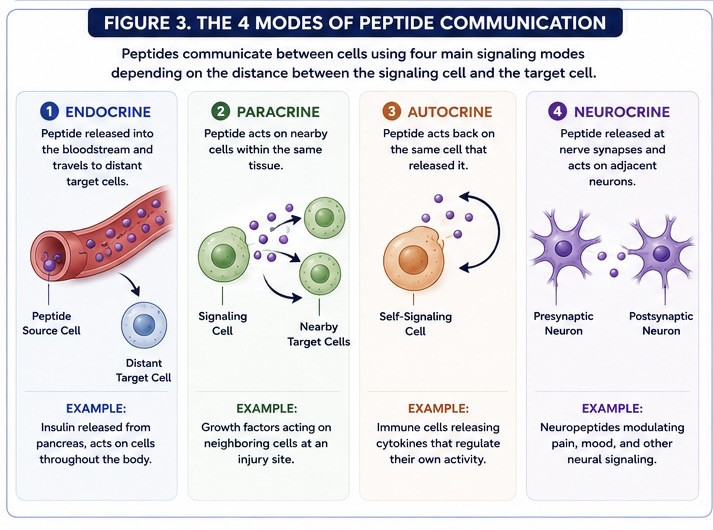
Peptides work by binding to specific receptors, triggering downstream signaling cascades. The 4 signaling modes are endocrine through the bloodstream, paracrine to nearby cells, autocrine as self signaling, and neurotransmitter function at synapses.
Each mode serves a different biological purpose. Endocrine signaling coordinates whole body responses. Paracrine signaling coordinates local tissue responses. Autocrine signaling creates feedback loops within individual cells. Neurocrine signaling modulates neural communication.
Understanding these four modes explains why peptide effects can be both systemic and highly localized depending on the specific compound and context. The same biological machinery, receptor binding followed by signal transduction, operates across all four modes. Only the scale and delivery mechanism differs.
How do peptides work in the body across different biological systems?
Peptide signaling is not confined to a single organ or system. The body uses peptide communication across virtually every major biological system. Here are the seven most extensively studied in the research literature.
Peptide Interactions Across Biological Systems
| Biological System | Role of Peptide Signaling | Research Focus |
|---|---|---|
| Endocrine System | Regulates hormone release and metabolic signaling | Growth hormone, insulin, metabolic peptides |
| Immune System | Coordinates immune cell activity and inflammation response | Cytokine regulation, immune modulation |
| Musculoskeletal System | Signals tissue repair, collagen synthesis, satellite cell activation | Recovery, tendon and muscle healing research |
| Nervous System | Modulates pain, mood, neuroprotection, and neural signaling | Neuropeptides, cognitive research |
| Cardiovascular System | Regulates vascular tone, angiogenesis, blood vessel formation | Nitric oxide pathways, vascular repair |
| Gastrointestinal System | Signals hunger, satiety, gut motility, and mucosal protection | GLP-1 pathways, gut health research |
| Integumentary System | Regulates collagen production, skin repair, melanin synthesis | Skin peptides, wound healing research |
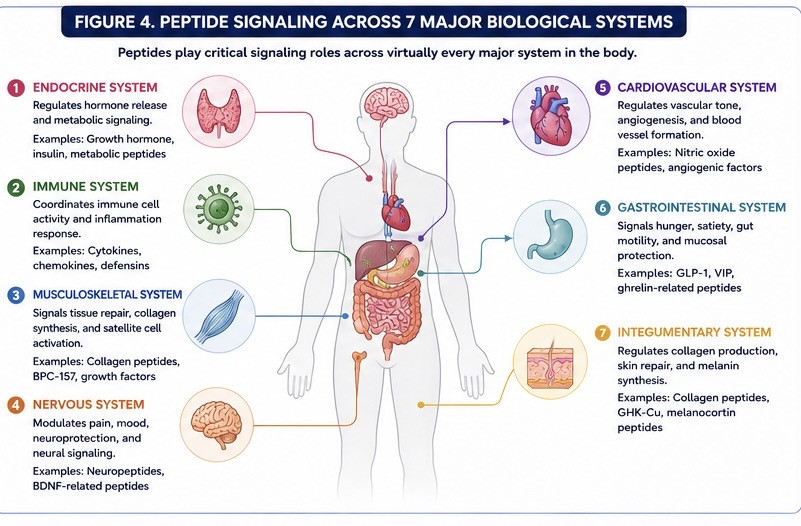
Understanding these categories helps clarify why peptide research continues to expand so rapidly in 2026. Peptides offer targeted benefits because they act through receptor specific pathways rather than broad systemic stimulation.
The breadth of biological systems that peptide signaling touches explains why the field of peptide research spans so many disciplines. The same fundamental mechanism of how do peptides work in the body receptor binding, signal transduction, downstream effect produces vastly different outcomes depending on which system is involved.
How do peptides work in the body differently based on their molecular structure?
The order of amino acids may influence receptor binding, solubility, stability, biological activity, and how the peptide is processed in the body or in laboratory systems. Even a small change in sequence can alter how a peptide functions. This is one reason peptide research often focuses on structure activity relationships. Researchers are not only interested in whether a peptide has biological activity, but also in how sequence and chemistry shape that activity.
This structure activity relationship is one of the most important concepts in peptide science. It explains why two peptides that are nearly identical in sequence can produce completely different biological effects. It is also why [peptide synthesis] quality matters so much a deletion sequence or truncated chain produced during synthesis is not a minor impurity. It is a structurally different compound with potentially different receptor interactions.
Several structural factors determine how a peptide behaves in biological systems:
Amino acid sequence is the primary determinant of receptor specificity. The precise order of amino acids creates the three dimensional shape that fits a specific receptor.
Chain length affects stability, solubility, and how quickly the peptide is broken down by enzymes called proteases that circulate in biological fluids.
Modifications and protecting groups such as acetylation, amidation, or pegylation can dramatically extend the half life of a peptide by making it more resistant to enzymatic degradation.
Charge and hydrophobicity affect how easily a peptide crosses cell membranes and how it distributes through biological compartments.
Understanding these structural variables is part of what makes peptide science genuinely complex beneath its surface level descriptions. How do peptides work in the body is never a single answer it is always a function of which peptide, which receptor, which tissue, and under which conditions.
How do peptides work in the body according to the latest published research?
The 2026 research landscape shows several important developments in the understanding of peptide mechanisms:
Receptor mapping is becoming more precise. Advanced imaging and structural biology tools have allowed researchers to visualize peptide receptor interactions at atomic resolution. This is revealing exactly why certain structural modifications improve or diminish receptor binding, providing a rational basis for designing peptides with specific properties.
Signaling cascade complexity is better understood. Research published through the National Library of Medicine continues to map the downstream consequences of peptide receptor activation in greater detail. The interactions between second messenger systems, kinase cascades, and gene expression are becoming clearer, revealing why the same peptide can produce different effects in different cellular environments.
Mitochondrial peptides are an emerging area. Small signaling peptides encoded by mitochondrial DNA are attracting significant research attention. Examples studied in the literature include MOTS-c, humanin, and SS-31. Research suggests these peptides play roles in cellular energy regulation and stress response.
Half life engineering is advancing. A major focus of current research is extending the functional half life of peptide compounds. Semaglutide’s engineered half life extends to approximately one week compared to natural GLP-1’s half life of roughly 2 to 3 minutes. That difference illustrates how structural modification of a peptide sequence directly controls pharmacokinetic behavior and experimental utility.
Further detail on current research directions is available through peer reviewed research databases.
How do peptides work in the body begins with receptor binding. A peptide travels through biological fluid, encounters a matching receptor on a cell surface, binds to it, and triggers a cascade of intracellular signaling events that produce a specific biological outcome.
How do peptides work in the body compared to hormones is a question of specificity and scale. Many hormones are themselves peptides. The distinction is often one of scope rather than mechanism. Peptides tend to be more targeted in their receptor interactions, while some classical hormones produce broader systemic effects across multiple receptor types simultaneously.
Peptides and proteins share the same building blocks but differ in size and function. Proteins tend to serve structural or enzymatic roles. How do peptides work in the body is primarily as signaling molecules, carrying specific messages to specific receptors rather than forming structures or catalyzing reactions.
Because each peptide has a specific three dimensional structure that fits a limited set of receptor binding sites. Each peptide binds to specific receptor types, triggering defined downstream effects. This is why peptides tend to have more targeted actions with fewer off target effects.
The timeline varies significantly by peptide and mechanism. Receptor binding and initial signal transduction can occur within seconds. Gene expression changes occur over minutes to hours. Structural changes in tissue occur over days to weeks. Understanding how do peptides work in the body means recognizing that different mechanisms operate on different timescales.
Receptor distribution. A peptide can only affect cells that carry the matching receptor on their surface. Cells without that receptor will not respond to the peptide regardless of how much is present. This is one of the fundamental reasons how do peptides work in the body is tissue specific rather than systemic for most compounds.
Continue Learning
This post is part of a growing educational library on peptide science. Related reading:
[What Is a Peptide?] The foundational guide to what peptides are and how they function as biological signals [What Is Peptide Synthesis?] How research peptides are built and why synthesis quality affects biological reliability [What Is Peptide Purity?] How to verify compound quality and what a Certificate of Analysis tells youWhat Is a Growth Hormone Secretagogue? Coming next in this seriesThis content is for educational and informational purposes only. It does not constitute medical advice, diagnosis, or treatment recommendations. Always consult a qualified healthcare professional before making any decisions related to your health.
10-vial kits • Capsule packs as listed • Research use only
© 2026 Pepkitshop. All rights reserved.
Vial product prices are per kit of 10 vials. Quantity 1 = 10 vials. Capsule products retain the pack size stated on their listing.
All products are supplied strictly for laboratory research. They are not intended for human or veterinary use, consumption, diagnosis, or treatment.
WhatsApp us

