Vial products: price per kit of 10 vials. Quantity 1 = 10 vials. Capsule products are priced per capsule pack as listed. Dismiss
By Pepkitshop | Peptide Coach and Educator
Updated July 2026 | Educational Content, Not Medical Advice
What is lyophilization and why does it matter for anyone serious about understanding research peptides?
If you have ever ordered or handled a research peptide, you have almost certainly seen the result of lyophilization firsthand. That fine white powder or thin white film sitting at the bottom of a sealed vial is not the original form the peptide took after synthesis. It arrived there through a carefully controlled scientific process designed to solve one of the fundamental challenges of working with biological compounds.
What is lyophilization at its core? It is the process that transforms a fragile peptide in liquid solution into a stable, long lasting powder that can be stored, shipped, and used reliably in research settings.
This guide explains what is lyophilization completely, from the basic science of sublimation through the three stage industrial process, the stability data behind why it matters, and what it means practically for understanding peptide quality.
If you are new here, start with our guide on [what a peptide actually is] before continuing. Understanding the structure of peptides first makes the preservation science much easier to follow.
What is lyophilization in plain English?
It is a low temperature dehydration process that removes water from a frozen substance through a phase transition called sublimation, producing a dry and stable solid that retains the original molecular structure of the compound.
In everyday language, most people know this process as freeze drying. The same technology used to preserve instant coffee, emergency food supplies, and certain pharmaceuticals is what produces the white powder form of every research peptide.
What is lyophilization specifically designed to solve? The fundamental instability of biological compounds in water. When amino acid chains are dissolved in liquid, water molecules interact with the peptide backbone in ways that accelerate molecular breakdown. Removing the water without exposing the peptide to heat which would destroy its structure preserves the compound in a stable state for months to years rather than days to weeks.
What is lyophilization in the context of peptide science? It is the final preservation step that transforms a purified peptide from a fragile laboratory solution into a research ready compound stable enough to be stored, shipped, and used reliably.
To fully understand what is lyophilization and why it exists, it is important to first understand the problem it solves.
Water molecules interact with the peptide backbone, accelerating hydrolysis, oxidation, and deamidation. These degradation pathways reduce potency over time, sometimes within days at room temperature.
Each of these degradation pathways breaks down the peptide in a different way:
Hydrolysis is the breaking of peptide bonds by water molecules. The same bonds that link amino acids together in a peptide chain are vulnerable to attack by water. Over time, hydrolysis progressively fragments the peptide into smaller, incorrect sequences reducing both purity and biological relevance.
Oxidation occurs when oxygen dissolved in water reacts with specific amino acid side chains, particularly those containing sulfur or aromatic rings. Oxidized amino acids change the chemical properties of the peptide and can significantly alter how it interacts with biological systems.
Deamidation is the conversion of certain amino acid residues from one chemical form to another under aqueous conditions. It is one of the most common degradation pathways in peptide solutions and can produce multiple closely related but distinct compounds from a single starting material.
Microbial growth is the fourth major threat to peptides in liquid form. Water supports the growth of bacteria and other microorganisms that can contaminate and degrade a peptide solution rapidly.
What is lyophilization’s primary function in this context? It eliminates water and in doing so, it eliminates all four of these degradation pathways simultaneously. In the dry state, hydrolysis cannot occur, oxidation is dramatically slowed, deamidation is halted, and microbial growth is impossible.
What is lyophilization built on scientifically? The answer is a phase transition called sublimation.
Most people are familiar with the three states of matter. Water, for example, exists as liquid, solid ice, or gaseous vapor. Under normal atmospheric conditions, ice melts into liquid before it becomes vapor. This is the standard solid to liquid to gas transition.
Sublimation is different. Under low pressure conditions, a substance can transition directly from solid to gas without passing through the liquid phase at all. Dry ice solid carbon dioxide is the most familiar example. It goes directly from solid to vapor at normal atmospheric pressure without melting into liquid first.
Lyophilization exploits this same principle by creating a low pressure environment around frozen material. The frozen water in the peptide solution, rather than melting into liquid and potentially damaging the molecular structure, converts directly to water vapor. That vapor is drawn away from the frozen peptide under vacuum, leaving behind a dry, intact powder.
Under vacuum and at low temperature, the ice transitions directly from solid to vapor without passing through a liquid phase. This is sublimation. It can take hours to days depending on volume and the lyophilizer design. Most of the water is removed in this stage.
This is the scientific foundation of what is lyophilization. The combination of freezing, vacuum, and controlled temperature drives water out of the compound without liquid phase contact and without heat exposure, preserving the peptide’s molecular structure throughout.
Lyophilization Stage Comparison Table
| Stage | What Happens | Temperature | Duration | Water Removed |
| Stage 1: Freezing | Peptide solution is frozen rapidly. | −40°C to −80°C | Several hours | None |
| Stage 2: Primary Drying | A vacuum is applied, causing the ice to sublimate directly into vapor. | Below −20°C (under vacuum) | Several hours to several days | Approximately 95% |
| Stage 3: Secondary Drying | The temperature is gradually increased to remove the remaining bound water molecules. | Gradually raised to 20–30°C | Several hours | Remaining ~5% |
Stage 1: Freezing
The peptide solution is rapidly frozen to temperatures typically between minus 40 and minus 80 degrees Celsius. The goal is to lock all water molecules into a solid crystalline state before any sublimation begins.
Freezing rate matters significantly. Slow freezing produces large ice crystals. Fast freezing produces small, uniform crystals. The crystal size affects the pore structure of the final dried product, which in turn affects how easily the peptide reconstitutes later and how efficiently vapor escapes during drying.
Stage 2: Primary Drying (Sublimation)
Once fully frozen, the chamber pressure is reduced dramatically using a vacuum pump. Under this low pressure environment, the frozen water undergoes sublimation, transitioning directly from solid ice to water vapor. The vapor is captured by a condenser and removed from the system.
Primary drying typically accounts for 60 to 70 percent of total cycle time, making it the rate limiting step in peptide lyophilization. This is the longest and most energy intensive stage of the process.
Stage 3: Secondary Drying (Desorption)
After sublimation removes the bulk of the frozen water, a small amount of water remains bound to the peptide and resin matrix through molecular interactions. This bound water cannot be removed by sublimation alone.
In secondary drying, the temperature is gradually raised under continued vacuum. This additional energy breaks the molecular bonds holding the residual water to the peptide structure, allowing it to evaporate and be removed. The final residual moisture content of a well lyophilized peptide is typically below 1 to 3 percent.
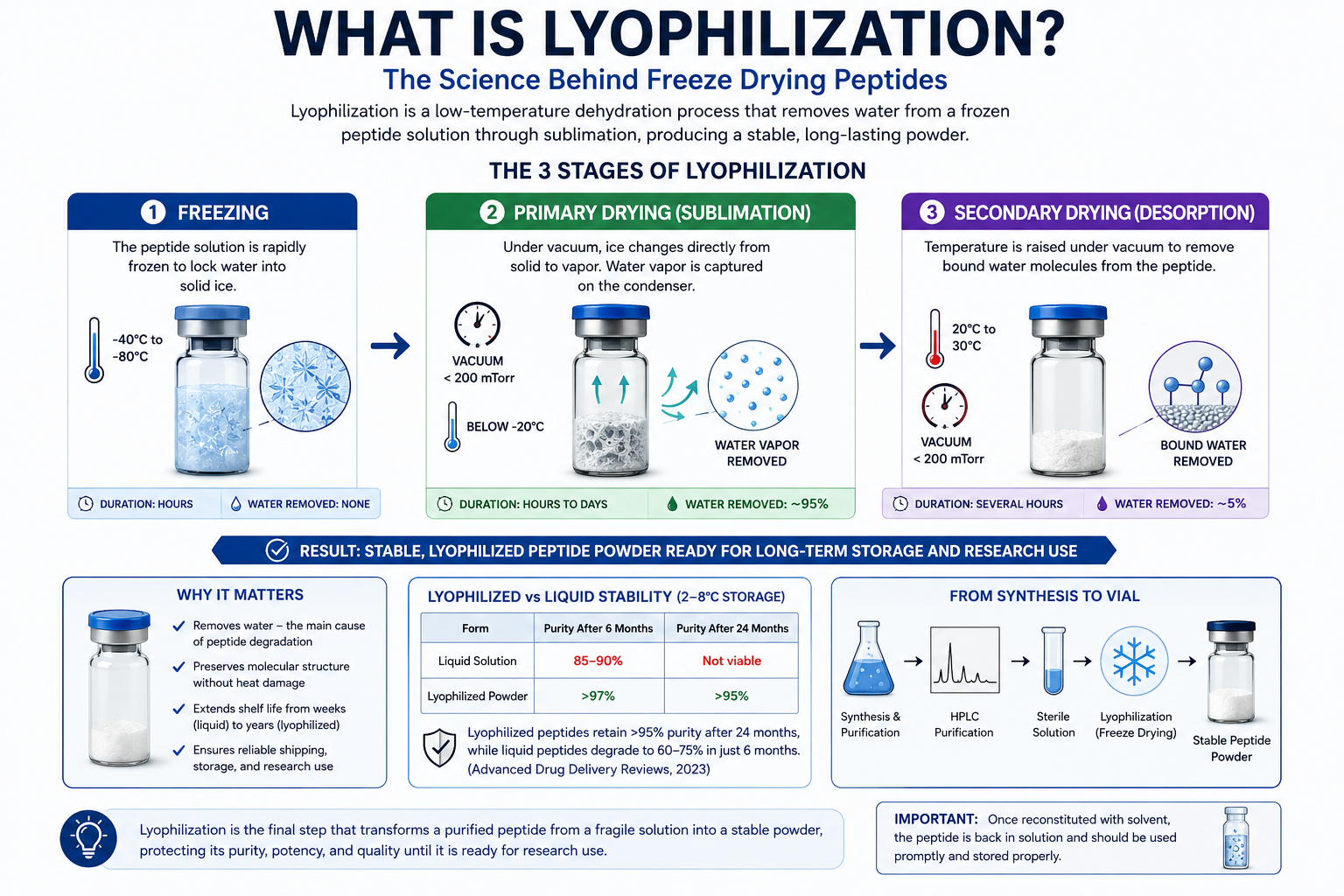
What is lyophilization worth in terms of actual measurable stability improvement?
The data is significant and well documented in peer reviewed literature.
| Storage Condition | Form | Purity After 6 Months | Purity After 24 Months |
| Refrigerated (2–8°C) | Liquid solution | 85–90% | Not viable |
| Refrigerated (2–8°C) | Lyophilized powder | >97% | >95% |
| Frozen (−20°C) | Liquid solution | Moderate degradation | Significant degradation |
| Frozen (−20°C) | Lyophilized powder | >98% | >95% |
| Room temperature | Liquid solution | Degraded within days | Not viable |
| Room temperature | Lyophilized powder | Moderate stability for short periods | Not recommended |
Data published in the European Journal of Pharmaceutics and Biopharmaceutics showed that lyophilized peptides retained greater than 95% purity after 24 months at 2 to 8 degrees C. The same peptides in aqueous solution dropped to 85 to 90% purity within just six months.
A more comprehensive analysis described in peer reviewed research extended this finding further. A 2023 systematic review published in Advanced Drug Delivery Reviews quantified this difference: lyophilized peptides retained greater than 95% purity after 24 months of storage at 2 to 8 degrees C, compared to the same peptides in solution retaining only 60 to 75% purity after just 6 months under identical temperature conditions.
That is a 4 to 8 times extension in usable research life. For anyone working with compounds that depend on verified [peptide purity] for reliable research outcomes, the difference between lyophilized and liquid forms is not a minor detail. It is a fundamental quality consideration.
What is lyophilization’s visible result in a peptide vial?
That fine white powder or thin white film sitting at the bottom of a sealed vial is not the original form the peptide took after synthesis. It is the result of water being removed from the peptide solution through sublimation, leaving behind only the dry peptide structure.
The appearance of lyophilized peptides can vary significantly between compounds and even between batches of the same compound:
White powder is the most common appearance. This typically indicates a well structured cake that has broken down during handling or shipping.
White cake or plug is an intact lyophilized structure that has not been disturbed. Some peptides produce a firm cake, others a loose fragile one.
Fluffy or fibrous texture occurs with certain peptide sequences and freezing conditions.
Off white or slightly yellow tint can occur naturally depending on the amino acid composition of the peptide. This does not necessarily indicate impurity or degradation.
Visual differences do not affect purity, potency, or analytical performance. The appearance of a lyophilized peptide is not a reliable indicator of quality. That determination requires analytical testing as described in our guide on [peptide purity] and documented on a valid Certificate of Analysis.
What is lyophilization’s relationship to the broader quality picture of a research peptide?
Understanding [peptide synthesis] showed that the manufacturing process inherently generates impurities alongside the target compound. Purification by preparative HPLC separates the target from those impurities. Lyophilization then preserves the purified compound in its verified state.
This sequence matters because it means the purity percentage on a Certificate of Analysis reflects the compound at the time of testing after synthesis and purification but before lyophilization occurs. Proper lyophilization preserves that purity level through storage and shipping. Improper lyophilization or poor storage conditions can degrade it.
The connection between synthesis quality, purification, testing, and lyophilization is therefore a chain. Each step depends on the previous one. A highly pure compound that is poorly lyophilized loses its quality advantage over time. A well lyophilized compound that was poorly purified carries its impurities into the frozen state where they remain.
This is why understanding what is lyophilization is not an isolated question. It is part of a complete picture of how research peptide quality is created and maintained from synthesis through to laboratory use. More detail on quality standards is available through the National Library of Medicine and peer reviewed research databases.
What is lyophilization followed by in a research setting?
Before a lyophilized peptide can be used in research, it must be reconstituted the process of dissolving the dry powder back into a liquid solution using an appropriate solvent.
Reconstitution is the reverse of lyophilization in purpose. Where lyophilization removes liquid to create stability, reconstitution restores liquid to create usability.
Reconstitution Key Principles Table
| Principle | Why It Matters |
| Use the appropriate solvent | Different peptides require different solvents for complete dissolution. |
| Add the solvent slowly down the inside wall of the vial | Helps prevent foam formation, which can denature the peptide. |
| Do not shake vigorously | Shaking can introduce air bubbles and mechanical stress that may damage the peptide. |
| Allow the peptide to dissolve naturally | Some peptides take several minutes to fully dissolve. |
| Store the reconstituted peptide at 2–8°C | Liquid peptides are significantly less stable than lyophilized powders. |
| Use the reconstituted peptide promptly | Degradation begins once water is reintroduced. |
| Avoid repeated freeze–thaw cycles | Each freeze thaw cycle increases the risk of peptide degradation. |
Once reconstituted, a peptide is back in liquid form and the same instability factors that lyophilization prevented become relevant again. Hydrolysis, oxidation, and deamidation resume at rates determined by storage conditions. This is why reconstituted peptides are used promptly and not stored for extended periods without returning to frozen conditions.
What is lyophilization at its core is a freeze drying process that removes water from a frozen peptide solution through sublimation. It is used for peptides because liquid peptides degrade rapidly through hydrolysis, oxidation, and deamidation. What is lyophilization’s primary benefit is converting a fragile liquid compound into a stable dry powder with a shelf life measured in years rather than days.
What is lyophilization explained simply is freeze drying. The peptide solution is frozen solid, then placed under vacuum so the frozen water converts directly to vapor and is removed without the solution ever becoming liquid again. The result is a dry, stable powder.
The white powder form is the direct result of lyophilization. After synthesis and purification, the peptide exists as a liquid solution. What is lyophilization doing in this context is removing the water from that solution under vacuum, leaving behind only the dry peptide in powder form.
No. The appearance of lyophilized peptide varies significantly based on amino acid sequence, freezing conditions, and other manufacturing variables. What is lyophilization’s visible result tells you nothing reliable about purity or quality. Only analytical testing through HPLC and mass spectrometry can verify those properties.
Research published in the European Journal of Pharmaceutics and Biopharmaceutics found that properly lyophilized peptides retained greater than 95% purity after 24 months at refrigerated temperatures. At minus 20 degrees C storage, stability extends further. This compares to liquid solutions which may degrade significantly within weeks to months.
What is lyophilization followed by is reconstitution. The dry powder is dissolved in an appropriate solvent to create a liquid solution ready for research use. Once reconstituted the peptide begins degrading again in liquid form and should be used promptly or stored carefully.
Continue Learning
This post is part of a growing educational library on peptide science. Related reading:
This content is for educational and informational purposes only. It does not constitute medical advice, diagnosis, or treatment recommendations. Always consult a qualified healthcare professional before making any decisions related to your health.
10-vial kits • Capsule packs as listed • Research use only
© 2026 Pepkitshop. All rights reserved.
Vial product prices are per kit of 10 vials. Quantity 1 = 10 vials. Capsule products retain the pack size stated on their listing.
All products are supplied strictly for laboratory research. They are not intended for human or veterinary use, consumption, diagnosis, or treatment.
WhatsApp us

