
No products in the cart.

Vial products: price per kit of 10 vials. Quantity 1 = 10 vials. Capsule products are priced per capsule pack as listed. Dismiss
By Pepkitshop | Peptide Research Education
Updated August 2026 | Educational Content, Not Medical Advice
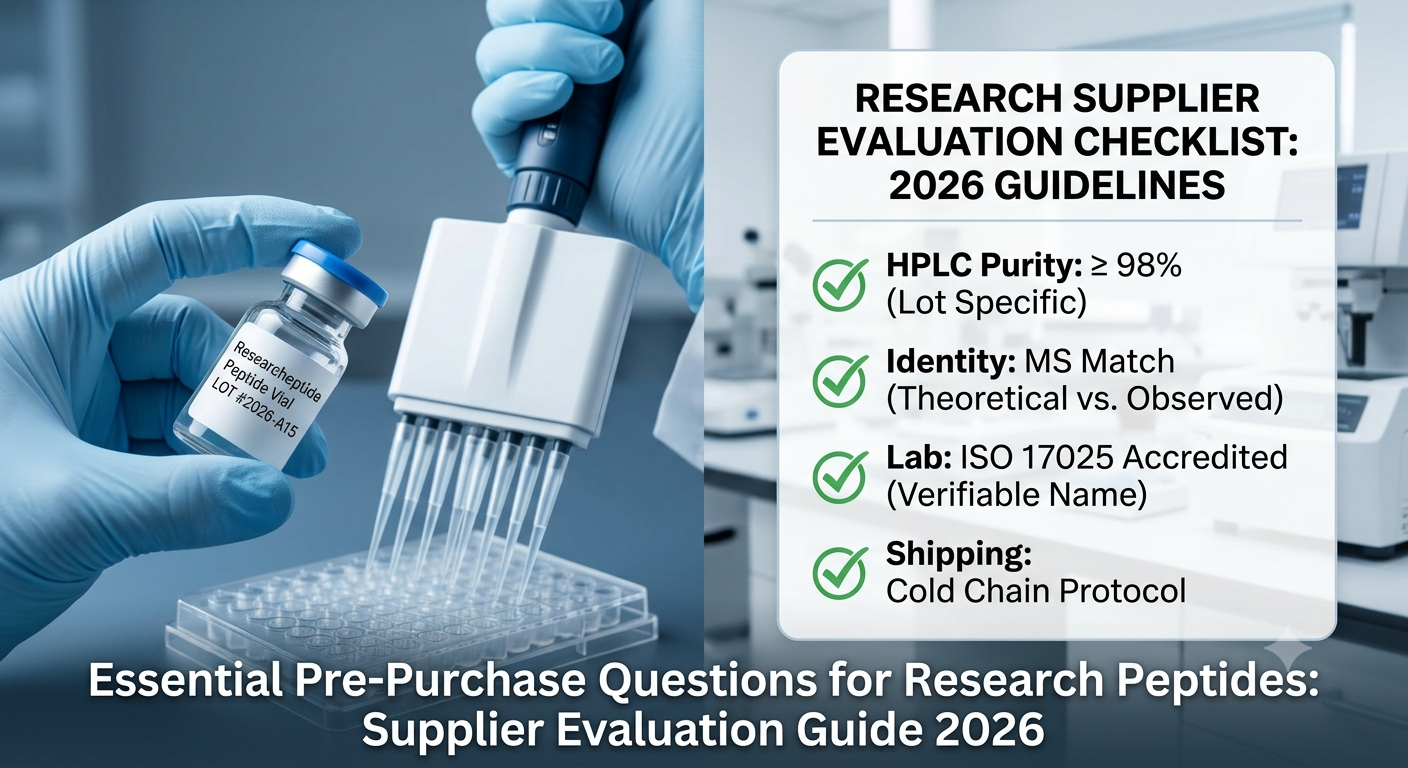
What questions should you ask before purchasing research peptides and which answers tell you whether a supplier deserves your order?
The research peptide market in 2026 rewards researchers who ask the right questions before placing an order. The closures of Science.bio in January 2026 and Peptide Sciences in March 2026 demonstrated that even suppliers with years of operation and large customer bases can fail without warning. Federal enforcement actions in 2025 and 2026 showed that compounds labeled as specific peptides sometimes contained entirely different substances.
In this environment, understanding what questions should you ask before purchasing research peptides is not due diligence for the overly cautious. It is basic scientific responsibility. The answers to these fifteen questions will either confirm that a supplier meets the standards serious research requires or reveal the gaps in their quality systems before those gaps compromise your work.
This guide provides all fifteen questions organized by category, explains what each question is designed to reveal, and describes what a satisfactory answer looks like versus what an evasive or inadequate answer signals.
What questions should you ask before purchasing research peptides has become more consequential than at any previous point.
If a supplier is difficult to reach before you have made a purchase, the situation rarely improves afterward. Test their responsiveness by asking a technical question before ordering. The speed and quality of their response is a reliable preview of your future customer experience.
Test support before purchase. Ask one technical question about lot documentation. The answer usually reveals whether the team understands its own inventory.
This dual function of pre-purchase questions is what makes them so valuable. They extract information you need to evaluate quality. And they reveal, through how a supplier responds, whether the people behind the operation have genuine expertise and genuine accountability.
Every claim a supplier makes is testable. Use pre-purchase questions on every supplier you evaluate. The data will sort the field. The suppliers that survive rigorous pre-purchase questioning are a much smaller set than the ones that show up in a search result. That is the work this framework does for you.
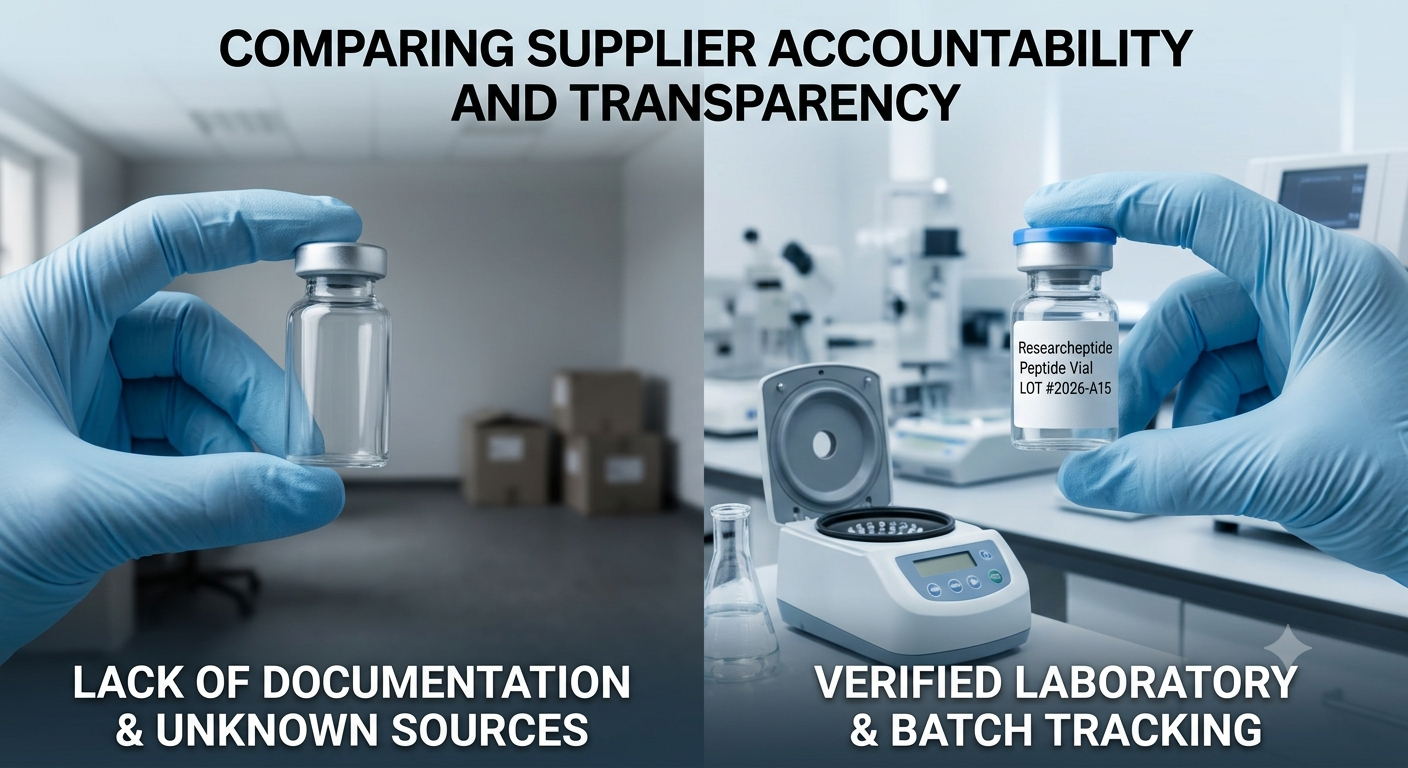
What questions should you ask before purchasing research peptides covers five categories: documentation, synthesis and manufacturing, shipping and handling, compliance and legal, and supplier accountability. Together they cover every dimension of quality that affects research reliability.
What questions should you ask before purchasing research peptides begins with documentation because this is where the highest concentration of meaningful quality signal exists.
When evaluating a research peptide supplier, ask yourself three questions about their COAs. First, are COAs actually available? Some vendors vaguely reference testing without publishing the underlying reports. Others bury COAs behind account walls or only produce them on request. The best suppliers make COAs publicly accessible on every product page so you can review them before you buy. Second, are the COAs batch specific? A single generic COA reused across every shipment is meaningless. Each production lot is unique and should carry its own documentation.
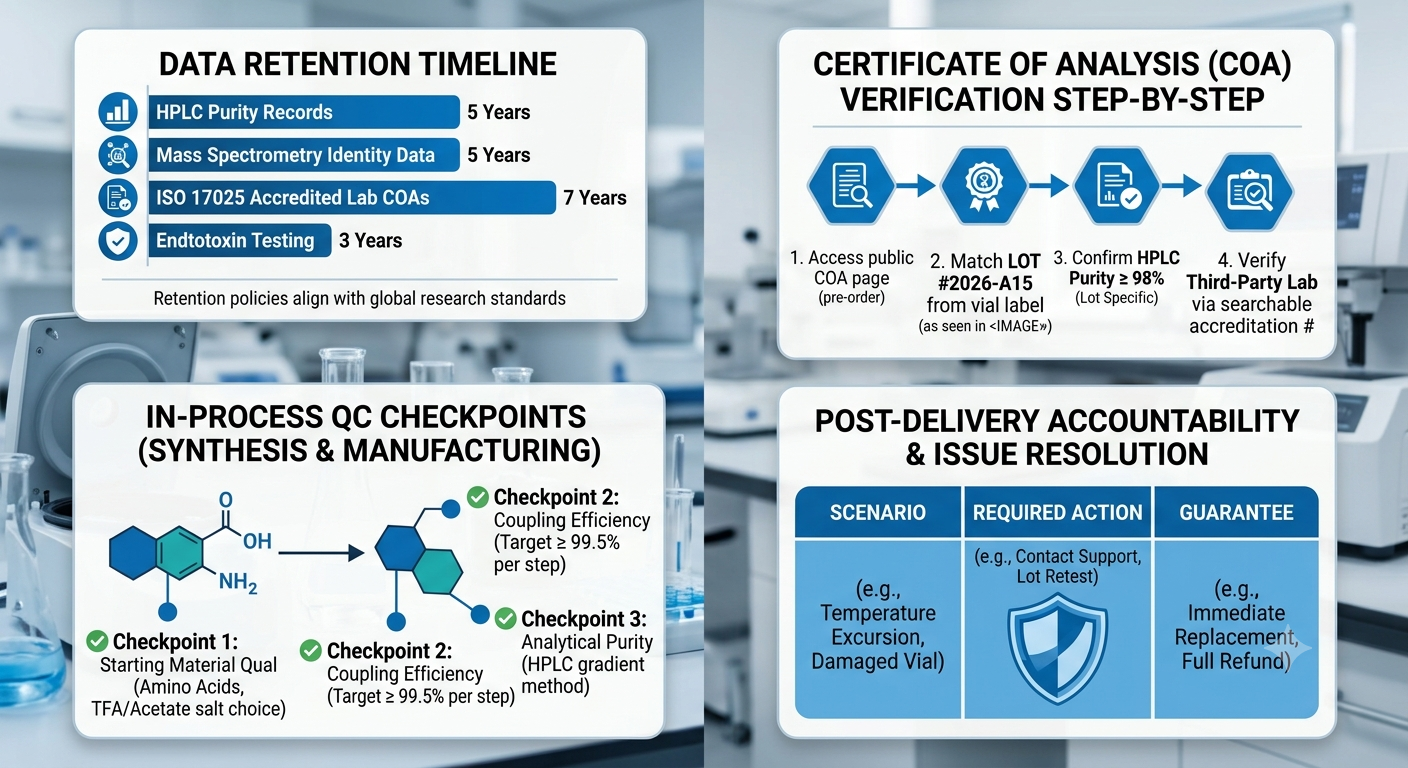
Question 1: Can I see the Certificate of Analysis for the specific lot I am ordering before I place my order?
What this reveals: Whether the supplier has batch specific documentation and is willing to share it before commitment.
Satisfactory answer: Yes, here is the COA for lot number [specific number]. The COA includes HPLC purity percentage, chromatogram, mass spectrometry data, and the testing laboratory name.
Inadequate answer: We have testing documentation available. Our products are tested to high purity standards. Contact us after ordering for documentation.
Why it matters: As covered in our guide on [how to read a peptide COA], a COA you cannot see before purchasing cannot inform your purchase decision. Suppliers who bury documentation behind order completion have removed your primary quality evaluation tool.
Question 2: What is the HPLC purity percentage for this specific compound and lot, and what UV wavelength was used?
What this reveals: Whether the supplier understands their own documentation and whether purity meets research standards.
Satisfactory answer: This lot tested at 99.2% purity by HPLC at 214 nm using reverse-phase gradient method.
Inadequate answer: Our peptides are pharmaceutical grade. We guarantee 99% purity. All products are tested.
Why it matters: The answer should be a number of 98% or higher plus a specific HPLC method. Pharmaceutical grade or research grade without a number is marketing copy. If they cannot quote a percentage threshold and the HPLC method used to verify it, walk away.
Question 3: Does the COA include mass spectrometry identity data and does the observed mass match the theoretical mass?
What this reveals: Whether identity verification was performed alongside purity testing.
Satisfactory answer: Yes, MS data is on the COA. Theoretical molecular weight is [X] daltons, observed is [X] daltons, confirmed match.
Inadequate answer: HPLC testing confirms purity. Our compounds are verified.
Why it matters: HPLC alone cannot detect every sequence error. Mass spectrometry confirms the expected molecular weight per lot. A supplier without per-batch MS data is shipping compounds with a known blind spot.
Question 4: Which third party laboratory performed your testing and what is their accreditation?
What this reveals: Whether testing is genuinely independent and whether the laboratory’s credentials can be verified.
Satisfactory answer: Testing is performed by [laboratory name], an ISO 17025 accredited laboratory. Their accreditation number is [number] and they can be found in the A2LA database.
Inadequate answer: We use an independent certified laboratory. Our testing meets the highest standards.
Why it matters: A laboratory name without accreditation details cannot be independently verified. As covered in our guide on [how to verify a third party COA], any laboratory named on a COA must be searchable through independent accreditation databases.
Question 5: Does your COA include endotoxin testing, and if so what was the result for this lot?
What this reveals: Whether the supplier provides the additional testing required for cell based research.
Satisfactory answer: Yes, endotoxin testing is included. This lot tested at [X] EU per mg, below the 5 EU per mg threshold for cell based research.
Inadequate answer: Our products are sterile and of the highest quality.
Why it matters: Endotoxin contamination confounds cell based assay results even when HPLC purity and mass spectrometry identity are both acceptable. This question immediately separates suppliers who provide complete documentation from those who provide partial documentation.
What questions should you ask before purchasing research peptides at the manufacturing level reveals whether quality is built into production or applied only at the documentation stage.
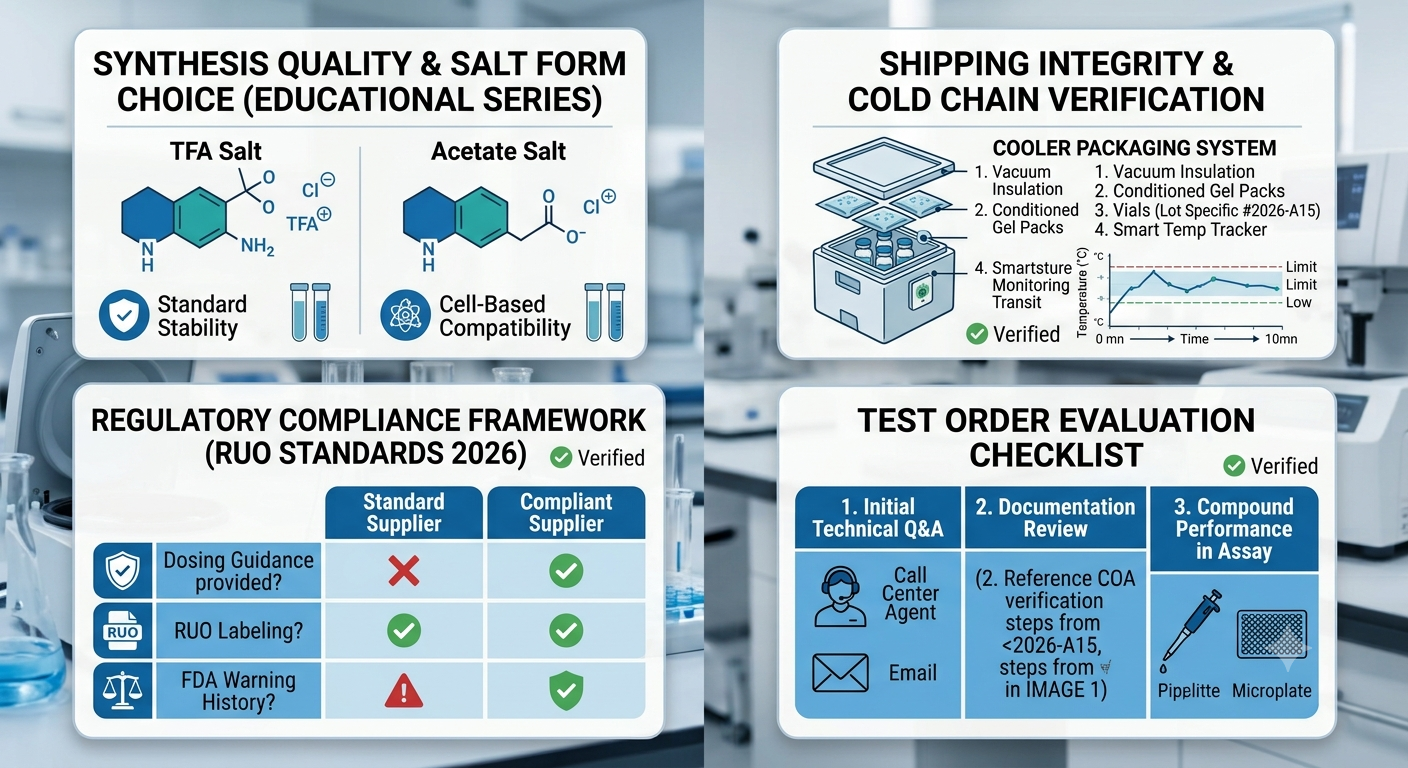
Question 6: What synthesis method do you use and what is your typical coupling efficiency?
What this reveals: Whether the supplier has genuine understanding of peptide chemistry and production quality.
Satisfactory answer: We use Fmoc solid phase peptide synthesis. Coupling efficiency is monitored per cycle and we target 99.5% or higher per step. Batches that do not meet specification are rejected before release.
Inadequate answer: We use the best synthesis methods available to produce premium quality peptides.
Why it matters: Coupling efficiency directly determines deletion sequence and impurity load in the final compound. A supplier who cannot discuss this has limited insight into their own manufacturing process.
Question 7: What salt form are your compounds supplied in and can you provide acetate form if required?
What this reveals: Whether the supplier understands salt form chemistry and can accommodate research-specific requirements.
Satisfactory answer: Our standard compounds are supplied as TFA salt form. Acetate salt conversion is available for cell based research applications at [price difference]. Lead time is [X] days.
Inadequate answer: Our peptides are pure and of the highest quality.
Why it matters: As covered throughout this educational library, TFA salt and acetate salt are not equivalent for cell based research. A supplier who cannot answer this question does not understand a fundamental aspect of their product.
Question 8: Where is the compound manufactured and under what quality management conditions?
What this reveals: Geographic and quality management context for manufacturing.
Satisfactory answer: Our compounds are synthesized at our facility in [location] under GMP-aligned quality management. We maintain documentation of starting material qualification, in-process controls, and final release testing.
Inadequate answer: Our peptides are manufactured to the highest standards by our trusted production partners.
Why it matters: The most trustworthy vendors in 2026 share three characteristics: independent third party testing with verifiable COAs, transparent manufacturing, and a documented history of customer satisfaction across many purchases.
What questions should you ask before purchasing research peptides about shipping reveals whether compound integrity is maintained from production through delivery.
Question 9: How do you ship temperature sensitive compounds and what cold chain measures are in place?
What this reveals: Whether the supplier understands peptide stability requirements during transit.
Satisfactory answer: All shipments include insulated packaging with gel ice packs sized for the anticipated transit time and ambient temperature conditions. We use [specific packaging system] for summer shipping and [specific system] for winter. Tracking is provided for all orders.
Inadequate answer: We ship quickly and our products maintain quality during shipping.
Why it matters: As covered in our storage post, heat is one of the four primary enemies of peptide stability. A supplier with no cold chain protocol cannot guarantee compound integrity on arrival.
Question 10: What is your policy if a compound arrives damaged or outside specified conditions?
What this reveals: Supplier accountability and recourse availability when things go wrong.
Satisfactory answer: If a compound arrives damaged, outside temperature range, or not matching documentation specifications, we will replace the compound or provide a refund. Please contact us within [X] days of delivery with photographs and lot number. We will initiate re-testing of the affected lot.
Inadequate answer: We stand behind our products and will review any concerns on a case by case basis.
Why it matters: How a supplier handles problems is often more revealing than how they handle smooth transactions. A reputable supplier will have a clear process for handling quality concerns, typically involving replacement, refund, or re-testing of the batch in question.
What questions should you ask before purchasing research peptides at the compliance level reveals whether the supplier operates within the appropriate legal framework.
Question 11: Do you carry a research use only designation on all products and do you provide dosing guidance for human use?
What this reveals: Whether the supplier is compliant with the research use only framework or is operating outside it.
Satisfactory answer: Yes, all our products carry a research use only designation. We do not provide dosing guidance for human use and our educational content is limited to scientific mechanisms. We maintain clear compliance with the RUO framework.
Inadequate answer: Our products are for research use but many customers report excellent results.
Why it matters: A supplier who provides human dosing guidance or implies personal use in their communications is operating outside the legal framework governing research peptide supply. This compliance failure is also a trust signal that extends to their quality documentation. As covered in our guide on [what makes a research peptide supplier trustworthy], research use only compliance is a non-negotiable criterion.
Question 12: Has your company or any of your products been subject to FDA enforcement action or warning letters?
What this reveals: Whether the supplier has a regulatory compliance history that affects trust.
Satisfactory answer: No, we have no history of FDA enforcement actions, warning letters, or product recalls. We maintain compliance records and can provide documentation of our regulatory standing on request.
Inadequate answer: We are fully compliant with all applicable regulations.
Why it matters: FDA enforcement history is a matter of public record and can be verified through FDA official guidance databases. A supplier who cannot confirm clean regulatory history, or whose history shows prior enforcement, warrants additional scrutiny.
What questions should you ask before purchasing research peptides about accountability reveals whether the supplier stands behind their products in verifiable ways.
Question 13: Can I place a small test order before committing to a larger purchase?
What this reveals: Supplier confidence in their own product quality and flexibility for new customer relationships.
Satisfactory answer: Yes, we welcome test orders. Minimum order quantities are [X]. Once you have verified the documentation and tested the compound in your research application, many researchers proceed to larger orders.
Inadequate answer: Our minimum order is [large quantity]. We offer discounts for bulk purchases.
Why it matters: Place a small test order before committing to larger purchases. This allows you to verify documentation, evaluate compound performance, and assess the supplier relationship before significant investment.
Question 14: Are your COAs publicly accessible on your product pages before purchase?
What this reveals: Commitment to transparency and whether documentation verification is possible before financial commitment.
Satisfactory answer: Yes, all COAs are published on the product page for each compound. You can review the batch specific documentation for any compound in our catalog before placing an order.
Inadequate answer: COAs are available upon request after ordering. Contact our team for documentation.
Why it matters: The vendors that win in 2026 are the ones whose quality is verifiable in public, not buried behind an email us for a COA wall. Public COA availability before purchase is one of the clearest signals of genuine transparency versus performative transparency.
Question 15: What is your lot traceability process and how long do you retain testing records?
What this reveals: Whether the supplier has robust quality management systems and can provide accountability across time.
Satisfactory answer: Each lot receives a unique identifier that is tracked from synthesis through testing and fulfillment. Testing records are retained for [X] years. If you need to revisit documentation for a lot purchased previously, we can provide records for any lot within our retention period.
Inadequate answer: We maintain comprehensive quality records for all our products.
Why it matters: Can I verify the batch before or immediately after delivery? Can I match the paperwork to the vial lot number without guesswork? Can I see analytical evidence instead of just marketing claims? Can I predict consistency if I reorder the same compound later? If a peptide cannot be documented clearly, it cannot be trusted easily.
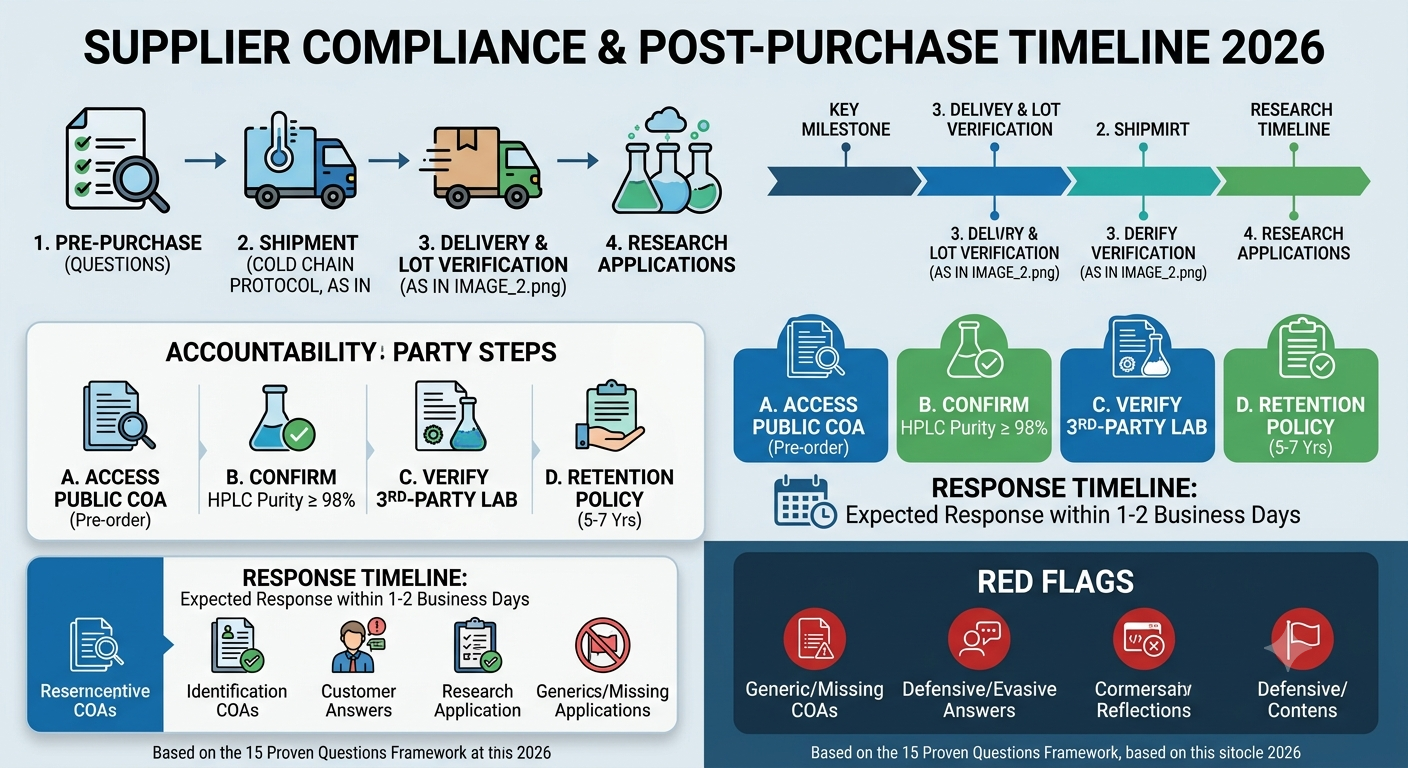
What questions should you ask before purchasing research peptides organized as a complete reference:
The 15 Pre-Purchase Questions and What Satisfactory Answers Include
| Category | Question | Key Element of Satisfactory Answer |
|---|---|---|
| Documentation | Q1: Can I see the lot specific COA before ordering? | COA provided with lot number, HPLC, MS, and lab name |
| Documentation | Q2: What is the HPLC purity and UV wavelength? | Specific percentage plus specific method |
| Documentation | Q3: Does the COA include mass spectrometry data? | Observed mass within 2 daltons of theoretical |
| Documentation | Q4: Which third party lab performed testing? | Named lab with verifiable ISO 17025 accreditation |
| Documentation | Q5: Is endotoxin testing included? | Below 5 EU per mg for cell based research |
| Synthesis | Q6: What synthesis method and coupling efficiency? | Fmoc SPPS with quantified coupling efficiency |
| Synthesis | Q7: What salt form and is acetate available? | TFA standard, acetate available with specifics |
| Synthesis | Q8: Where is it manufactured and under what conditions? | Named location with quality management context |
| Shipping | Q9: What cold chain measures are used? | Specific insulated packaging and ice pack protocol |
| Shipping | Q10: What is your damage or quality failure policy? | Clear replacement or refund process stated |
| Compliance | Q11: Do you carry RUO designation and avoid dosing guidance? | Clear yes on both |
| Compliance | Q12: Any FDA enforcement history? | Clean record confirmed |
| Accountability | Q13: Can I place a test order first? | Yes with specific minimum quantities |
| Accountability | Q14: Are COAs publicly accessible before purchase? | Yes, on every product page |
| Accountability | Q15: What is your lot traceability and record retention? | Specific retention period and retrieval process |
What questions should you ask before purchasing research peptides is only half the framework. Knowing how to evaluate the answers is equally important.
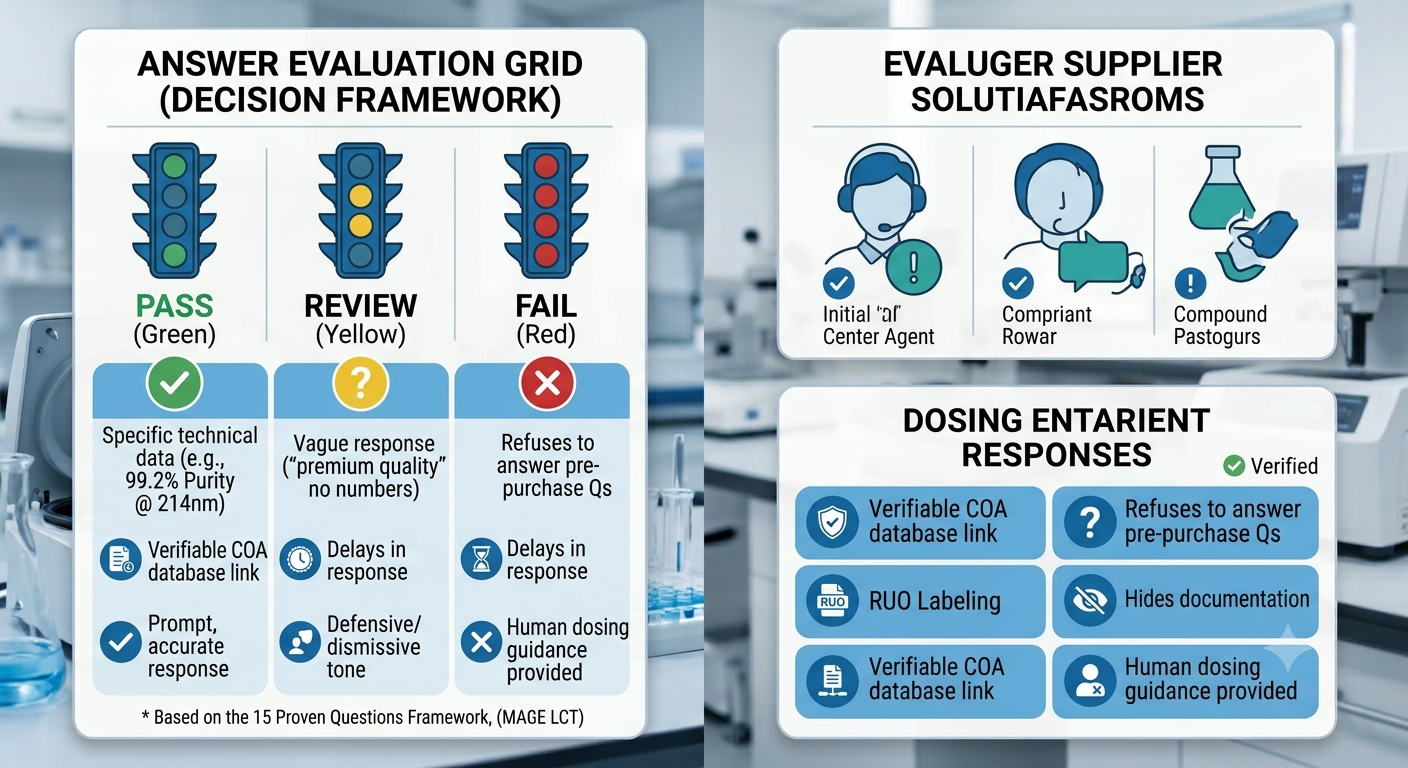
Answer Quality Evaluation Guide
| Answer Type | Signal | Recommended Action |
|---|---|---|
| Specific, technical, verifiable | High quality supplier with genuine expertise | Proceed to documentation verification |
| Specific but unverifiable | Moderate confidence, verify claims independently | Verify laboratory, check accreditation databases |
| General and positive but non-specific | Marketing language without substance | Ask the question again more specifically |
| Evasive or redirecting | Possible lack of expertise or something to hide | Consider alternative supplier |
| Defensive or dismissive | Red flag for accountability | Do not proceed with order |
| No response within reasonable time | Poor responsiveness preview | Consider alternative supplier |
The speed and quality of their response is a reliable preview of your future customer experience. A supplier who answers technical questions specifically, accurately, and promptly before a purchase will generally maintain that standard afterward. A supplier who deflects, delays, or provides marketing language instead of technical answers before a purchase rarely improves after the order is placed.
At Pepkitshop, we welcome all fifteen of these questions and encourage researchers to ask them before placing any order. Our documentation is publicly accessible, our testing laboratory is named and verifiable, and our team can answer technical questions about synthesis, salt form, cold chain protocols, and compliance. We built this educational library because we believe informed researchers make better research decisions and because suppliers who cannot withstand informed questioning should not be in this market.
What questions should you ask before purchasing research peptides as the single highest priority is Question 4: which third party laboratory performed your testing and what is their accreditation? This question immediately distinguishes suppliers with genuine independent verification from those with in-house or unverifiable documentation. A specific, verifiable answer with an ISO 17025 accredited laboratory name provides the strongest available quality signal.
What questions should you ask before purchasing research peptides in the documentation category are the five questions covering COA availability before purchase, HPLC purity and method specifics, mass spectrometry identity data, third party laboratory identity and accreditation, and endotoxin testing results. Together these five questions verify the complete quality documentation picture. More detail on evaluating the answers is in our guide on [how to read a peptide COA].
What questions should you ask before purchasing research peptides about purity should produce a specific numerical answer combined with a specific analytical method. A satisfactory answer is something like 99.2% purity by reverse phase HPLC at 214 nm for lot number [X]. An unsatisfactory answer uses terms like pharmaceutical grade, premium quality, or highest standards without specific numbers or methods.
What questions should you ask before purchasing research peptides to test expertise is Question 6 about synthesis method and coupling efficiency. This question requires genuine knowledge of peptide chemistry to answer specifically and accurately. A supplier who deflects or provides a generic answer about premium synthesis methods without being able to discuss coupling efficiency or batch rejection criteria likely has limited technical oversight of their own production.
What questions should you ask before purchasing research peptides should receive responses within one to two business days for straightforward documentation questions. Technical questions about synthesis may take slightly longer for a thorough response, but should still be acknowledged quickly. Waiting more than three business days for a response to a direct pre-purchase question is a meaningful signal about the supplier’s responsiveness standards. More context on supplier evaluation is available through the National Library of Medicine.
What questions should you ask before purchasing research peptides for repeat purchases from established suppliers can be streamlined to the documentation questions, specifically Questions 1 through 5 applied to the new lot. For first purchases from any supplier, all 15 questions are appropriate. For critical research applications where compound quality is especially consequential, all 15 questions are appropriate regardless of purchase history with the supplier.
What questions should you ask before purchasing research peptides becomes conclusive when a supplier refuses to answer. <cite index=”12-1″>No legitimate peptide supplier operating to any reasonable quality standard declines to share documentation of third-party testing. Seek an alternative supplier who maintains transparent quality records.</cite> A supplier who will not answer questions before purchase has revealed, through that refusal, that they cannot or will not be accountable for what they sell.
This post completes our buying intent and product adjacent educational series. The complete research peptide education library from Pepkitshop covers:
Foundation Science
Quality and Documentation
Handling and Storage
Supplier and Quality Evaluation
Subscribe for updates as this educational library continues to grow. Evidence based peptide research guidance explained clearly and practically at Pepkitshop.
This content is for educational and informational purposes only. It does not constitute medical advice, diagnosis, or treatment recommendations. Research peptides are for laboratory use only and are not approved for human consumption or therapeutic use. Always consult a qualified healthcare professional before making any decisions related to your health.
10-vial kits • Capsule packs as listed • Research use only
© 2026 Pepkitshop. All rights reserved.
Vial product prices are per kit of 10 vials. Quantity 1 = 10 vials. Capsule products retain the pack size stated on their listing.
All products are supplied strictly for laboratory research. They are not intended for human or veterinary use, consumption, diagnosis, or treatment.
WhatsApp us
 Optimized by Seraphinite Accelerator
